Non Linear Preprocessing for Support Vector Machines
Keywords
Summary
198 words
Critical Evaluation
Value of the Information & Strength of the Argument
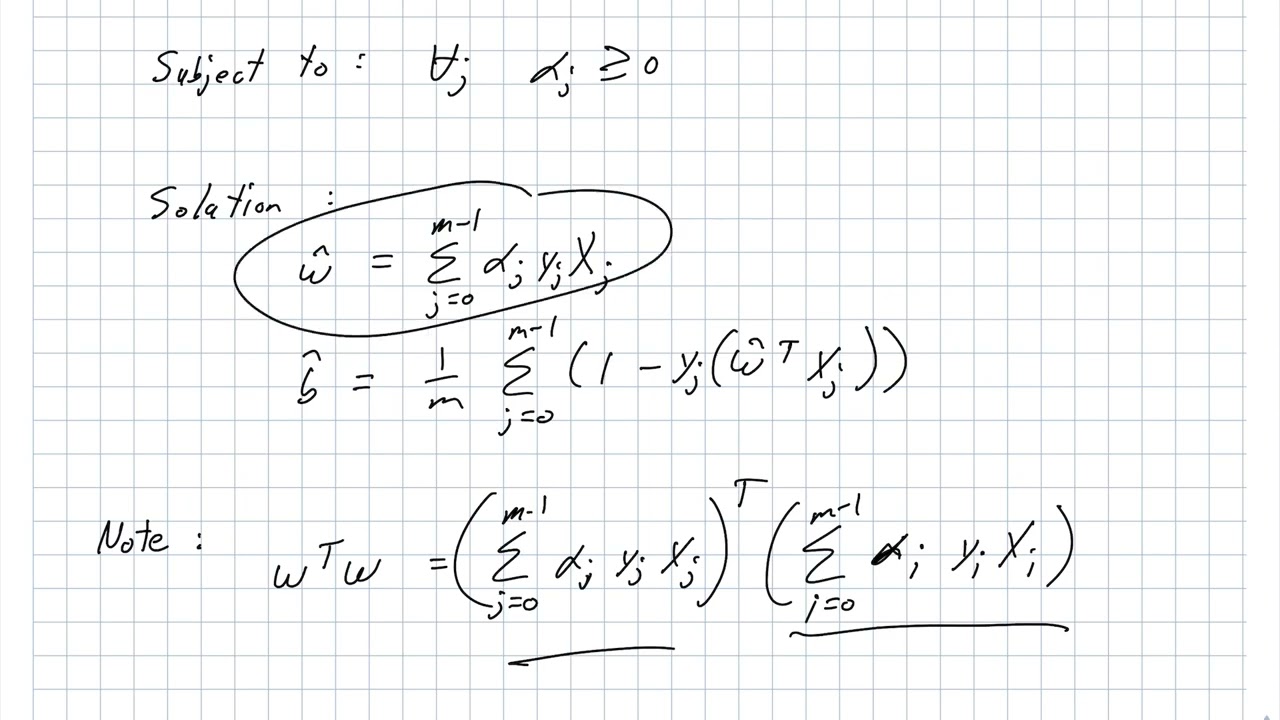
The video provides a solid introduction to kernel methods for SVMs, explaining the mathematical rationale behind the dual formulation and the kernel trick. The argumentation is coherent and builds step-by-step, from the motivation for non-linear preprocessing to the derivation of the kernel function. The presenter uses concrete examples, such as polynomial kernels, to illustrate the concepts, which enhances understanding. However, the video does not delve into the derivation of the dual problem, instead stating that it is beyond the scope, which may leave some viewers wanting more depth. The value lies in its clear exposition of the kernel trick and its practical implications, making it a useful resource for learners.
Scientific Rigor, Source Quality, Title Accuracy
The video is scientifically rigorous in its presentation of the mathematical concepts, but it does not cite any external sources or references. The content aligns with standard machine learning textbooks, such as those by Bishop or Hastie et al., but the lack of citations reduces its scholarly value. The title accurately reflects the content, which focuses on non-linear preprocessing for SVMs. The video does not include any promotional or sponsored content. The presenter’s explanations are accurate and well-structured, but the absence of references to original papers or further reading is a limitation.
217 words
Title / Content Match
The title accurately reflects the content, which focuses on non-linear preprocessing via feature transformations and kernels for SVMs.
Quality & Reliability
7/10
The video provides a clear and accurate explanation of the mathematical foundations of kernel methods for SVMs, including the dual formulation and the kernel trick. The content aligns with standard machine learning literature, but lacks citations to external sources and does not address potential limitations or alternative viewpoints.
Key Moments
Markers derived by PSI from the transcript: the creator did not define chapters.
- Introduction to non-linear preprocessing for SVMs
- Example of polynomial kernel transformation
- Discussion of the dual problem and its formulation
- Derivation of the kernel trick for polynomial kernels
- Introduction to the Gaussian kernel and infinite-dimensional feature space
- Requirements for valid kernel functions and their combinations
- Summary and limitations of SVMs with kernels
Contribution & Novelties
The video provides a clear and accessible explanation of the kernel trick for SVMs, emphasizing the computational efficiency of using kernel functions instead of explicit feature transformations. It offers a step-by-step derivation of the polynomial kernel and mentions the Gaussian kernel’s infinite-dimensional feature space. The content is not novel but serves as a good educational resource.
Pour aller plus loin :
- Support Vector Machine - Wikipedia — Overview of SVMs and kernel methods.
- Kernel method - Wikipedia — General concept of kernel methods in machine learning.
- Mercer’s theorem - Wikipedia — Mathematical foundation for kernel validity.
96 words
Radar Profile
The radar profile shows high scores in quantity of information, technical level, and reliability, with a slightly lower score in quality of information due to the lack of citations. This indicates a technically sound but not deeply referenced educational content.