Multi-class Classification
Keywords
Summary
153 words
Critical Evaluation
Value of the Information & Strength of the Argument
The video provides a clear and intuitive explanation of multi-class classification strategies, using visual examples to illustrate the concepts. The argumentation is logical and easy to follow, building from binary classification to the two main approaches. However, the presentation lacks depth in mathematical details and does not discuss potential pitfalls or practical considerations beyond the basic trade-off. The value lies in its pedagogical clarity, making it suitable for beginners, but it does not offer advanced insights or novel perspectives.
Scientific Rigor, Source Quality, Title Accuracy
The video does not cite any external sources, which limits its scientific rigor. The content is based on standard machine learning knowledge, but without references, it is difficult to verify claims or explore further. The title accurately reflects the content, and the video stays on topic throughout. The lack of sources is a notable weakness, but the explanation is coherent and technically correct.
157 words
Title / Content Match
The title accurately reflects the content, which focuses on extending binary classification to multiple classes.
Quality & Reliability
7/10
The video provides a clear and accurate explanation of multi-class classification strategies (one-vs-one and one-vs-all) with illustrative examples. The content is technically sound, but lacks depth in mathematical formulation and practical implementation details. No sources are cited, and the presentation is introductory.
Key Moments
Markers derived by PSI from the transcript: the creator did not define chapters.
- Introduction to multi-class classification and the need for extending binary classifiers.
- Illustration of a feature space with three classes and the concept of decision surfaces.
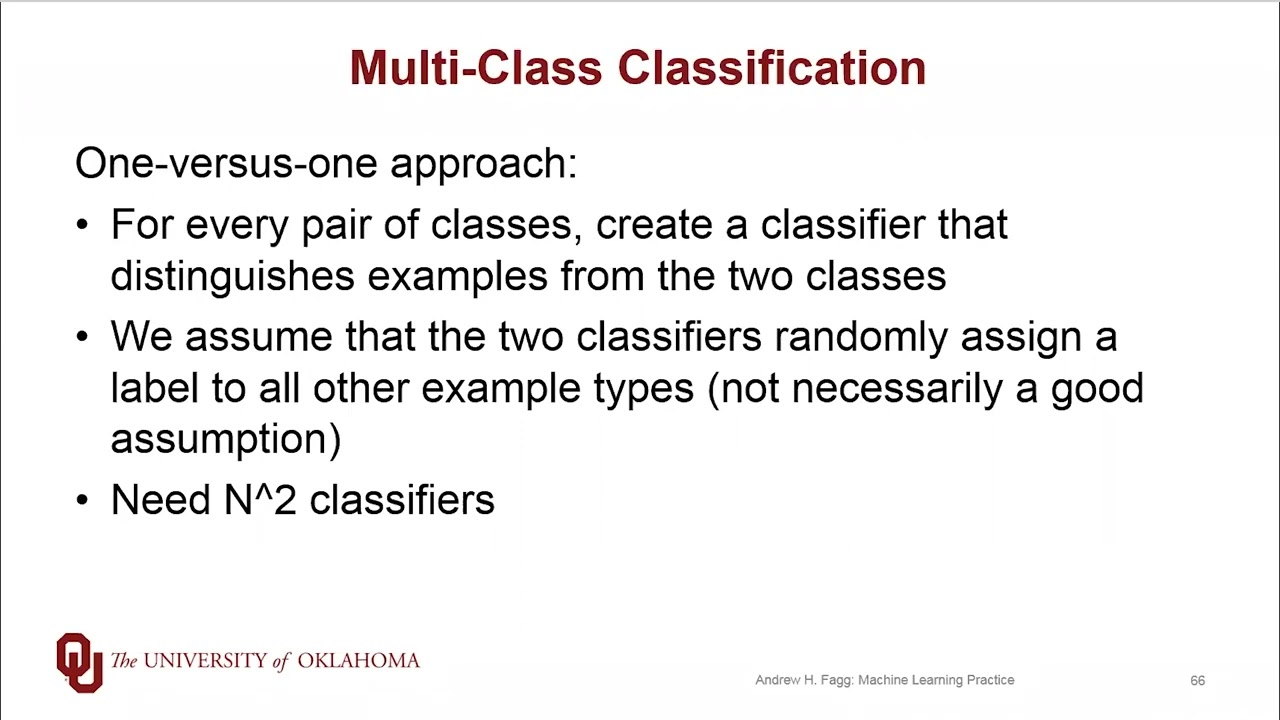
- Explanation of one-vs-one approach: building classifiers for each pair of classes and aggregating votes.
- Discussion of the cost of one-vs-one (O(n^2) classifiers) and the implicit assumption of no bias between classes.
- Introduction of one-vs-all approach: building a classifier for each class against all others.
- Example of one-vs-all with three classes, showing decision boundaries and vote aggregation, including a tie scenario.
- Comparison of trade-offs between one-vs-one and one-vs-all, and mention of SGDClassifier's automatic selection.
- Conclusion and preview of upcoming coding example.
Contribution & Novelties
The video provides a clear and accessible introduction to multi-class classification strategies, specifically one-vs-one and one-vs-all, with visual examples. It explains the trade-offs in terms of computational cost and decision surface complexity. The content is standard but well-presented for beginners.
Pour aller plus loin :
- One-vs-one (OvO) classification — Overview of the method.
- One-vs-all (OvA) classification — Overview of the method.
- scikit-learn SGDClassifier documentation — Details on the implementation and automatic selection of OvO/OvA.
74 words
Radar Profile
The radar profile shows moderate scores across all dimensions, with slightly higher quality and reliability compared to quantity and technical depth. This indicates a balanced but introductory tutorial that is reliable but not exhaustive.