Example: Implementing a Voting Classifier
Keywords
Summary
171 words
Critical Evaluation
Value of the Information & Strength of the Argument
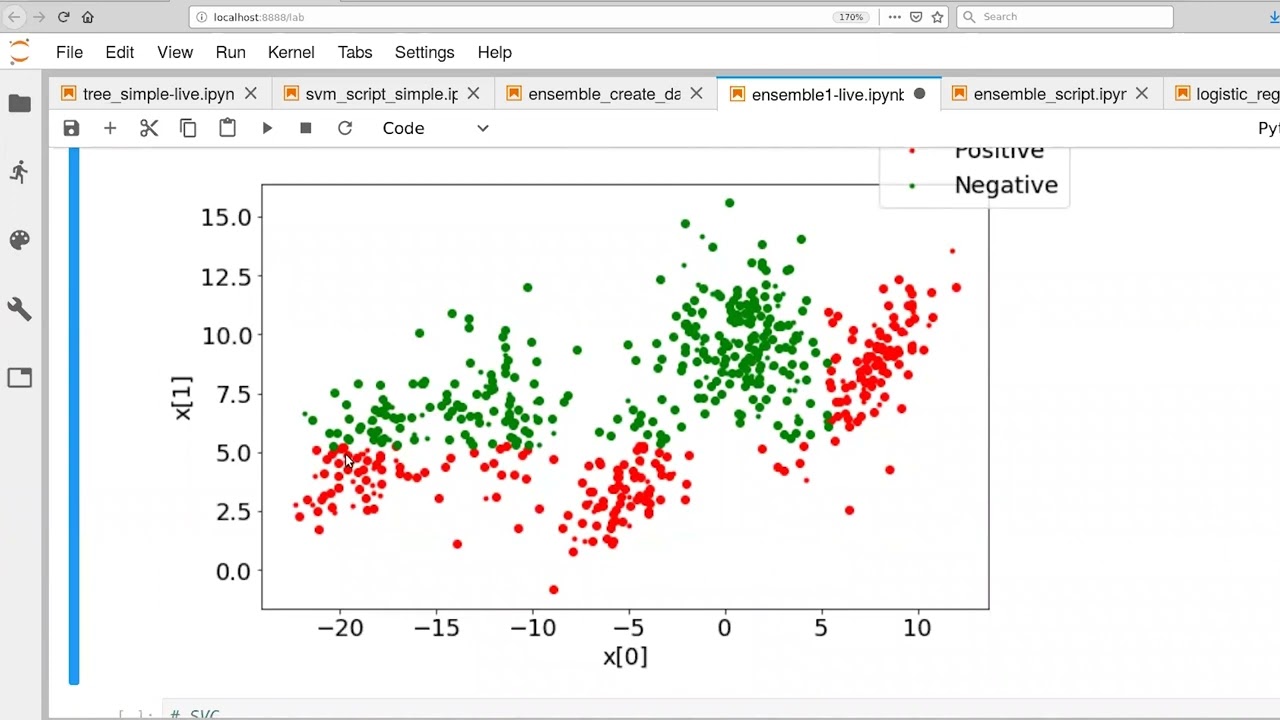
The video provides a practical, step-by-step demonstration of implementing a voting classifier, which is valuable for learners seeking hands-on experience. The argumentation is clear and logical, showing the performance of individual classifiers and then comparing them to the ensemble. The instructor explains the difference between hard and soft voting and demonstrates the impact on accuracy. The use of a synthetic dataset with overlapping clusters effectively illustrates the strengths and limitations of each classifier. The tutorial also includes a cautionary note about results that seem too good to be true, highlighting the importance of validation. However, the video lacks a deeper theoretical discussion of why voting works and does not explore variations or potential pitfalls in detail.
Scientific Rigor, Source Quality, Title Accuracy
The video is a tutorial that does not cite external sources, but it relies on the scikit-learn library, which is well-documented and widely used. The content is technically accurate, and the code examples are reproducible. The title accurately reflects the content, as it is a direct example of implementing a voting classifier. The video does not include any references to research papers or additional resources, which limits its scientific rigor. The instructor’s explanations are clear and demonstrate a good understanding of the topic, but the lack of citations means the video is more of a practical guide than a scholarly resource.
232 words
Title / Content Match
The title accurately reflects the content, which is a practical example of implementing a voting classifier.
Quality & Reliability
7/10
The video provides a clear, hands-on tutorial on implementing voting classifiers in scikit-learn, with code demonstrations and explanations of hard and soft voting. The content is technically accurate, though it lacks references to external sources and does not delve into theoretical underpinnings. The demonstration includes a cautionary note about overfitting and data leakage, showing practical awareness.
Key Moments
Markers derived by PSI from the transcript: the creator did not define chapters.
- Introduction to ensemble methods and voting classifier concept.
- Loading the voting classifier and setting up the dataset.
- Training individual classifiers: decision tree, SVM, and logistic regression.
- Evaluating individual classifier accuracies.
- Implementing hard voting classifier and evaluating accuracy.
- Implementing soft voting classifier with probability=True for SVM.
- Comparing hard and soft voting results and discussing improvements.
- Conclusion and preview of next steps in ensemble methods.
Contribution & Novelties
The video provides a clear, practical demonstration of implementing voting classifiers, which is a fundamental ensemble technique. It offers a step-by-step guide that is accessible to learners, with code examples and visualizations. The comparison between hard and soft voting is particularly useful, as it shows the impact of probability averaging. The tutorial also highlights the importance of validation and the potential for overfitting. For further exploration, one can look into more advanced ensemble methods such as bagging, boosting, and stacking, which build on the concept of combining multiple models.
Pour aller plus loin :
- Ensemble learning — Overview of ensemble methods and their variants.
- Voting classifier documentation — Official scikit-learn documentation for voting classifiers.
- Bagging — A technique that trains models on different subsets of data to reduce variance.
129 words
Radar Profile
The radar profile shows balanced scores across all dimensions, with slightly higher scores in information quantity and quality, indicating a solid tutorial that provides useful content and accurate information. The technical level is moderate, suitable for intermediate learners, and the overall reliability is good, though not backed by external sources.