The Many Charlatans Problem
Keywords
Summary
185 words
Critical Evaluation
Value of the Information & Strength of the Argument
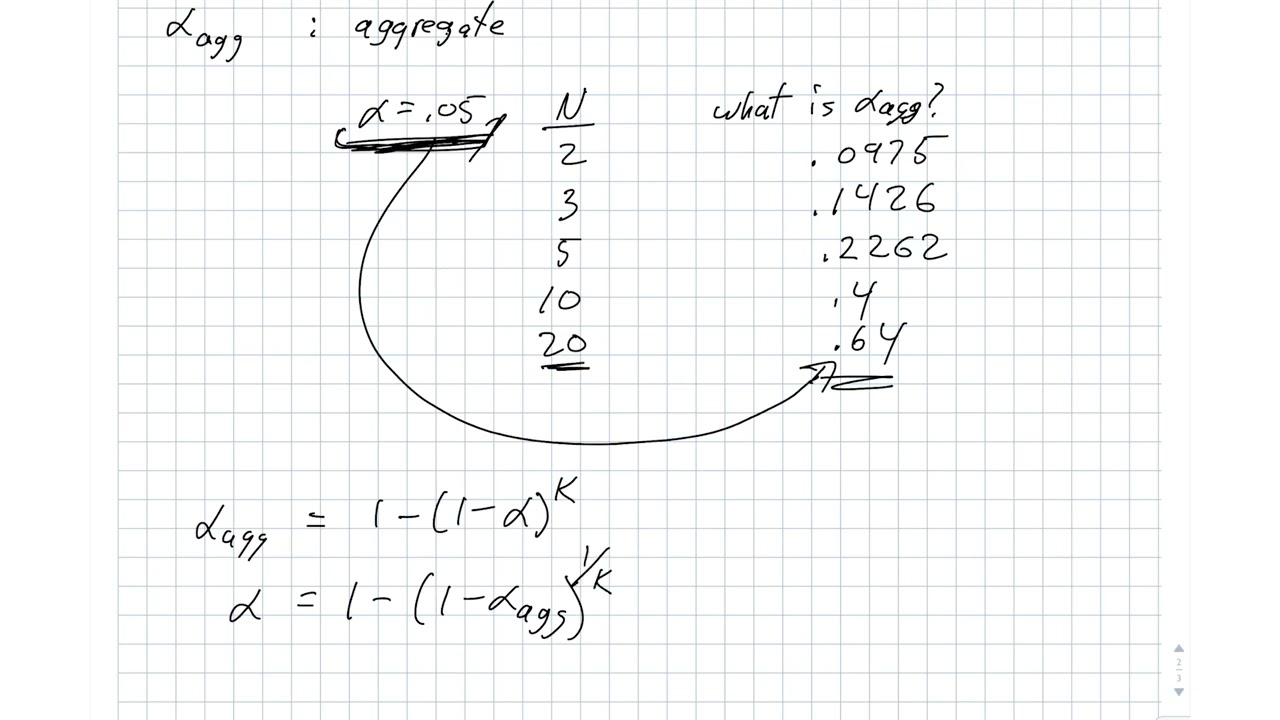
The video provides a clear and rigorous explanation of the multiple comparisons problem, using a relatable analogy of stock brokers. It walks through the mathematical derivation step-by-step, showing how the probability of a false positive increases with the number of comparisons. The argumentation is solid, with concrete numerical examples that illustrate the impact. The video also introduces two common correction methods (Sidak and Bonferroni) and explains their equivalence in typical scenarios. However, it does not delve into practical considerations such as the assumptions of independence or the trade-offs between corrections, which could be a limitation for a more advanced audience.
Scientific Rigor, Source Quality, Title Accuracy
The video is scientifically rigorous in its mathematical treatment, but it does not cite any external sources or references. The title accurately reflects the content, which focuses on the problem of multiple comparisons. The video is a tutorial, and its content is consistent with standard statistical practices. However, the lack of citations means that viewers cannot easily verify or explore the concepts further. The video does not mention any public comments, so no analysis of audience feedback is possible.
194 words
Title / Content Match
The title accurately reflects the content, which addresses the problem of multiple comparisons in model selection.
Quality & Reliability
8/10
The video provides a clear, mathematically grounded explanation of the multiple comparisons problem and its correction methods (Sidak and Bonferroni). The reasoning is sound, and the examples illustrate the concepts effectively. However, it lacks citations to external sources and does not discuss practical implementation nuances.
Key Moments
Markers derived by PSI from the transcript: the creator did not define chapters.
- Introduction to the single charlatan problem and the need for testing multiple brokers.
- Formulation of the null hypothesis and the probability of rejecting at least one charlatan.
- Numerical examples showing the increase in aggregate error with more brokers.
- Derivation of the Sidak correction formula and comparison with Bonferroni.
- Discussion of the multiple comparisons problem in machine learning and the use of validation/test sets.
- Conclusion and preview of the next video on hyperparameter selection.
Contribution & Novelties
The video offers a clear, accessible explanation of the multiple comparisons problem, using a stock broker analogy to illustrate the statistical concept. It provides a step-by-step derivation of the Sidak correction and compares it with the Bonferroni method, highlighting their equivalence in typical scenarios. The video also connects the concept to machine learning model selection, emphasizing the importance of using separate validation and test datasets.
Pour aller plus loin :
- Multiple comparisons problem — Overview of the problem and common correction methods.
- Bonferroni correction — Detailed explanation of the Bonferroni method.
- Sidak correction — Explanation of the Sidak correction and its derivation.
102 words
Radar Profile
The radar profile shows high scores in quality, technical level, and reliability, with a slightly lower score in quantity of information. This indicates a focused, well-explained tutorial that may not cover all aspects of the topic but provides solid foundational knowledge.