Machine Learning Practice: Conclusions
Keywords
Summary
178 words
Critical Evaluation
Value of the Information & Strength of the Argument
The video provides valuable practical advice for machine learning practitioners, emphasizing the importance of understanding the problem and data, starting with simple models, and being honest in reporting results. The argumentation is based on the instructor’s experience and common best practices, but lacks empirical evidence or citations. The advice is sound and aligns with widely accepted practices, but the lack of concrete examples or case studies weakens the argumentation. The instructor’s points are logically structured and coherent, but the video would benefit from more specific illustrations of the concepts discussed.
Scientific Rigor, Source Quality, Title Accuracy
The video does not cite any external sources, and the description contains no links. The content is based on the instructor’s expertise, which is acceptable for an educational summary but limits the scientific rigor. The title accurately reflects the content, and the video is well-structured, covering key aspects of machine learning practice. The lack of sources is a significant weakness for a scientific evaluation, but the advice given is consistent with standard practices in the field.
181 words
Title / Content Match
The title accurately reflects the content, which summarizes key lessons and advice for machine learning practice.
Quality & Reliability
7/10
The video provides practical advice based on the instructor's experience, but lacks citations or references to specific research or literature. The content is coherent and aligns with standard machine learning practices, but the absence of sources limits its scientific rigor.
Key Moments
Markers derived by PSI from the transcript: the creator did not define chapters.
- Introduction: end of semester, advice on machine learning in larger contexts.
- Importance of knowing the problem and data, including costs and error types.
- Advice on visualizing data and checking for formatting issues.
- Choosing approaches based on data and prediction type, starting with simple methods.
- Grid search and cross-validation for hyperparameter tuning.
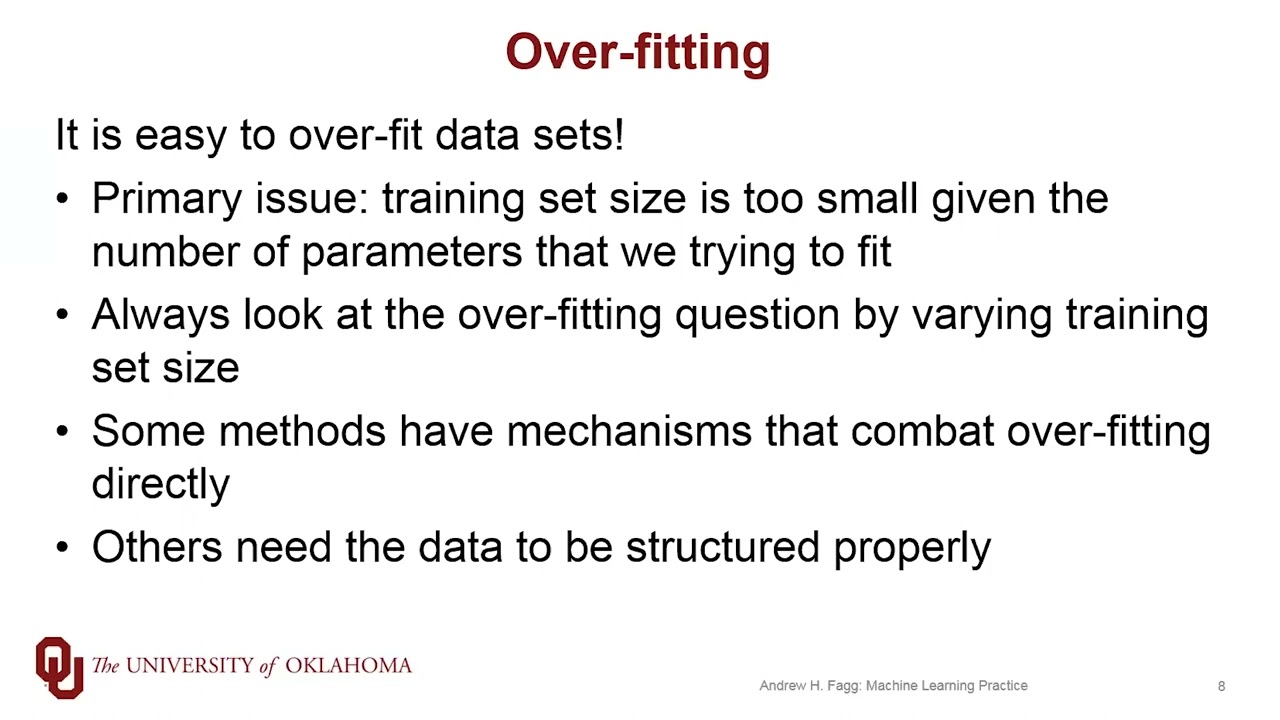
- Overfitting and sensitivity analysis, regularization methods.
- High-dimensional spaces and dimensionality reduction techniques.
- Communicating results to stakeholders, showing raw data and test performance.
Contribution & Novelties
The video offers a concise summary of best practices for machine learning projects, emphasizing the importance of understanding data and problem, starting simple, and honest reporting. It does not present new research but serves as a practical guide. For further exploration, consider the following concepts:
Pour aller plus loin :
- Cross-validation (statistics) — Essential for model evaluation.
- Overfitting — Key concept discussed.
- Curse of dimensionality — Relevant to high-dimensional spaces.
- Principal component analysis — Mentioned as a linear method.
- t-distributed stochastic neighbor embedding — Non-linear dimensionality reduction.
87 words
Radar Profile
The radar profile shows balanced scores across all dimensions, with slightly higher quality and reliability compared to quantity and technical level. This indicates a well-rounded but not deeply technical video, suitable for beginners seeking practical advice.