Example: Using Regularization in the Brain-Machine Interface Problem
Keywords
Summary
166 words
Critical Evaluation
Value of the Information & Strength of the Argument
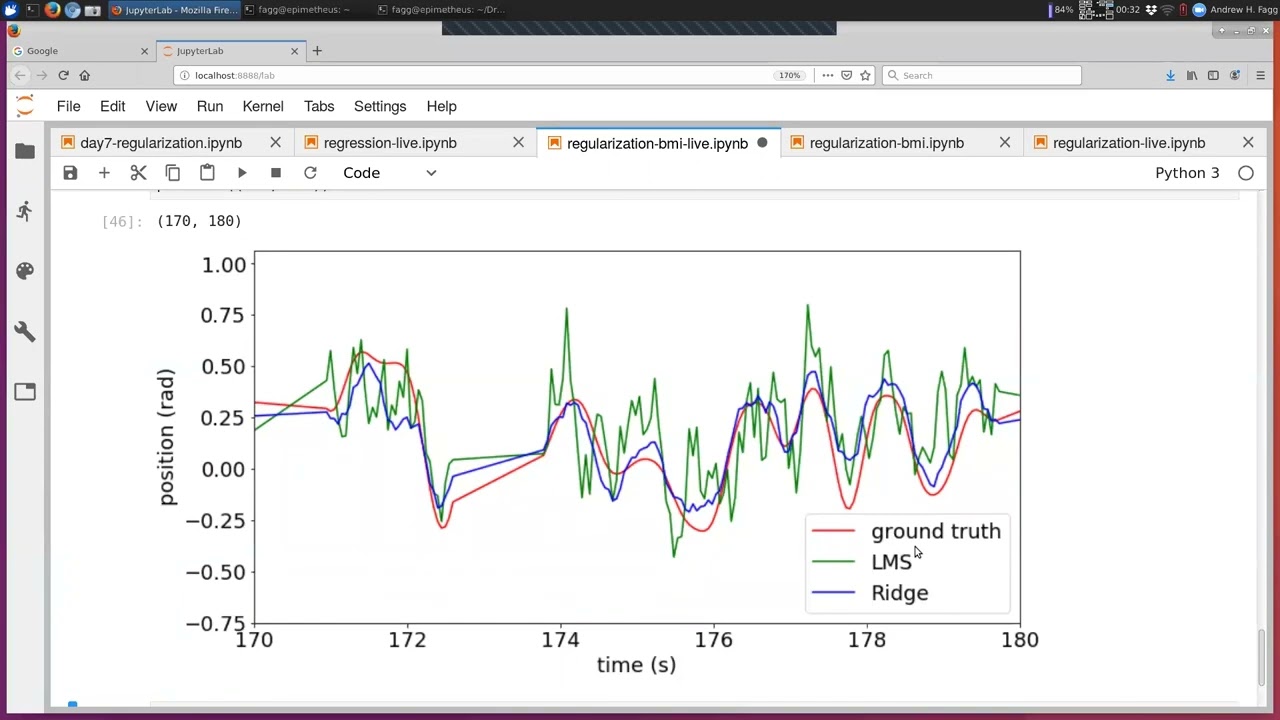
The video provides a hands-on demonstration of regularization methods, which is valuable for practitioners. The argumentation is clear and logical: it starts with a problem (overfitting), introduces solutions (regularization), and systematically explores hyperparameters. The presenter explains the intuition behind each method and shows the trade-offs between bias and variance. The use of visualizations (time series plots and coefficient histograms) effectively illustrates the concepts. However, the video does not provide a rigorous statistical comparison of the methods, and the conclusions are based on a single dataset fold.
95 words
Title / Content Match
The title accurately describes the content: a code example applying regularization to a brain-machine interface problem.
Quality & Reliability
8/10
The video is a practical tutorial demonstrating regularization techniques on a real brain-machine interface dataset. The methodology is clear, reproducible, and based on established machine learning principles. The presenter explains the effects of hyperparameters and compares methods, showing a good understanding of the subject. However, the video lacks citations to external sources and does not provide statistical validation of the results.
Key Moments
Markers derived by PSI from the transcript: the creator did not define chapters.
- Introduction to the problem of overfitting in BMI and the goal of using regularization.
- Setup of the Jupyter notebook and loading the BMI dataset.
- Building a linear regression model and evaluating its performance (RMSE 13.5).
- Plotting predictions vs. actual positions, showing high-frequency noise.
- Introduction to ridge regression with alpha=1, showing slight improvement.
- Increasing alpha to 10, 100, 1000, and observing RMSE decrease and smoother predictions.
- Alpha=10000 leads to increased RMSE, showing the sweet spot around 500.
- Introduction to lasso regression, with alpha=1e-4, and its effect.
- Comparison of coefficient histograms for LMS, ridge, and lasso.
- Introduction to elastic net and its performance.
Contribution & Novelties
This video provides a practical, code-driven walkthrough of regularization techniques applied to a brain-machine interface problem, which is a niche but important application. It offers a clear comparison of ridge, lasso, and elastic net, including visualizations of coefficient distributions. The main novelty is the concrete demonstration on real neural data, which can help practitioners understand the trade-offs.
Pour aller plus loin :
- Regularization (mathematics) - Wikipedia — Provides a general overview of regularization in statistics and machine learning.
- Tikhonov regularization - Wikipedia — Details on ridge regression and its mathematical formulation.
- Lasso (statistics) - Wikipedia — Explains L1 regularization and its properties.
- Elastic net regularization - Wikipedia — Discusses the combination of L1 and L2 penalties.
116 words
Radar Profile
The radar profile shows high scores in information quantity, quality, and reliability, with a slightly lower technical level. This indicates a well-structured tutorial that is accessible yet informative, with a strong practical focus.