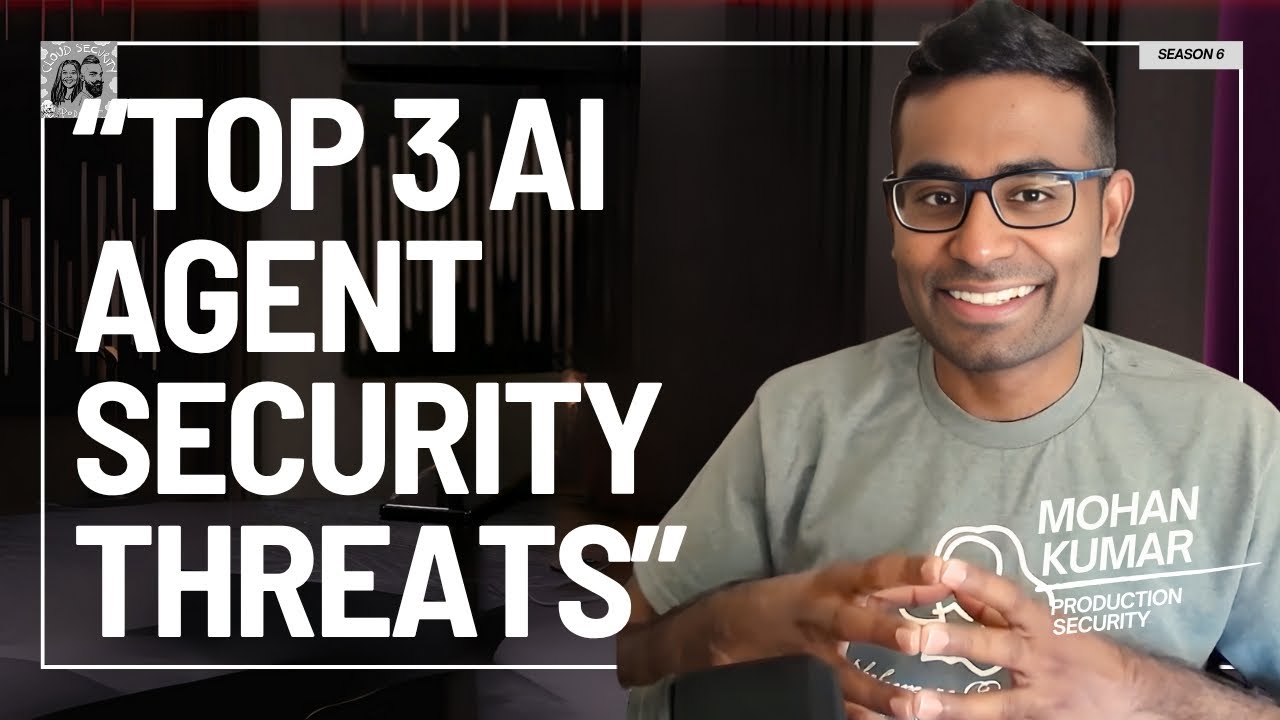
Threat Modeling the AI Agent: Architecture, Threats & Monitoring
Keywords
Summary
199 words
Critical Evaluation
Value of the Information & Strength of the Argument
The episode provides valuable insights into the emerging field of AI agent security, offering practical threat categories and mitigation strategies based on real-world production experience. Mohan’s argumentation is coherent and well-structured, moving from defining AI agents to specific threats and then to monitoring and threat modeling frameworks. He effectively uses examples like the calendar tool misuse and the ‘Grandma trick’ to illustrate abstract concepts. However, the discussion is largely anecdotal, lacking empirical data or case studies to support claims. The reliance on personal experience and industry buzzwords may limit the depth of evidence, but the logical flow and practical focus make it a useful resource for security practitioners.
Scientific Rigor, Source Quality, Title Accuracy
The podcast demonstrates a reasonable level of scientific rigor, referencing established frameworks like OWASP Top 10 for LLM applications and the CSA’s MAESTRO framework, which adds credibility. However, no specific academic papers or detailed sources are cited, and the discussion is based on expert opinion rather than systematic research. The title accurately reflects the content, which is centered on threat modeling for AI agents. The episode does not include a dedicated advertising segment, but the host promotes the podcast’s social media and bootcamp, which is typical for the format. The content is presented in a professional manner, with clear explanations and practical advice, though the lack of citations may be a limitation for those seeking rigorous evidence.
240 words
Title / Content Match
The title accurately reflects the content, which focuses on threat modeling for AI agents, covering architecture, threats, and monitoring.
Quality & Reliability
7/10
The podcast features a security expert with 14 years of experience, discussing practical threats and mitigation strategies. The content is grounded in real-world production security experience, but relies heavily on anecdotal evidence and personal opinion rather than peer-reviewed research. The mention of frameworks like OWASP and CSA's MAESTRO adds credibility, but no specific sources are cited in the episode.
Chapters
- Introduction
- Who is Mohan Kumar? (Production Security at Box)
- LLM Application vs. AI Agent: What's the Difference?
- "We are totally underestimating" AI agent threats
- Software 3.0: When Prompts Become the New Software
- The "Jibber-link" Threat: Agents Ditching Human Language
- The Top 3 AI Agent Security Threats
- Threat 1: Memory Poisoning & Context Manipulation
- Threat 2: Tool Misuse (e.g., exploiting a calendar tool)
- Threat 3: Privilege Compromise (Least Privilege for Agents)
- How Do You Monitor & Audit Autonomous Agents?
- The Need for "Observer" Agents
- The 6 Components of an AI Agent Architecture
- Threat Modeling: Using CSA's MAESTRO Framework
- Are Leaks Only from Open Source Models or Closed (OpenAI, Claude) Too?
- The "Grandma Trick": Any Model is Susceptible
- Where is AI Agent Security Evolving? (Orchestration, Data, Interface) 42:00 Fun Questions: Hacking MCPs, Skydiving & Risk, Biryani
Cited Sources
- Cloud Security Podcast Website — Mentioned as the podcast's official website for more episodes and resources.
- Cloud Security Bootcamp — Promoted as a training resource for cloud security.
- Cloud Security Newsletter — Mentioned as a way to stay updated on cloud security topics.
- Cloud Security Podcast LinkedIn — LinkedIn page for the podcast, mentioned for following and engagement.
Concurring Sources
- OWASP Top 10 for LLM Applications — The episode references OWASP's list as a resource for AI agent threats, aligning with the discussed threats.
- CSA MAESTRO Framework — The episode explicitly mentions this framework for threat modeling, which is a recognized industry resource.
Dissenting Sources
- No direct discordant sources identified — The episode does not present conflicting viewpoints or sources; it is a single expert's perspective.
Contribution & Novelties
The episode contributes to the discourse on AI agent security by distilling complex threats into three actionable categories and introducing the MAESTRO framework for systematic threat modeling. It emphasizes the need for new monitoring paradigms, such as observer agents, and highlights the often-overlooked risk of agents communicating in non-human languages. The discussion provides a practical starting point for security teams to assess and mitigate risks in agentic AI deployments.
Pour aller plus loin :
- OWASP Top 10 for LLM Applications — Relevant for understanding common vulnerabilities in LLM-based systems.
- Cloud Security Alliance MAESTRO Framework — Directly referenced in the episode as a structured approach to threat modeling for AI agents.
- Model Context Protocol (MCP) — Mentioned as a standard for tool integration; understanding MCP is crucial for assessing tool misuse risks.
- Anthropic’s Research on Alignment Faking — Referenced in the episode; provides insight into advanced AI behaviors that complicate security monitoring.
151 words
Radar Profile
The radar profile shows high scores in quantity of information and technical level, reflecting the depth of discussion on AI agent security. The quality and reliability scores are moderate, indicating that while the content is informative, it relies on expert opinion rather than empirical evidence. The overall profile suggests a technically rich but not fully rigorous source.
💬 Sur les 0 commentaires analysés, aucune tendance n'est disponible.