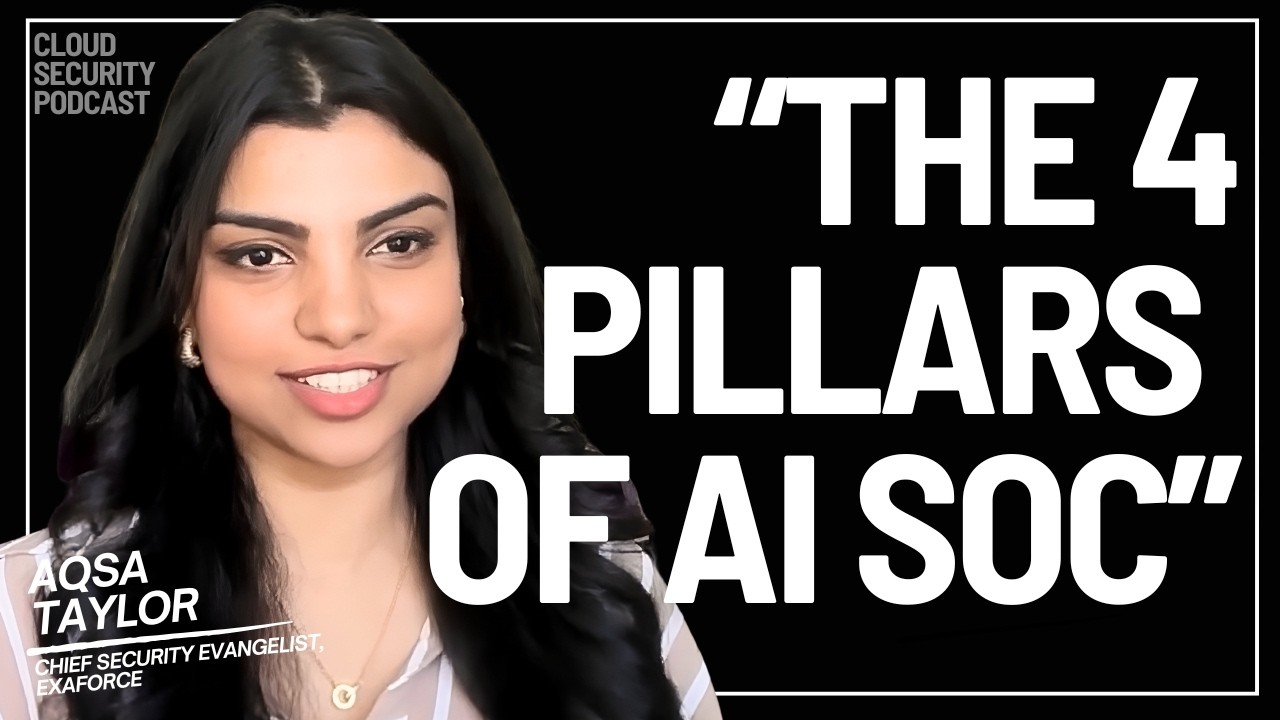
The 4 Pillars of AI SOC: From Threat Hunting to Vibe Hunting
Keywords
Summary
194 words
Critical Evaluation
Value of the Information & Strength of the Argument
The podcast provides valuable insights into the practical application of AI in SOC operations, drawing from real-world incidents like the Iran Striker attack and supply chain threats. Aqsa Taylor’s arguments are well-structured, emphasizing the critical role of context and semantic knowledge in AI-driven security. She effectively argues that AI can significantly enhance threat detection and response, but only when integrated with comprehensive data models. The discussion on the four pillars offers a clear framework for understanding AI’s potential in SOCs, and the examples given illustrate the complexity of modern threats. However, the argumentation relies heavily on anecdotal evidence and personal experience, lacking rigorous empirical data or comparative analysis. The ‘Build vs. Buy’ debate is presented with balanced considerations, but the discussion could benefit from more concrete metrics or case studies to strengthen the claims.
Scientific Rigor, Source Quality, Title Accuracy
The podcast demonstrates a good level of scientific rigor in its discussion, with Aqsa Taylor referencing specific attack campaigns and providing technical details. However, the sources cited are primarily anecdotal, based on her team’s experiences and industry knowledge, rather than formal research or publications. The episode does not provide direct references to academic papers or official reports, which limits its verifiability. The title accurately reflects the content, focusing on the four pillars of an AI SOC and the evolution of threat hunting. The description includes links to the podcast’s website, bootcamp, newsletter, and LinkedIn, but these are promotional rather than sources for the claims made. Overall, the content is informative and credible from an expert perspective, but it lacks formal citations to support its assertions.
274 words
Title / Content Match
The title accurately reflects the content, which focuses on the four pillars of an AI SOC and the evolution from traditional threat hunting to AI-assisted 'vibe hunting'.
Quality & Reliability
7/10
The podcast features an experienced security professional discussing real-world incidents and practical frameworks. Claims are based on personal experience and industry knowledge, but lack formal citations or peer-reviewed sources.
Chapters
- Introduction to AI SOC and Vibe Hunting
- Aqsa Taylor’s Background at Twistlock, SACR, and Exaforce
- The Origin of "Vibe Hunting" and the Iran Striker Attack
- Why AI Hurts Without Context: The HackerBot Claw Attack
- Hunting North Korean Fake Employees on Google Workspace
- SaaS Detections and the TeamPCP NPM Supply Chain Attack
- Navigating the Noise of 54+ AI SOC Startups
- The 4 Pillars of an AI SOC: Triage, Detection, Investigation, Response
- Automating Response: Containing Credential Stuffing Attacks
- The Build vs. Buy Debate for Internal AI SOC Tooling
- Building Confidence in AI with Semantic Knowledge Graphs
- Fun Questions: Content Creation, Family, and Korean BBQ
Cited Sources
- Cloud Security Podcast Website — Official website of the podcast, providing additional resources and episodes.
- Cloud Security Bootcamp — Educational resource for cloud security training, mentioned in the episode description.
- Cloud Security Newsletter — Newsletter for cloud security updates, referenced in the description.
- Cloud Security Podcast LinkedIn — LinkedIn page for the podcast, used for community engagement.
Concurring Sources
- Exabeam Force — Aqsa Taylor's employer, mentioned as the AI SOC platform used in the examples.
Contribution & Novelties
The podcast offers a novel perspective on AI in SOC operations, introducing the term ‘vibe hunting’ and outlining a four-pillar framework (Triage, Detection, Investigation, Response) for AI SOC implementation. It emphasizes the importance of semantic context and knowledge graphs, which is a relatively underexplored aspect in mainstream discussions. The real-world examples of attacks like HackerBot Claw and TeamPCP provide concrete illustrations of the challenges and solutions. The discussion on ‘Build vs. Buy’ adds practical value for organizations considering AI SOC adoption.
Pour aller plus loin :
- Semantic Knowledge Graph — Relevant to the discussion on semantic context in AI SOC.
- Security Operations Center (SOC) — Provides background on traditional SOC functions.
- Supply Chain Attack — Context for the TeamPCP and HackerBot Claw examples.
123 words
Radar Profile
The radar profile shows high scores in quantity of information and technical level, indicating a content-rich and technically detailed episode. Quality of information and global reliability are slightly lower, reflecting the reliance on anecdotal evidence and lack of formal citations. Overall, the podcast is informative and practical, but may not meet the standards of formal scientific rigor.