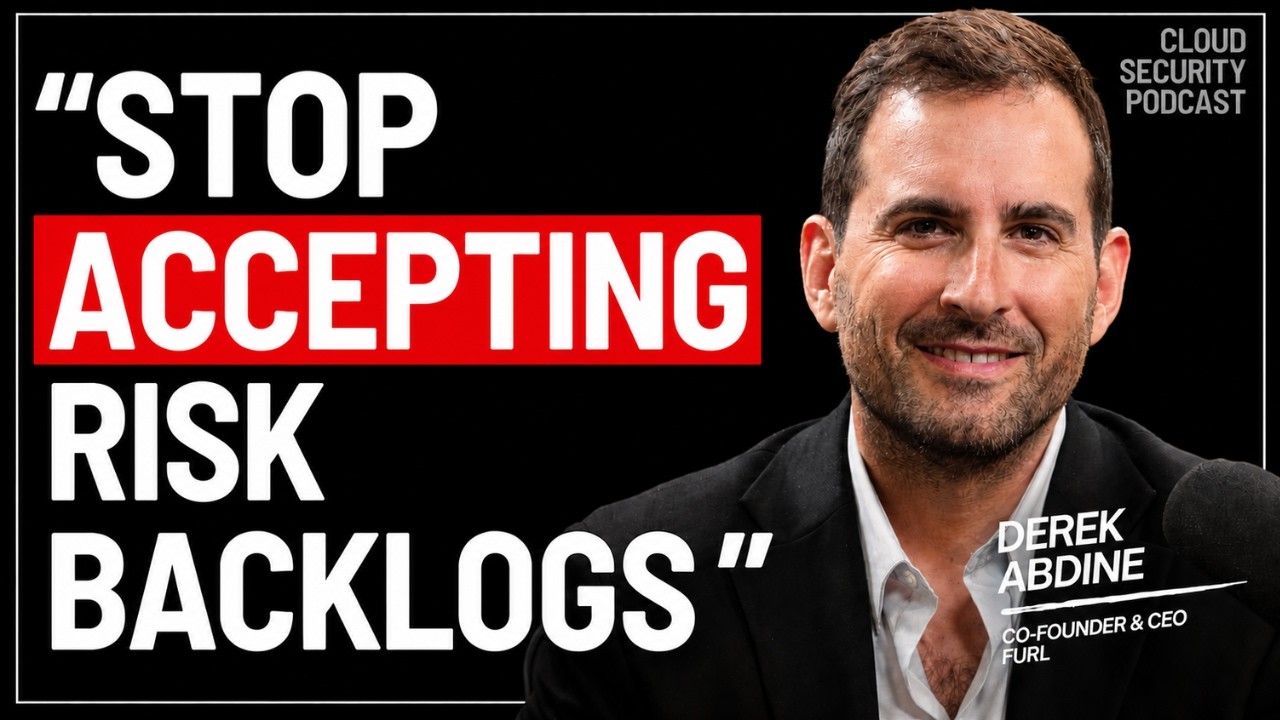
Autonomous AI Remediation: Solving the Vulnerability Backlog | Derek Abdine, Furl
Keywords
Summary
166 words
Critical Evaluation
Value of the Information & Strength of the Argument
The episode provides valuable insights into the practical challenges of vulnerability remediation, a topic often overshadowed by detection. Derek Abdine’s argument that logical scripts are insufficient due to environmental nuances is well-supported by his experience and concrete examples, such as the need to check disk space or package pinning before applying fixes. He effectively contrasts the theoretical capabilities of AI models with the operational realities of deploying patches, using the Mythos example to illustrate the gap between source code analysis and artifact deployment. The discussion on separating CVEs from configuration weaknesses offers a fresh perspective that could help organizations refine their vulnerability management strategies. However, the argumentation is largely anecdotal and lacks empirical data or case studies with measurable outcomes, which weakens the overall persuasiveness. The host’s promotional tone and the lack of critical questioning also limit the depth of the analysis.
Scientific Rigor, Source Quality, Title Accuracy
The episode demonstrates a moderate level of scientific rigor. Derek Abdine’s background at Rapid7 and Census lends credibility to his statements, and he references real-world incidents like the Axios NPM token hijack and the 2008 power plant scanning incident, which add authenticity. However, the discussion is primarily opinion-based, with no citations of specific studies, reports, or technical documentation. The title accurately reflects the content, focusing on AI-driven remediation and the guest’s expertise, though it slightly overstates the ‘solving’ aspect. The podcast’s promotional nature, including mentions of Furl’s platform, introduces a potential bias that is not critically examined. Overall, the sources are not rigorously verified, and the episode would benefit from more concrete data and references.
272 words
Title / Content Match
The title accurately reflects the core topic of AI-driven remediation and the guest's role, though it slightly overpromises by implying a comprehensive solution rather than a discussion of concepts.
Quality & Reliability
7/10
The episode features a practitioner with 20+ years in the field, providing concrete examples and industry context. However, it is primarily an opinion-driven discussion with limited verifiable data or references, and the host's promotional framing reduces the overall reliability.
Chapters
- Introduction & The Remediation Challenge
- Derek Abdine’s Background (Rapid7, Census, Furl.ai)
- Why Detection is Solved But Remediation Remains Broken
- Defining Remediation Lifecycle Management
- The 30-60-90 Day Patch Backlog Trap
- Separating CVEs from Configuration Weaknesses
- The Mythos Reality: Source Code Scanning vs. Artifact Deployment
- Deconstructing the Axios Supply Chain Incident
- Vibe Coding vs. Maintaining SaaS Remediation Pipelines
- Human Accountability in Self-Healing Systems
- Managing Unpatched Vulnerabilities in OT & Power Plants
- Building Trust in AI Remediation & Contextual Guardrails
- First Principles: Rethinking 30 Years of Vulnerability Management
- Blending IT and Security into One Proactive Operations Team
- The "You Laugh, You Lose" Cybersecurity Joke Challenge
Cited Sources
- Cloud Security Podcast — Official website of the podcast, providing additional episodes and resources.
- Cloud Security Bootcamp — Educational resource mentioned in the description, likely for training in cloud security.
- Cloud Security Newsletter — Newsletter for cloud security updates, referenced in the description.
- Cloud Security Podcast LinkedIn — LinkedIn page for the podcast, used for community engagement.
Concurring Sources
- Vulnerability management — General concept of vulnerability management, aligning with the episode's focus on remediation.
- Common Vulnerabilities and Exposures (CVE) — The episode discusses CVEs as a distinct category from configuration weaknesses.
Dissenting Sources
- No discordant sources identified — The episode does not present conflicting viewpoints or sources; it is a single-perspective discussion.
Contribution & Novelties
The episode contributes to the discourse on AI in cybersecurity by shifting focus from detection to remediation, a less-explored area. It introduces the concept of ‘remediation lifecycle management’ and emphasizes the importance of context-aware reasoning in automated patching. The discussion on separating CVEs from configuration weaknesses offers a practical framework for improving vulnerability management. The critique of frontier models like Mythos highlights a critical gap between AI’s ability to find bugs and the operational challenge of deploying fixes, which is often overlooked in industry hype.
Pour aller plus loin :
- Vulnerability management — Provides a foundational overview of the processes discussed.
- Common Vulnerabilities and Exposures (CVE) — Relevant to the distinction between CVEs and configuration issues.
- Common Weakness Enumeration (CWE) — Related to the evolution of vulnerability classification mentioned in the episode.
- Supply chain attack — Context for the Axios NPM incident discussed.
- Self-healing systems — Concept referenced in the discussion on autonomous remediation.
154 words
Radar Profile
The radar profile shows a balanced but moderate performance across all dimensions, with slightly higher scores in information quantity and quality, reflecting the episode's substantive content but limited depth. The technical level is adequate for a professional audience, while reliability is tempered by the lack of verifiable sources.
💬 No comments were provided for analysis.