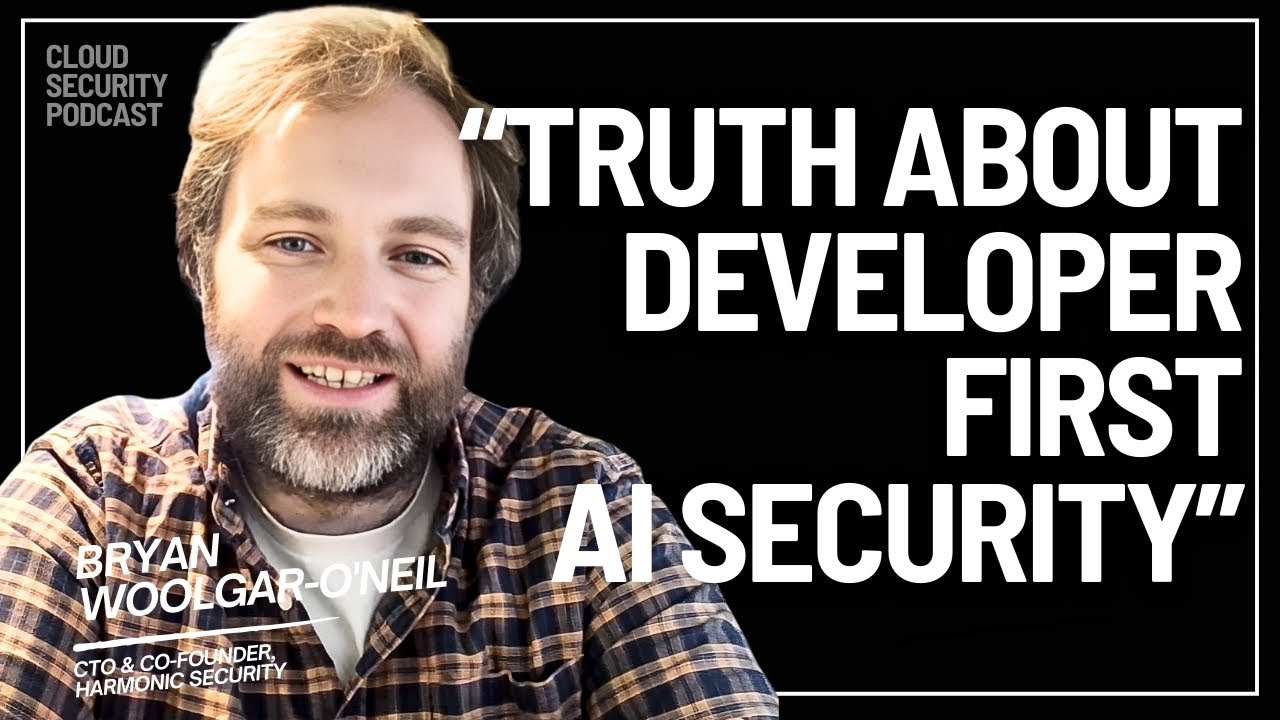
Is Developer Friendly AI Security Possible?
Keywords
Summary
166 words
Critical Evaluation
Value of the Information & Strength of the Argument
The value of the information is high for practitioners in cloud security and AI governance. Bryan provides concrete insights from his experience as CTO, such as the statistic that 70% of MCP servers run locally, and practical advice on implementing a ‘coaching’ approach. The argumentation is solid, grounded in real-world examples like the bug-fixing scenario that reduced time from 5 days to 20 minutes. He effectively contrasts blocking vs. permissive cultures and explains why AI security is fundamentally different due to speed, scale, and the non-deterministic nature of AI. The discussion is coherent and well-structured, though it remains opinion-based without empirical data or citations to external research.
Scientific Rigor, Source Quality, Title Accuracy
The scientific rigor is moderate; the content is based on expert opinion and anecdotal evidence rather than peer-reviewed research. The sources cited are limited to the podcast’s own website and social media links, with no external references to academic papers or industry reports. The title accurately reflects the content, as the episode directly addresses the question of developer-friendly AI security. The discussion is well-organized with clear chapters, but the lack of verifiable sources reduces the overall reliability. No comments were provided for analysis.
205 words
Title / Content Match
The title accurately reflects the central debate of the episode: whether developer-friendly AI security is achievable, and the discussion directly addresses this question.
Quality & Reliability
7/10
The podcast features an experienced CTO discussing practical AI security challenges and solutions, grounded in real-world examples and industry experience. However, it is primarily opinion-based with limited empirical data or peer-reviewed sources.
Chapters
- Introduction
- Who is Bryan Woolgar-O'Neil?
- Why AI Adoption Stops at Experimentation
- The "Shadow AI" Blind Spot: Firewall Stats vs. Reality
- Is AI Security Fundamentally Different? (Speed & Scale)
- Can Security Ever Be "Developer Friendly"?
- What is MCP (Model Context Protocol)?
- Why 70% of MCP Usage is Local (and the Risks)
- The "Coaching" Approach: Don't Just Block, Educate
- Developer First: Permissive vs. Blocking Cultures
- The Rise of the "Head of AI" Role
- Use Cases: Workforce Productivity vs. Product Integration
- An AI Security Maturity Model (Visibility, Access, Coaching)
- Future Prediction: Agentic Flows & Urgent Tasks
- Why Small Language Models (SLMs) Will Win
- Fun Questions: Feature Films & Pork Dumplings
Cited Sources
- Cloud Security Podcast Website — Official website of the podcast, providing additional resources and episodes.
- Cloud Security Bootcamp — Training program mentioned in the description, likely relevant for those seeking deeper knowledge.
- Cloud Security Newsletter — Newsletter for updates on cloud security topics.
- Cloud Security Podcast LinkedIn — LinkedIn page for the podcast, where discussions and updates are shared.
Concurring Sources
- Model Context Protocol (MCP) Official Site — The official documentation for MCP, which aligns with the technical details discussed in the episode.
Contribution & Novelties
The episode provides a fresh perspective on AI security by advocating for a ‘coaching’ approach rather than blocking, and by highlighting the prevalence of locally-run MCP servers. It offers a practical maturity model (visibility, access, coaching) that organizations can adopt. The prediction about SLMs outperforming general models for specific tasks is forward-looking.
Pour aller plus loin :
- Model Context Protocol (MCP) — Official documentation for MCP, the protocol discussed extensively in the episode.
- OWASP Top 10 for LLM Applications — A resource on security risks for LLM applications, relevant to the discussion on AI security.
- Small Language Models (SLMs) — Wikipedia article on SLMs, providing background on the concept Bryan predicts will win.
113 words
Radar Profile
The radar profile shows high scores in information quantity and technical level, indicating a content-rich episode with deep technical insights. The lower reliability score reflects the lack of external citations and reliance on expert opinion. Overall, the episode is valuable for practitioners seeking practical guidance on AI security.