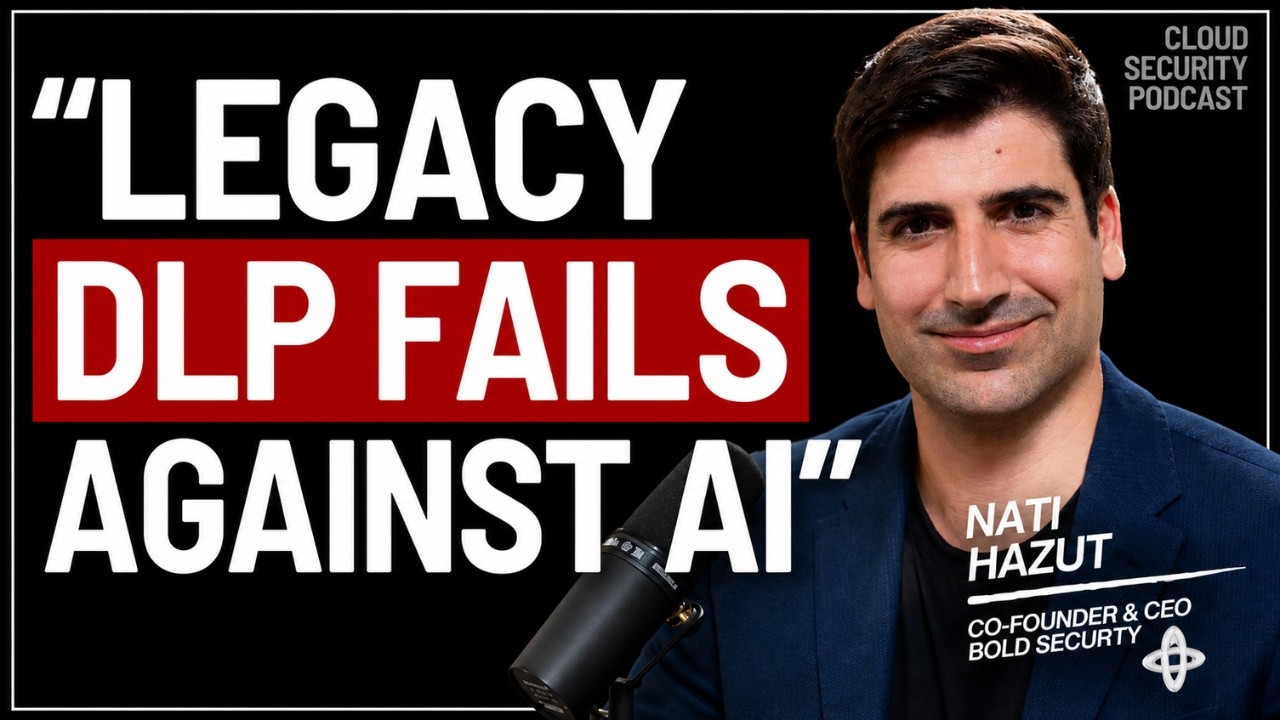
Network Security and DLP Can't Stop Agent Exfiltration | Nati Hazut | Bold Security
Keywords
Summary
150 words
Critical Evaluation
Value of the Information & Strength of the Argument
The value of the information lies in its practical insights from a founder with deep experience in DSPM and endpoint security. Hazut provides a compelling argument for why endpoint security is critical in the AI era, citing specific gaps in current solutions (e.g., file size limits in cloud scanning, lack of context in EDR). The argumentation is coherent and grounded in real-world customer interactions, though it is inherently promotional for Bold Security. The discussion of trade-offs in DSPM and the concept of ‘zero policy’ are thought-provoking, but the lack of independent data or case studies weakens the overall persuasiveness.
Scientific Rigor, Source Quality, Title Accuracy
The scientific rigor is moderate: the conversation is based on expert opinion and anecdotal evidence rather than peer-reviewed research. The sources cited are limited to the podcast’s own website and social media, with no external references to academic or industry reports. The title accurately reflects the content, which consistently addresses the limitations of network security and DLP against agent exfiltration. The episode does not include a public comment section analysis, so no public sentiment is available.
190 words
Title / Content Match
The title accurately reflects the core thesis that traditional network security and DLP are insufficient against AI-driven data exfiltration, and the conversation consistently supports this claim.
Quality & Reliability
7/10
The discussion is based on the speaker's extensive industry experience and specific product insights, but it lacks empirical data, peer-reviewed references, and independent validation. Claims about DLP limitations and endpoint AI advantages are plausible but presented without quantitative evidence.
Chapters
- Introduction to Endpoint Security and AI
- Nati Hazut’s Background (SAM, Polyrise, Varonis, Bold)
- Why Endpoint Security is a Priority Again in the AI Era
- Why Legacy DLP Fails to Understand AI Agent Intentions
- The Blind Spots of EDR and Network-Based Security
- Cloud AI vs. Local Endpoint AI: Overcoming Data Sampling Trade-offs
- Catching Large File Exfiltration with Local Scans
- Shadow AI and the Danger of Rogue MCP Connections
- Controlling AI Adoption and Sanctioning Specific MCPs
- The "Zero Policy" Approach to Data Visibility
- Integrating Endpoint Alerts with MCPs for Incident Response
- Certificate Pinning: Why Network Traffic Visibility is Shrinking
- The "You Laugh, You Lose" Cybersecurity Joke Challenge
Cited Sources
- Cloud Security Podcast Website — Main podcast page with episode details and additional resources.
- Cloud Security Bootcamp — Educational resource mentioned in the description for cloud security training.
- Cloud Security Newsletter — Newsletter for cloud security updates, referenced in the description.
- Cloud Security Podcast LinkedIn — LinkedIn page for the podcast, providing additional community engagement.
Concurring Sources
- Cloud Security Podcast Website — The podcast's main site, which may contain related episodes and resources that align with the discussion.
Contribution & Novelties
The episode provides a novel perspective on the limitations of traditional DLP and network security in the context of AI agents, emphasizing the need for endpoint-based AI-driven prevention. It introduces concepts like ‘shadow MCPs’ and ‘zero policy’ visibility, which are relatively new in the cybersecurity discourse. The discussion on running lightweight AI models locally to avoid data sampling trade-offs is a distinctive contribution.
Pour aller plus loin :
- Data Loss Prevention (DLP) - Wikipedia — Provides foundational understanding of DLP and its evolution.
- Model Context Protocol (MCP) - Official Documentation — Explains the MCP standard, central to the discussion on shadow MCPs.
- Endpoint Detection and Response (EDR) - NIST — Clarifies EDR’s scope and limitations, as discussed in the episode.
120 words
Radar Profile
The radar profile shows balanced scores across information quantity, quality, technical level, and reliability, indicating a well-rounded but not exceptional episode. The technical level is moderate, making it accessible to a broad audience while still providing depth for security professionals.