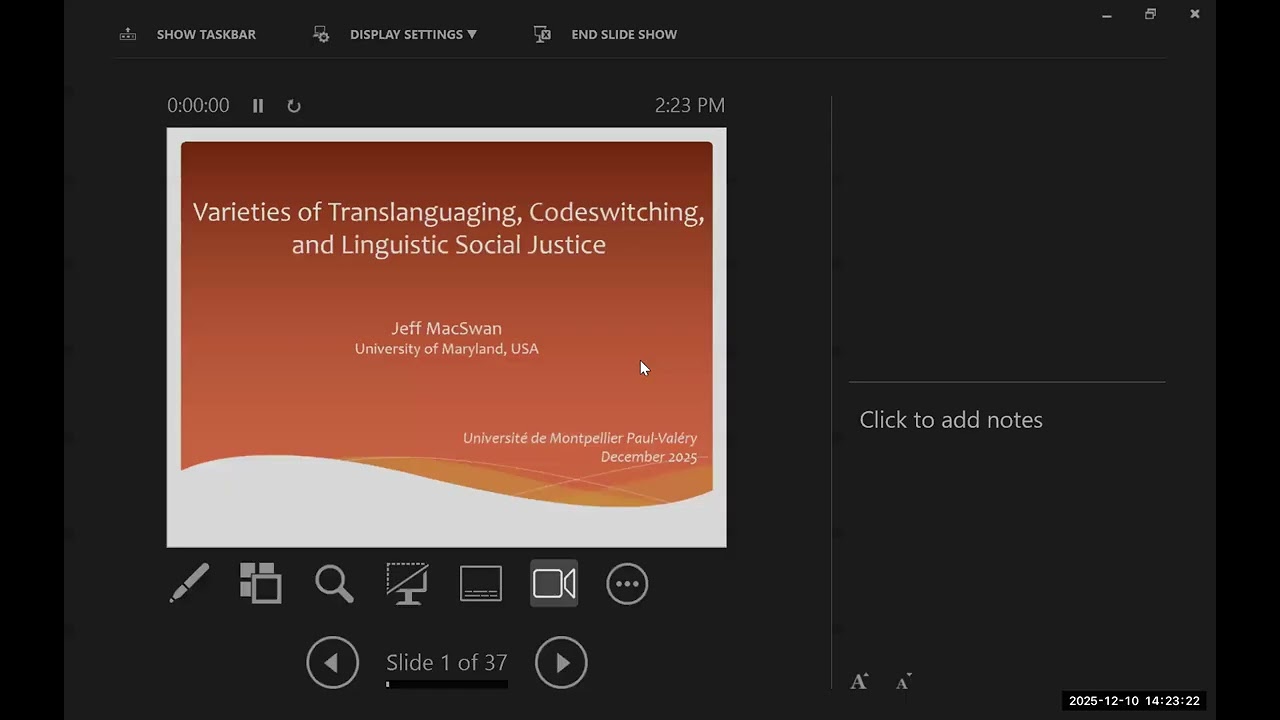
Jeff Mac Swan : Varieties of Translanguaging, Codeswitching, and Linguistic Social Justice
Keywords
Summary
133 words
Critical Evaluation
Value of the Information & Strength of the Argument
The talk provides a valuable overview of the historical and theoretical debates surrounding translanguaging and codeswitching. MacSwan’s argumentation is solid, drawing on specific empirical studies and linguistic theory to support his critique of deconstructivism. He effectively demonstrates the structured nature of bilingual grammar through examples and references to his own research. The presentation is persuasive, though it represents a particular viewpoint within the field. The speaker’s expertise lends credibility, but the lack of visual aids in the transcript limits the depth of some explanations.
Scientific Rigor, Source Quality, Title Accuracy
MacSwan demonstrates scientific rigor by referencing key scholars and studies in the field, such as García, Pennycook, and Gumperz. He provides specific examples and data from his own research on codeswitching. The title accurately reflects the content, which focuses on varieties of translanguaging and codeswitching in relation to social justice. The talk is well-structured, but the absence of a formal reference list in the description means that sources are only mentioned verbally. The speaker’s critical stance is clear, and he acknowledges the contributions of early translanguaging theory while rejecting the deconstructivist turn.
191 words
Title / Content Match
The title accurately reflects the content, which covers varieties of translanguaging, codeswitching, and their implications for linguistic social justice.
Quality & Reliability
8/10
The talk is delivered by a recognized expert in the field, with a clear argumentation based on empirical research and theoretical frameworks. The speaker presents a critical perspective on deconstructivist translanguaging, grounding his claims in specific studies and linguistic data. However, the presentation is an opinion/expert talk rather than a peer-reviewed publication, and the lack of visual data in the transcript limits full verification.
Key Moments
Markers derived by PSI from the transcript: the creator did not define chapters.
- Introduction and overview of the talk's structure.
- Distinction between pedagogical and theoretical translanguaging.
- Historical development of codeswitching research and its empirical foundations.
- Examples of grammatical constraints in codeswitching from Spanish-English bilinguals.
- Explanation of the integrated model of multilingualism.
- Critique of deconstructivist translanguaging and its lack of empirical evidence.
- Discussion of the implications of deconstructivism for language learning and social justice.
- Summary of the main arguments and concluding remarks.
Cited Sources
- García, O. (2009). Bilingual Education in the 21st Century: A Global Perspective — Mentioned as the origin of early translanguaging theory.
- Pennycook, A. (2017). The Cultural Politics of English as an International Language — Cited as the source of the deconstructivist approach to language policy.
- García, O., & Wei, L. (2014). Translanguaging: Language, Bilingualism and Education — Referenced in the context of the evolution of translanguaging theory.
- Gumperz, J. J., & Hernandez-Chavez, E. (1970). Cognitive aspects of bilingual communication — Cited for early work on linguistic constraints in codeswitching.
- MacSwan, J. (2017). A Multilingual Perspective on Translanguaging — The speaker's own work, mentioned in the context of the integrated model.
Concurring Sources
- MacSwan, J. (2017). A Multilingual Perspective on Translanguaging — The speaker's own work aligns with the arguments presented in the talk.
- Gumperz, J. J. (1982). Discourse Strategies — Early work on codeswitching that supports the empirical foundation.
Dissenting Sources
- García, O., & Wei, L. (2014). Translanguaging: Language, Bilingualism and Education — This work represents the deconstructivist approach that the speaker critiques.
- Pennycook, A. (2017). Postmodernism and language policy — Pennycook's postmodernist perspective is directly challenged by the speaker.
Contribution & Novelties
The talk offers a critical perspective on the deconstructivist turn in translanguaging theory, arguing that it lacks empirical support and undermines linguistic social justice. It provides a detailed account of the empirical evidence for structured bilingual grammar, drawing on codeswitching research. The speaker’s expertise adds authority to the argument, and the talk serves as a valuable resource for scholars and students interested in the theoretical debates surrounding multilingualism.
Pour aller plus loin :
- Translanguaging - Wikipedia — Overview of translanguaging theory and its variants.
- Code-switching - Wikipedia — Comprehensive introduction to codeswitching research.
- Bilingualism - Wikipedia — Background on bilingualism and related concepts.
- Linguistic justice - Wikipedia — Discussion of social justice issues in language policy.
116 words
Radar Profile
The radar profile shows high scores in information quantity, quality, and reliability, with a slightly lower technical level, indicating a well-substantiated expert talk that is accessible to a broader audience. The overall balance suggests a strong contribution to the field.
💬 No comments were provided for analysis.