Protein Isolation & Purification Techniques | Week 4 | Fundamentals of Protein Chemistry | NPTEL
Keywords
Summary
143 words
Critical Evaluation
Value of the Information & Strength of the Argument
The video provides valuable information for students and researchers in biochemistry and biotechnology. It systematically explains the entire workflow of protein purification, from expression to final characterization. The argumentation is solid, based on established biochemical principles and standard laboratory practices. The instructor uses clear diagrams and examples to illustrate complex concepts like the lac operon and T7 expression system. The inclusion of interactive questions helps reinforce learning and addresses common pitfalls. However, the video is primarily a tutorial and does not present new research or critical analysis. The depth is appropriate for an introductory to intermediate level, but it may not satisfy experts seeking advanced insights.
Scientific Rigor, Source Quality, Title Accuracy
The scientific rigor is good, as the content aligns with standard textbooks and well-known laboratory techniques. The instructor references Lehninger Biochemistry and Voet & Voet, which are authoritative sources. However, specific citations are not provided in the video, and the description only mentions a general reference. The title accurately reflects the content, which is a lecture on protein isolation and purification. The video is part of an NPTEL course, which adds credibility. The presentation is clear and well-organized, with a logical flow from theory to practical applications. The main limitation is the lack of in-depth source citations and the reliance on a single instructor’s perspective.
226 words
Title / Content Match
The title accurately reflects the content, which covers protein isolation and purification techniques as part of a week 4 lecture in a protein chemistry course.
Quality & Reliability
7/10
The content is based on established biochemistry principles and references standard textbooks (Lehninger, Voet & Voet). The instructor is a research scholar from IIT Kharagpur, adding credibility. However, the video is a tutorial with interactive elements and lacks in-depth citations or peer-reviewed sources.
Key Moments
Markers derived by PSI from the transcript: the creator did not define chapters.
- Introduction to protein isolation and purification, importance and applications.
- Overview of recombinant protein expression and host organisms.
- Detailed explanation of cloning and expression vectors.
- Discussion on host cells: E. coli, yeast, mammalian cells, and their pros/cons.
- Step-by-step workflow: transformation, cultivation, induction with IPTG.
- Explanation of BL21(DE3) cells and the lac operon/T7 expression system.
- Interactive question: why recombinant proteins can be toxic to host cells.
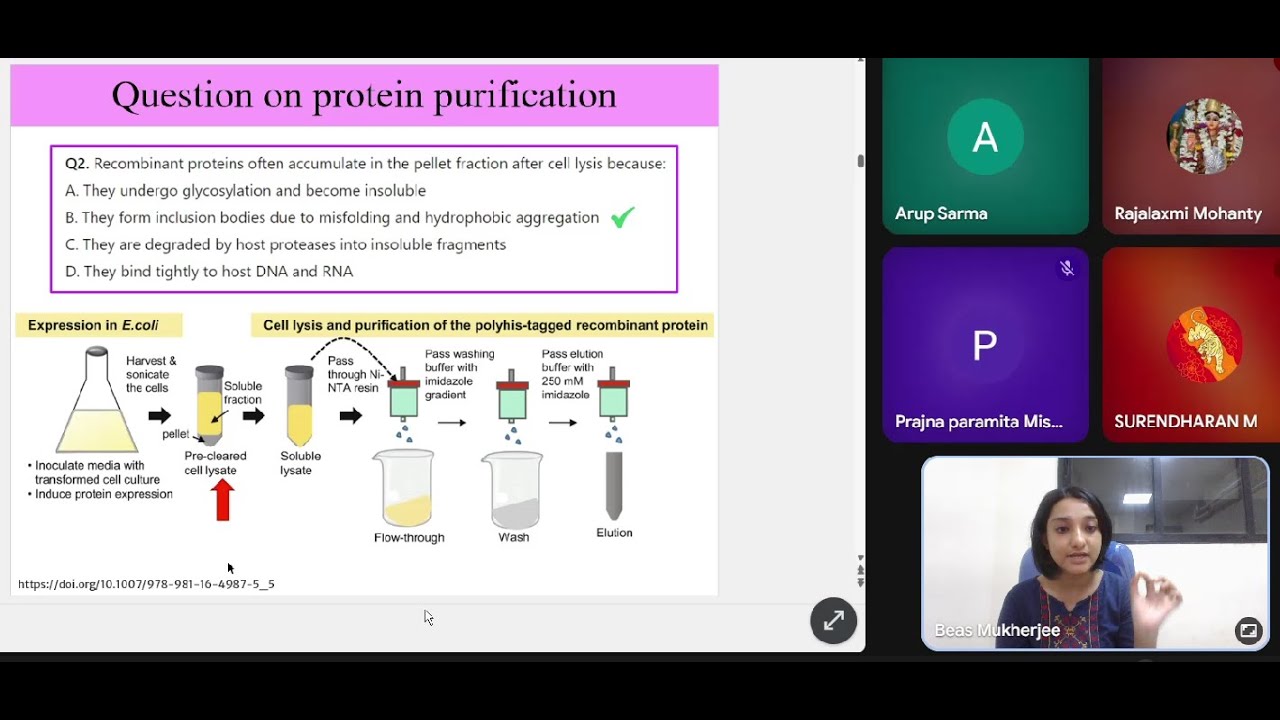
- Discussion on inclusion bodies and protein solubility issues.
- Introduction to purification techniques: centrifugation, precipitation, chromatography.
- Detailed explanation of affinity chromatography (Ni-NTA, His-tag).
- Size exclusion chromatography and its principles.
- HPLC and PAGE analysis for purity assessment.
- Calculations: enzyme activity, specific activity, purification fold.
- Strategies for multi-step purification in research and industry.
Cited Sources
- Lehninger Principles of Biochemistry — Referenced as a standard textbook for protein chemistry.
- Voet & Voet Biochemistry — Referenced as a standard textbook for biochemistry.
- Singh & Bose (2022) Protein Purification Methods — Referenced in the video description as a source for protein purification methods.
Concurring Sources
- Protein Purification - Wikipedia — Provides a general overview of protein purification methods, consistent with the video's content.
- Affinity Chromatography - Wikipedia — Explains affinity chromatography principles, matching the video's discussion.
- Size Exclusion Chromatography - Wikipedia — Details size exclusion chromatography, as covered in the video.
Contribution & Novelties
The video provides a comprehensive and structured overview of protein purification techniques, making it a valuable educational resource for students preparing for competitive exams. It bridges theory and practical lab applications, offering insights into common challenges like inclusion bodies and toxicity. The interactive format encourages active learning.
Pour aller plus loin :
- Protein purification - Wikipedia — Overview of methods and principles.
- Affinity chromatography - Wikipedia — Detailed explanation of affinity-based purification.
- Size-exclusion chromatography - Wikipedia — Principles and applications.
- His-tag - Wikipedia — Information on histidine tags and their use in purification.
- Lac operon - Wikipedia — Background on the lac operon and IPTG induction.
106 words
Radar Profile
The radar profile shows high scores in quantity of information and technical level, indicating a content-rich and technically detailed video. Quality and reliability are slightly lower, reflecting the tutorial nature and lack of primary sources. The overall balance suggests a solid educational resource for intermediate learners.
💬 No comments were provided for analysis.