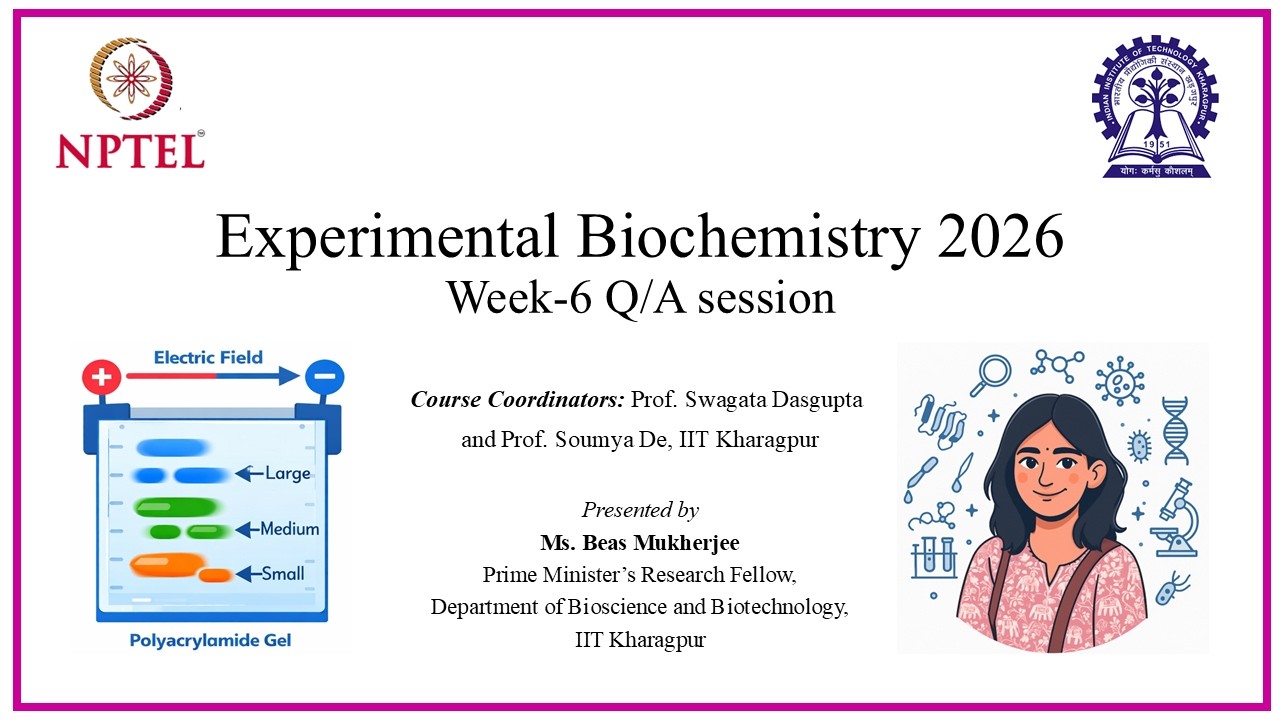
SDS PAGE, AGE, 2D PAGE, Native PAGE | MCQs, MSQs and NATs | Experimental Biochemistry | NPTEL 2026
Keywords
Summary
204 words
Critical Evaluation
Value of the Information & Strength of the Argument
The video provides a comprehensive and structured overview of gel electrophoresis techniques, explaining the underlying principles clearly and connecting them to practical applications. The instructor uses diagrams and analogies to illustrate concepts like the stacking gel mechanism and the effect of SDS. The argumentation is logical, building from basic physics to specific techniques. The inclusion of solved problems reinforces understanding and demonstrates the application of concepts. However, the video lacks critical evaluation of the techniques’ limitations or comparisons with alternative methods, and the argumentation is largely descriptive rather than critical.
99 words
Title / Content Match
The title accurately reflects the content, which covers SDS-PAGE, AGE, 2D-PAGE, and Native PAGE, including MCQs, MSQs, and NATs.
Quality & Reliability
7/10
Content is based on established biochemistry principles and techniques, presented by a research scholar from IIT Kharagpur. The video includes a live Q&A session and problem-solving, but lacks explicit citations to primary literature. The information is generally accurate and aligns with standard textbook knowledge.
Key Moments
Markers derived by PSI from the transcript: the creator did not define chapters.
- Introduction to the video and overview of gel electrophoresis techniques.
- Explanation of electrophoresis principles: migration of charged particles, electrophoretic mobility, and factors affecting it.
- Discussion on the physics behind electrophoresis, including Ohm's law and the effects of constant voltage, current, and power.
- Introduction to different types of electrophoresis: capillary, isoelectric focusing, and gel electrophoresis.
- Detailed explanation of polyacrylamide gel preparation, including acrylamide and bis-acrylamide ratio, and polymerization with APS and TEMED.
- Explanation of SDS-PAGE: denaturing proteins with SDS, reducing agents, and the principle of separation by size.
- Discussion on the stacking and resolving gel system, including the role of glycine and chloride ions in focusing proteins.
- Protein visualization techniques: Coomassie Blue and silver staining.
- Introduction to native PAGE and its applications, such as EMSA.
- Explanation of agarose gel electrophoresis for DNA and RNA, including the effect of DNA topology.
- Introduction to 2D-PAGE and isoelectric focusing, and their use in proteomics.
- Solving MCQs and MSQs related to the techniques discussed.
- Solving numerical aptitude tests (NATs) and previous year questions.
- Q&A session addressing a student's issue with protein separation.
- Conclusion and summary of key points.
Contribution & Novelties
The video provides a thorough educational review of gel electrophoresis techniques, integrating theoretical principles with problem-solving exercises. It is particularly useful for exam preparation, offering a structured approach to understanding and applying these methods. The inclusion of a live Q&A adds practical troubleshooting advice.
Pour aller plus loin :
- Polyacrylamide gel electrophoresis — Overview of PAGE, including SDS-PAGE and native PAGE.
- Agarose gel electrophoresis — Detailed explanation of AGE for nucleic acids.
- Two-dimensional gel electrophoresis — Introduction to 2D-PAGE and its applications in proteomics.
- Isoelectric focusing — Principle and use of IEF in protein separation.
95 words
Radar Profile
The radar profile shows high scores in quantity of information and technical level, indicating a comprehensive and detailed tutorial. The quality and reliability scores are moderate, reflecting the lack of citations but overall accuracy. The video is strong in educational value but could benefit from referencing primary sources.