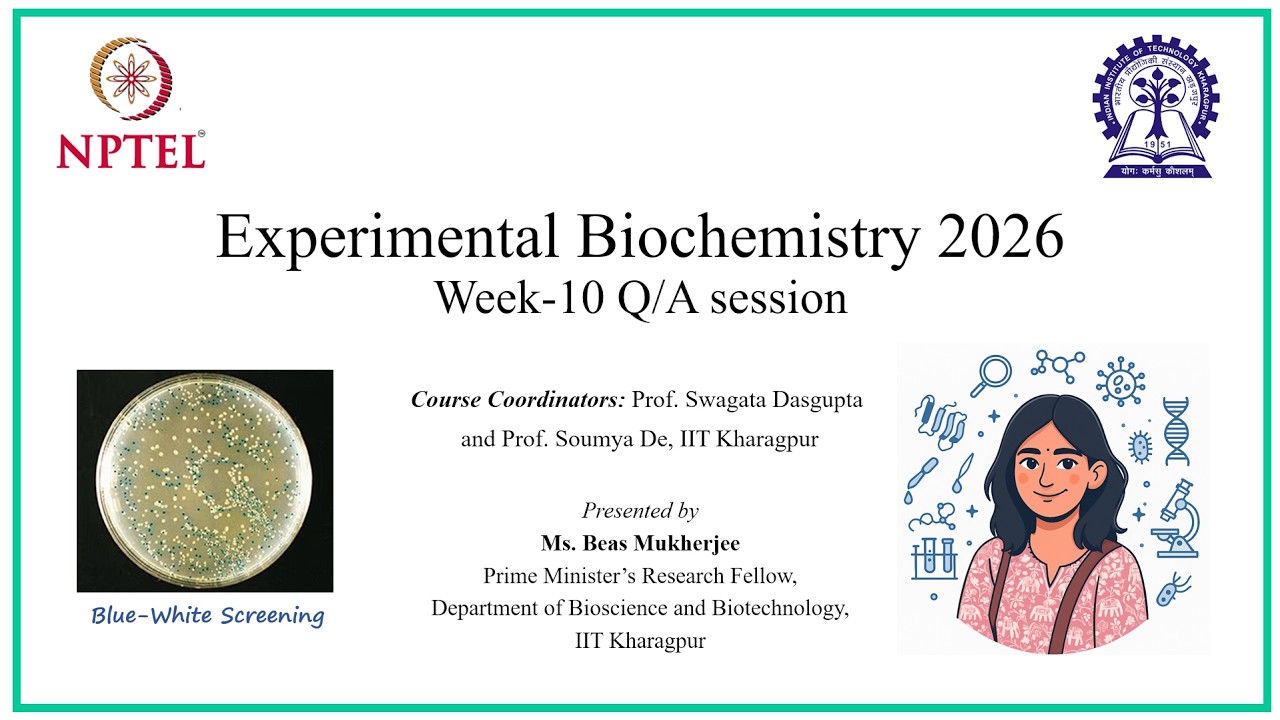
Recombinant DNA Technology, Vectors, Gene transfers methods, CRISPR-Cas9 | GATE BT 2019-2026 PYQs
Keywords
Summary
167 words
Critical Evaluation
Value of the Information & Strength of the Argument
The video provides a solid overview of recombinant DNA technology, covering fundamental concepts and techniques. It explains the rationale behind each step, such as why sticky ends are preferred and why dephosphorylation prevents self-ligation. The inclusion of GATE exam questions adds practical value, helping viewers apply knowledge to exam contexts. The argumentation is clear and logical, with diagrams and examples used to illustrate complex processes like blue-white screening and CRISPR. However, the depth is sometimes uneven; for instance, CRISPR is covered briefly compared to other topics. The presentation is didactic, aiming to teach rather than debate, and it effectively builds understanding from basic to more advanced concepts.
Scientific Rigor, Source Quality, Title Accuracy
The content is based on an NPTEL course, which is a reputable educational platform, and the instructors are from academic institutions. The video does not cite specific research papers, but it references standard molecular biology techniques and concepts. The title accurately reflects the content, which is focused on RDT and related topics for GATE preparation. The video includes a brief interruption (likely a guest), but it does not detract from the scientific rigor. The lack of explicit citations within the video is a minor limitation, but the information aligns with established knowledge in molecular biology.
217 words
Title / Content Match
The title accurately reflects the content, which covers recombinant DNA technology, vectors, gene transfer methods, and CRISPR-Cas9, with a focus on GATE exam questions.
Quality & Reliability
7/10
The video provides a structured overview of recombinant DNA technology, covering key concepts, enzymes, vectors, and screening methods. It is based on an NPTEL course, which adds credibility. However, the presentation is somewhat informal with interruptions, and the depth varies across topics. The content is accurate but not exhaustive, and the lack of citations within the video limits verification.
Key Moments
Markers derived by PSI from the transcript: the creator did not define chapters.
- Introduction to recombinant DNA technology and its applications.
- Overview of the steps in RDT: isolation, cutting, insertion, transformation, selection, expression.
- Detailed explanation of restriction enzymes and the restriction-modification system.
- Comparison of E. coli and T4 DNA ligases, including cofactor requirements and optimal temperatures.
- Discussion of cloning vectors: plasmids, λ phage, cosmids, BACs, YACs, and expression vectors.
- Gene transfer methods: transformation (chemical and electroporation), transduction, conjugation, and plant methods.
- Screening and selection: antibiotic resistance, blue-white screening, and insertional inactivation.
- Introduction to CRISPR-Cas9 genome editing: components, mechanism, and applications.
- Solving GATE previous year questions related to RDT and CRISPR.
Cited Sources
- NPTEL Course: Experimental Biochemistry — The video is part of this NPTEL course, and the instructors are from IIT Kharagpur.
Concurring Sources
- Molecular Cloning: A Laboratory Manual (Sambrook et al.) — Standard reference for molecular cloning techniques, consistent with the video's content.
Contribution & Novelties
The video offers a comprehensive review of recombinant DNA technology tailored for GATE exam preparation, integrating multiple topics into a single lecture. It provides clear explanations of complex concepts like blue-white screening and CRISPR, with practical examples from previous exams. The inclusion of multiple-choice questions with answers helps reinforce learning.
Pour aller plus loin :
- Restriction enzyme — Overview of restriction enzymes and their types.
- DNA ligase — Detailed information on DNA ligases and their mechanisms.
- Blue-white screen — Explanation of the blue-white screening technique.
- CRISPR gene editing — Comprehensive resource on CRISPR-Cas9.
- Ti plasmid — Information on the Ti plasmid used in plant genetic engineering.
106 words
Radar Profile
The radar profile shows high scores in quantity of information and technical level, indicating a dense and detailed lecture. Quality and reliability are slightly lower due to the informal presentation and lack of citations. Overall, the video is a valuable educational resource for exam preparation.
💬 No comments were provided for analysis.