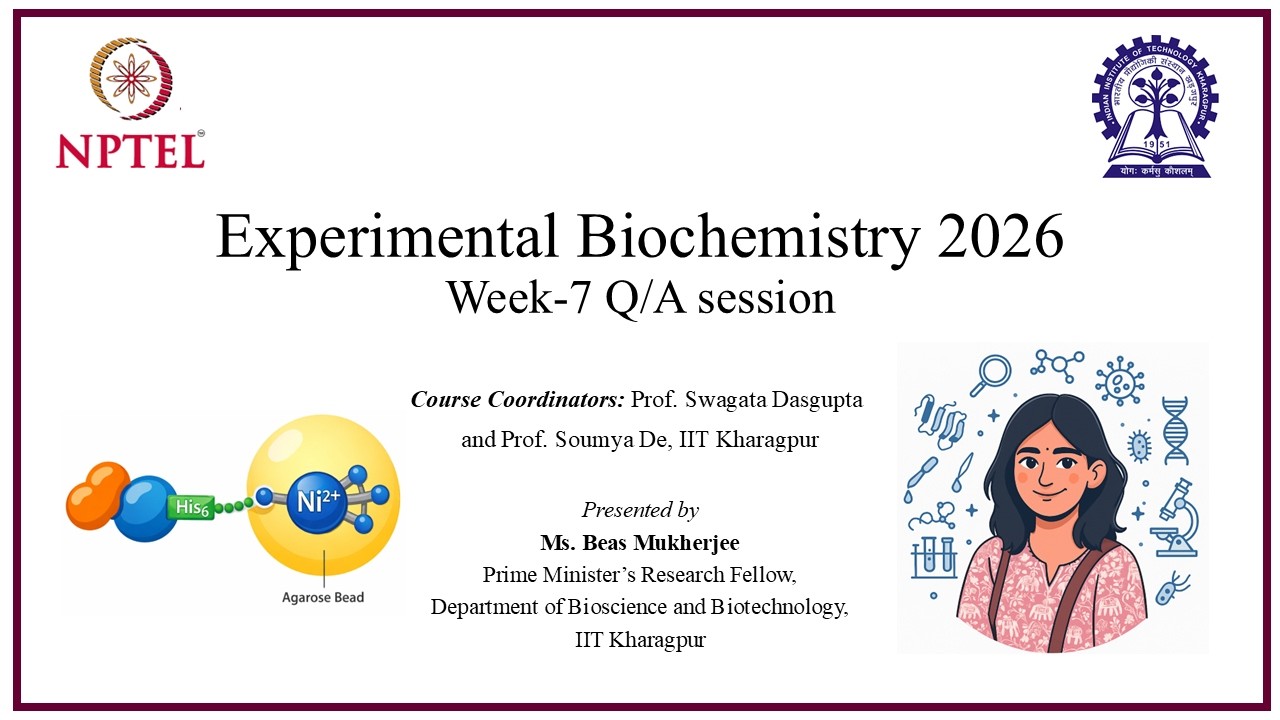
Recombinant Protein Overexpression and Purification | GATE MCQs, MSQs, NATs | Week 7 | NPTEL 2026
Keywords
Summary
158 words
Critical Evaluation
Value of the Information & Strength of the Argument
The video provides a comprehensive overview of protein purification, from natural sources to recombinant expression. The instructor explains the rationale behind each step, such as why IPTG is used for induction and why PMSF is added to prevent proteolysis. The argumentation is logical and builds on previous knowledge of chromatography. The inclusion of MCQs and problem-solving enhances the educational value, making it useful for exam preparation. However, the video lacks critical evaluation of alternative methods or potential pitfalls, and the discussion is somewhat superficial in places.
Scientific Rigor, Source Quality, Title Accuracy
The video is based on standard biochemistry knowledge and the NPTEL course curriculum. The instructor mentions a book chapter and provides a DOI on a slide, but the reference is not verbally cited. The title accurately reflects the content. The video does not cite specific research papers or sources within the spoken content, but the description mentions the NPTEL course and the instructor’s affiliation with IIT Kharagpur, lending credibility. The content is scientifically accurate, though not exhaustive.
178 words
Title / Content Match
The title accurately reflects the content, which focuses on recombinant protein overexpression and purification, with practice questions for GATE and other exams.
Quality & Reliability
7/10
The video is an educational tutorial by a research scholar from IIT Kharagpur, covering standard biochemical techniques. It is based on the NPTEL course 'Experimental Biochemistry' and includes problem-solving for GATE/CSIR-NET. The content is accurate but lacks in-depth critical analysis and references are not explicitly cited within the video.
Key Moments
Markers derived by PSI from the transcript: the creator did not define chapters.
- Introduction to protein isolation and purification, importance, and applications.
- Extraction from natural sources: methods, advantages, disadvantages.
- Recombinant protein overexpression: gene cloning, vectors, and expression systems.
- Detailed steps of protein purification: cell lysis, sonication, centrifugation, and chromatography.
- Discussion on IPTG, PMSF, and protease inhibitors.
- Comparison of expression systems: bacterial, yeast, insect, mammalian.
- Solving MCQs and conceptual questions for GATE/CSIR-NET.
- Summary of purification workflow and SDS-PAGE analysis.
Cited Sources
- NPTEL Experimental Biochemistry Course — The video is part of this course, and the instructor references it.
Concurring Sources
- Protein Purification - Wikipedia — Provides general background on protein purification methods.
Contribution & Novelties
The video provides a structured walkthrough of protein purification, integrating theory with exam-oriented problem solving. It clarifies common misconceptions, such as the role of IPTG and the purpose of isoelectric precipitation. The inclusion of multiple choice questions helps reinforce learning.
Pour aller plus loin :
- Protein purification - Wikipedia — Overview of techniques and principles.
- Immobilized metal affinity chromatography - Wikipedia — Detailed explanation of His-tag purification.
- Codon optimization - Wikipedia — Importance of codon usage in recombinant expression.
79 words
Radar Profile
The radar profile shows balanced scores across all dimensions, with a slight emphasis on information quantity and technical level, indicating a solid educational resource. The fiabilite_globale is moderate, reflecting the lack of explicit citations.