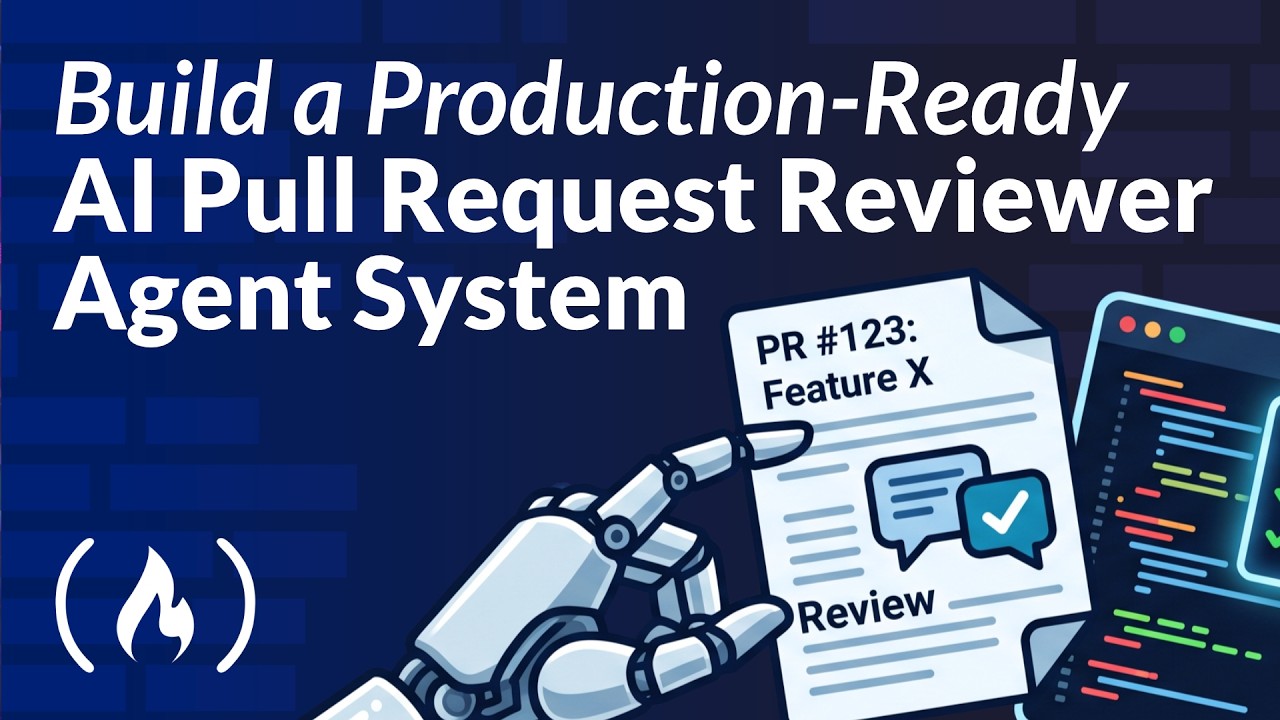
System Design for AI Agents – Building a Multi-Agent PR Reviewer
Keywords
Summary
138 words
Critical Evaluation
Value of the Information & Strength of the Argument
The video offers substantial value by presenting a structured methodology for designing AI agent systems, moving beyond simple prompt-based approaches. The argumentation is solid, grounded in real-world engineering concerns such as failure modes, reliability, and human bottleneck. The instructor effectively argues for a selective, human-in-the-loop design, emphasizing that the goal is not full automation but intelligent augmentation of human reviewers. The reasoning is clear and well-supported with practical examples, making a compelling case for the proposed architecture.
Scientific Rigor, Source Quality, Title Accuracy
The scientific rigor is moderate; while the tutorial is technically sound and well-structured, it lacks formal citations to academic literature or external sources. The primary source is the instructor’s expertise and the Genesis kit repository. The title accurately reflects the content, and the tutorial’s structure with chapters enhances clarity. The content is consistent with established software engineering and AI system design principles, though it would benefit from referencing industry standards or research on multi-agent systems.
167 words
Title / Content Match
The title accurately reflects the content: a detailed system design tutorial for building a multi-agent AI PR reviewer.
Quality & Reliability
8/10
The tutorial provides a comprehensive, systematic approach to designing and building a multi-agent AI system, with clear reasoning about failure modes and reliability engineering. The content is well-structured and grounded in practical engineering principles, though it lacks formal citations and peer-reviewed sources.
Chapters
- Introduction: Building a Production-Ready AI PR Review Agent
- The System Design Lens & Mapping the Mess
- Addressing AI Failure Modes & Reliability Engineering
- Part 1: First Principles & Reclaiming Senior Engineer Attention
- The Four Mindsets of a Reviewer (Security, Quality, Testing, Docs)
- Implementing the Agentic Fan-Out and Fan-In Pattern
- Part 2: Data Engineering & Memory Shapes
- Database Selection
- Part 3: System Architecture Assembly
- Orchestration Engine Selection: LangGraph vs. Temporal
- Part 4: Implementation Using the Genesis Kit
- Running Milestones and Independent AI Code Verification
Cited Sources
- Genesis Kit GitHub Repository — The instructor references the Genesis kit as the AI-native development harness used for implementation.
- freeCodeCamp News — Mentioned as a resource for learning to code and reading programming articles.
- Scrimba — Mentioned as a sponsor and learning platform.
- freeCodeCamp — Mentioned as the main platform for learning to code.
Concurring Sources
- Genesis Kit GitHub Repository — The tutorial's implementation is based on this repository, providing a concrete example of the concepts discussed.
Contribution & Novelties
The tutorial provides a novel contribution by emphasizing a systematic design process for AI agents, focusing on failure modes and reliability engineering. It offers a practical framework for building multi-agent systems with human oversight, which is often overlooked in simpler tutorials. The use of the Genesis kit for AI-native development is a distinctive approach.
Pour aller plus loin :
- Multi-agent systems — Provides foundational concepts on multi-agent architectures.
- Reliability engineering — Relevant to the tutorial’s emphasis on designing for failure.
- LangGraph — A framework for building stateful, multi-agent applications, mentioned in the tutorial.
- Temporal — A workflow orchestration platform, also mentioned in the tutorial.
104 words
Radar Profile
The radar profile shows high scores in quantity of information and technical level, indicating a dense, technical tutorial. Quality of information is also high, but reliability is slightly lower due to lack of formal citations. The overall profile suggests a well-structured, practical guide with strong technical depth.