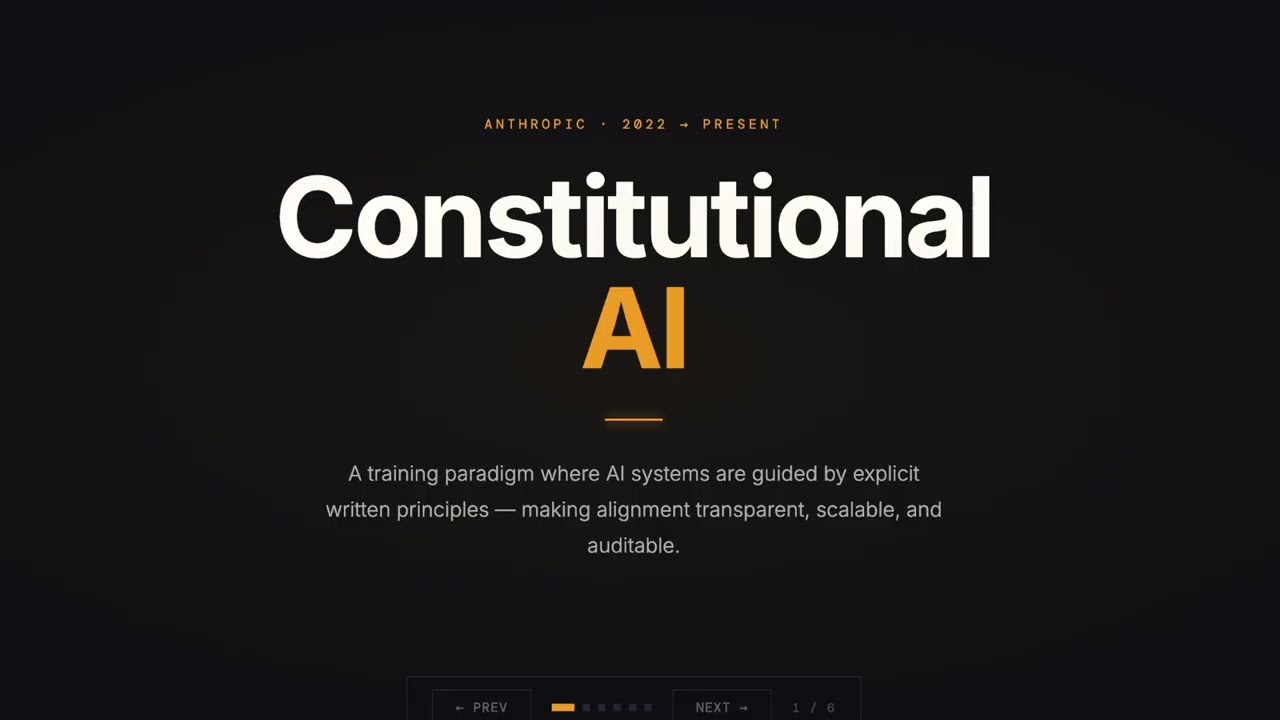
How AI governs itself with a Constitution
Keywords
Summary
177 words
Critical Evaluation
Value of the Information & Strength of the Argument
The video provides a clear and comprehensive explanation of Constitutional AI, breaking down complex concepts into accessible language. It effectively argues for the superiority of this approach over traditional RLHF by highlighting its efficiency, transparency, and ability to avoid evasive behavior. The argumentation is well-structured, using concrete examples from the paper to illustrate key points. The video also addresses potential counterarguments, such as the need for the critique step, and explains the rationale behind design choices. Overall, the information is valuable for anyone interested in AI alignment and safety, and the argumentation is solid and convincing.
Scientific Rigor, Source Quality, Title Accuracy
The video is based on the research paper ‘Constitutional AI: Harmlessness from AI Feedback’ by Anthropic, which is a credible and peer-reviewed source. The video accurately represents the paper’s content and methodology, and it clearly distinguishes between the paper’s findings and its own commentary. The description provides links to the paper’s GitHub repository and the organization’s official channels, which adds to the credibility. The title accurately reflects the content, and the video does not misrepresent the research. The video also mentions the use of chain-of-thought prompting and ablation studies, which are key technical details from the paper. Overall, the scientific rigor is high, and the sources are of good quality.
221 words
Title / Content Match
The title accurately reflects the content, which focuses on how AI can govern itself using a constitution as described in Anthropic's research.
Quality & Reliability
8/10
The video is based on a well-known research paper (Constitutional AI) and provides a detailed, accurate explanation of the methodology. It clearly distinguishes between the paper's content and its own commentary. The description includes links to the paper's GitHub repository and the organization's official channels, enhancing credibility. However, the video is a secondary source and does not provide original experimental data.
Key Moments
Markers derived by PSI from the transcript: the creator did not define chapters.
- Introduction to the concept of Constitutional AI and the problem with traditional RLHF.
- Explanation of the evasive AI problem caused by human risk aversion in RLHF.
- Stage 1: Supervised learning with critique and revision using the constitution.
- Discussion of ablation studies and why the critique step is kept for transparency.
- Stage 2: Reinforcement learning from AI feedback (RLAIF) and the role of chain-of-thought prompting.
- Clarification that AI is not exercising personal morality but following the constitution.
- Evaluation results: ELO scores and examples of improved responses to sensitive prompts.
- Summary of the benefits and implications for scalable AI oversight.
Cited Sources
- Machine Learning Tokyo GitHub — Organization's GitHub repository, likely containing related resources.
- Study Model Behavior GitHub Repository — Repository for the Model Behavior Study Group, possibly containing study materials related to Constitutional AI.
- AI Communities Events on Luma — Events page for AI communities, possibly hosting discussions on AI topics.
- MLT LinkedIn — Company LinkedIn page for MLT Artificial Intelligence.
- MLT Website — Official website of MLT Artificial Intelligence.
Concurring Sources
- Constitutional AI: Harmlessness from AI Feedback (ArXiv) — The original research paper by Anthropic, which the video is based on. It provides the primary source for the claims made in the video.
Contribution & Novelties
The video provides a clear and accessible explanation of Constitutional AI, a novel approach to AI alignment that reduces reliance on human feedback. It highlights the key innovations: using a written constitution for self-critique and revision, and using AI feedback with chain-of-thought prompting for scalable supervision. The video also emphasizes the transparency benefits and the potential for democratizing AI safety. This is a valuable contribution for a general audience interested in understanding cutting-edge AI safety research.
Pour aller plus loin :
- Constitutional AI: Harmlessness from AI Feedback (ArXiv) — The original research paper by Anthropic, providing the technical details and experiments.
- Reinforcement Learning from Human Feedback (RLHF) — Wikipedia article explaining the traditional approach that Constitutional AI aims to improve upon.
- Chain-of-Thought Prompting Elicits Reasoning in Large Language Models (ArXiv) — The paper introducing chain-of-thought prompting, a key technique used in the RLAIF stage.
144 words
Radar Profile
The radar profile shows high scores in information quantity, quality, and technical level, indicating a well-structured and informative video. The fiabilite_globale score is also high, reflecting the credibility of the source material. The video is strong in all dimensions, with no significant weaknesses.
💬 No comments were provided for analysis.