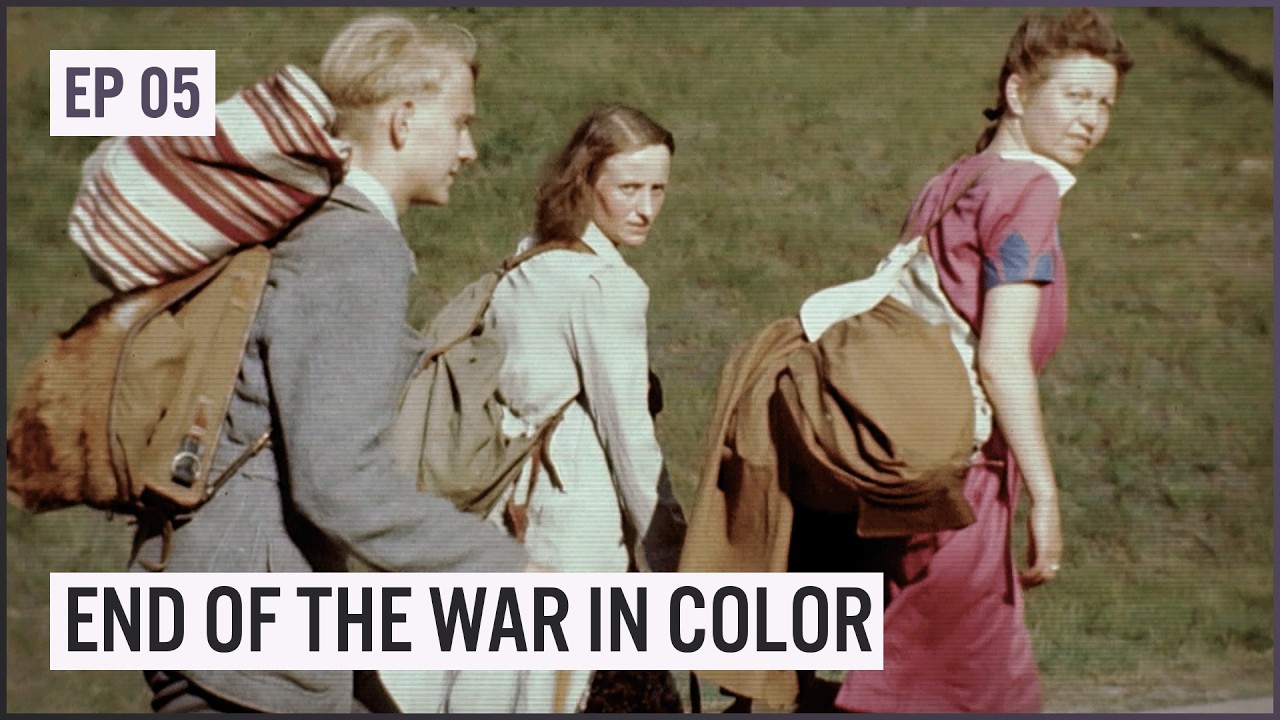
Victors And The Defeated | End Of The War In Color Uncensored Episode 05
Keywords
Summary
178 words
Critical Evaluation
Value of the Information & Strength of the Argument
The documentary provides substantial historical value by presenting rare color footage and personal diary excerpts, which humanize the experience of post-war Berlin. The argumentation is well-structured, weaving together visual evidence, contemporary accounts, and expert narration to build a coherent narrative. However, it sometimes relies on emotional storytelling rather than rigorous analysis, and the lack of explicit sourcing for some claims weakens its scholarly weight. The inclusion of multiple perspectives, including those of Berliners and Allied soldiers, enriches the narrative but could benefit from more critical examination of the sources.
98 words
Title / Content Match
The title accurately reflects the content, focusing on the aftermath of WWII in Berlin and the dynamics between victors and defeated.
Quality & Reliability
8/10
The documentary uses archival footage and diary excerpts, providing a vivid historical account. However, it lacks explicit citations for many claims and relies on narrative interpretation, which slightly reduces its scientific rigor.
Key Moments
Markers derived by PSI from the transcript: the creator did not define chapters.
- Soviet victory parade in Moscow, Stalin overseeing the Red Army.
- Aerial view of Berlin's destruction, statistics on bomb damage.
- Rubble women clearing debris, rationing system explained.
- Visit to Hitler's Reich Chancellery, discussion of his fate.
- Black market at Brandenburg Gate, police efforts.
- British parade, tensions between Allies hinted.
- Arrival of Truman and Churchill for Potsdam Conference.
- Stalin's visit to Truman, start of negotiations.
Cited Sources
- History Hit — Mentioned in the description as a platform for more historical documentaries.
Concurring Sources
- Potsdam Conference — Provides factual background on the conference depicted in the documentary.
Dissenting Sources
- Some viewers question the absence of bomb craters — A commenter noted the lack of visible bomb craters in the footage, suggesting possible editing or filling, which contrasts with the documentary's depiction of destruction.
Contribution & Novelties
This documentary offers a unique visual and personal perspective on post-war Berlin, using colorized archival footage and diary excerpts to bring the era to life. It contributes to the understanding of the immediate post-war period, highlighting the human cost and the political complexities. The focus on women’s experiences and the daily struggle for survival adds a valuable dimension often overlooked in traditional histories.
Pour aller plus loin :
- Potsdam Conference — Overview of the conference and its outcomes.
- Rubble women — Historical context on the women who cleared debris in post-war Germany.
- Ruth Andreas-Friedrich — Information on the diarist whose writings are featured.
103 words
Radar Profile
The radar profile shows high scores in quantity and quality of information, indicating a rich and well-presented documentary. The technical level is moderate, suitable for a general audience, while reliability is good but not perfect due to occasional lack of explicit sourcing.
💬 The comments are generally positive, with viewers appreciating the historical value and sobering content. Some express reflections on war and peace, while a few critique the background music or aspect ratio. Overall, the sentiment is balanced with a slight positive lean.