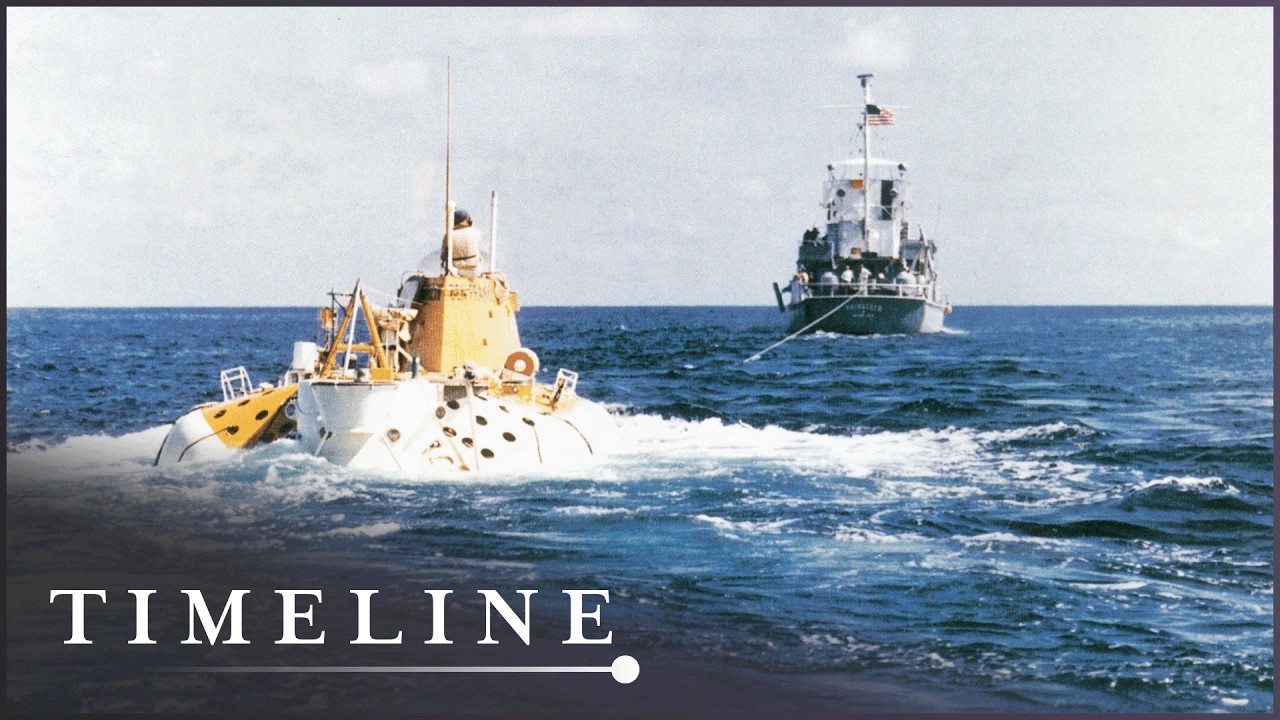
Why Did Nasa Secretly Send 6 Men To The Bottom Of The Ocean In 1969?
Keywords
Summary
183 words
Critical Evaluation
Value of the Information & Strength of the Argument
The documentary provides valuable historical and scientific information about a little-known deep-sea mission. It effectively argues that the PX-15 mission was a significant achievement in ocean exploration, with lasting impacts on both oceanography and space research. The argumentation is solid, supported by expert commentary from marine archaeologist James Delgado and firsthand accounts from crew members. The documentary also addresses technical challenges and solutions, such as the innovative buoyancy control system and the use of portholes, which were initially controversial. However, it could have delved deeper into the scientific results and the mission’s broader implications, and it occasionally sensationalizes the ‘secret’ aspect, which is contradicted by some viewers.
Scientific Rigor, Source Quality, Title Accuracy
The documentary demonstrates scientific rigor by featuring expert commentary, archival footage, and interviews with the actual crew members. The sources cited are primarily the crew members and James Delgado, who are directly involved in the mission’s history. The title’s claim of ‘secretly’ is somewhat misleading, as the mission was not classified but rather overshadowed by the Apollo 11 landing, as noted by several commenters. The documentary does not provide formal citations for its claims, but the use of primary sources and expert testimony enhances its credibility. The adéquation between the title and content is moderate, as the content is accurate but the title exaggerates the secrecy aspect.
229 words
Title / Content Match
The title is somewhat sensationalized, as the mission was not entirely secret but rather overshadowed by the Apollo 11 moon landing. The content does cover the mission in detail, but the 'secretly' aspect is overstated.
Quality & Reliability
8/10
The documentary is produced by a reputable history channel and features a renowned marine archaeologist, James Delgado, who provides expert commentary. It includes archival footage and interviews with surviving crew members, adding authenticity. However, the title's claim of 'secretly' is disputed by some commenters, and the documentary does not provide detailed citations for all claims, slightly reducing the score.
Key Moments
Markers derived by PSI from the transcript: the creator did not define chapters.
- Introduction to the PX-15 mission and its historical significance.
- James Delgado discovers the wreck of the Ben Franklin in a Vancouver shipyard.
- Background on Jacques Piccard and his father Auguste, including the Trieste dive.
- Design and construction of the PX-15, including the innovative buoyancy system.
- Challenges with batteries and portholes, and the christening of the Ben Franklin.
- Launch day and the descent into the Gulf Stream, with initial technical issues.
- Life aboard the submarine, including observations of marine life and the swordfish incident.
- The crew's reaction to the Apollo 11 moon landing and the development of Velcro darts.
- Encounter with underwater waves and the temporary loss of position.
- Recovery and restoration of the submarine, and the reunion of the crew.
Cited Sources
- History Hit membership — Mentioned in the video description as a way to access more documentaries.
Concurring Sources
- Comment by user on the mission's routine nature — A commenter noted that by 1969, US Navy submarines had already conducted longer submerged missions, suggesting the mission was not unique in terms of endurance.
Dissenting Sources
- Comment disputing the 'secret' label — Several commenters pointed out that the mission was not secret but rather overshadowed by the Apollo 11 landing, contradicting the documentary's framing.
Contribution & Novelties
The documentary brings to light a relatively obscure but significant chapter in ocean exploration, providing a detailed account of the PX-15 mission and its contributions to science and space research. It offers unique insights from the crew and experts, and highlights the mission’s role in developing technologies and techniques later used in space programs.
Pour aller plus loin :
- Jacques Piccard — Background on the explorer and his contributions.
- Mesoscaphe — Explanation of the type of submersible used.
- Gulf Stream — Information on the ocean current studied during the mission.
- Skylab — NASA’s space station that benefited from the mission’s findings on isolation.
103 words
Radar Profile
The radar profile shows high scores in quantity and quality of information, with a slightly lower score in technical level, indicating a documentary that is informative and reliable but not overly technical. The overall fiabilité is high, reflecting the use of expert sources and archival material.
💬 Positif. Sur les 30 commentaires analysés, la majorité exprime de l'intérêt et de l'appréciation pour le documentaire, avec quelques critiques sur le titre et des précisions techniques.