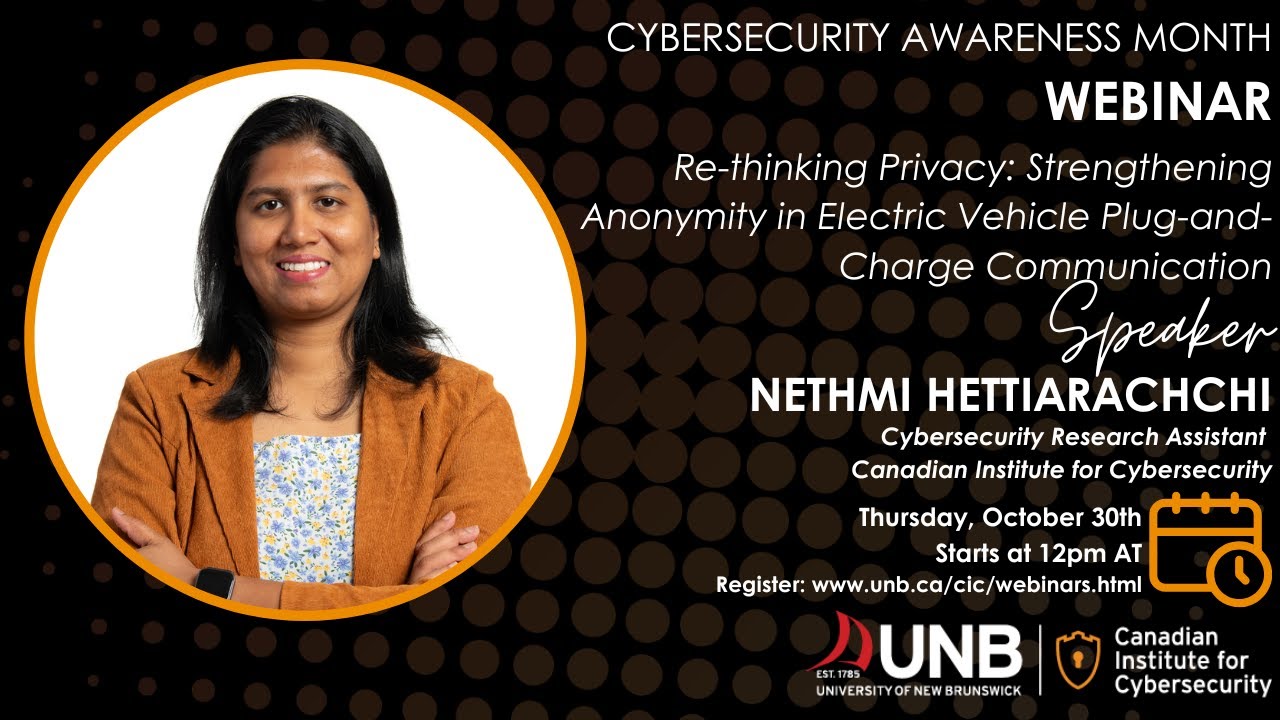
Re-thinking Privacy: Strengthening Anonymity in Electric Vehicle Plug-and-Charge Communication
Keywords
Summary
157 words
Critical Evaluation
Value of the Information & Strength of the Argument
The presentation provides valuable insights into a niche but growing area of cybersecurity: EV charging privacy. It clearly articulates the privacy gaps in the widely adopted ISO 15118 standard, supported by real-world attack examples. The proposed protocol is a significant contribution, offering a practical solution that balances privacy with efficiency. The argumentation is well-structured, moving from background to problem statement to solution, and is backed by formal verification and implementation results. The speaker’s expertise and the publication of the work in a peer-reviewed conference enhance its credibility.
Scientific Rigor, Source Quality, Title Accuracy
The presentation demonstrates scientific rigor through the use of formal verification (Tamarin prover) and implementation on testbeds. The speaker references real-world incidents, such as the 2023 ransomware attack and the 2025 data breach at Digital Charging Solutions, to underscore the urgency. However, specific sources for these incidents are not cited in the video or description. The title accurately reflects the content, focusing on rethinking privacy and strengthening anonymity in EV PnC communication. The description provides links to the institute’s website and social media, but no direct references to the research paper or related publications are included.
198 words
Title / Content Match
The title accurately reflects the content, which focuses on enhancing anonymity in EV plug-and-charge communication.
Quality & Reliability
8/10
The presentation is based on original research published in a peer-reviewed conference (SECRYPT 2025) and formally verified with Tamarin prover. The speaker is a PhD candidate with relevant expertise. However, the webinar format and limited public scrutiny of the specific claims reduce the score slightly.
Chapters
- Intro & welcome
- Topic overview
- Speaker intro
- Presentation begins
- Nethmi’s background
- Agenda
- EV market growth
- EV types overview
- Charging connector types
- EV communication methods
- Plug‑and‑charge communication
- EV–charger protocols (ISO 15118)
- E‑mobility architecture
- How authentication works
- Certificate & key flow
- Why security matters in EV charging
- Real‑world EV charging attacks
- Introducing the research problem
- Research contributions
- Privacy gaps in ISO 15118
- Attack scenarios
- Privacy requirements
- Proposed anonymous protocol
- Protocol flow explained
- Challenge–response & key agreement
- Testbed implementation
- Results & cipher performance
- Conclusion & key takeaways
- Q&A begins
- Motivation for researching EV privacy
- Closing remarks & sign‑off
Cited Sources
- Canadian Institute for Cybersecurity Blog — Mentioned as a resource for staying connected with the institute.
- Canadian Institute for Cybersecurity Facebook — Social media link provided in the description.
- Canadian Institute for Cybersecurity LinkedIn — Social media link provided in the description.
- Canadian Institute for Cybersecurity Website — Official website of the institute.
- CIC Webinar Series Introduction — Referenced as a promotional video for the institute.
Concurring Sources
- ISO 15118-2:2014 — The standard that defines Plug-and-Charge communication, which is the focus of the research.
- Tamarin Prover — Tool used for formal verification of the proposed protocol.
Contribution & Novelties
The webinar presents original research that addresses a critical privacy gap in the ISO 15118 standard. The proposed anonymous authentication and billing protocol is a novel contribution, offering a lightweight solution suitable for resource-constrained environments. The formal verification using Tamarin prover adds rigor, and the implementation on testbeds demonstrates practical feasibility. This work advances the field of EV charging security and privacy.
Pour aller plus loin :
- ISO 15118-2:2014 — The standard for vehicle-to-grid communication interface, providing the basis for Plug-and-Charge.
- Tamarin Prover — A tool for formal verification of security protocols, used to verify the proposed protocol.
- Privacy by Design — A framework for embedding privacy into system design, relevant to the proposed approach.
115 words
Radar Profile
The radar profile shows high scores in information quantity and quality, with slightly lower technical depth and reliability. This indicates a well-structured presentation with solid content, but the technical level may be accessible to a broader audience, and the reliability is based on the speaker's expertise and published research.
💬 Sur les 0 commentaires analysés, aucune tendance n'est disponible.