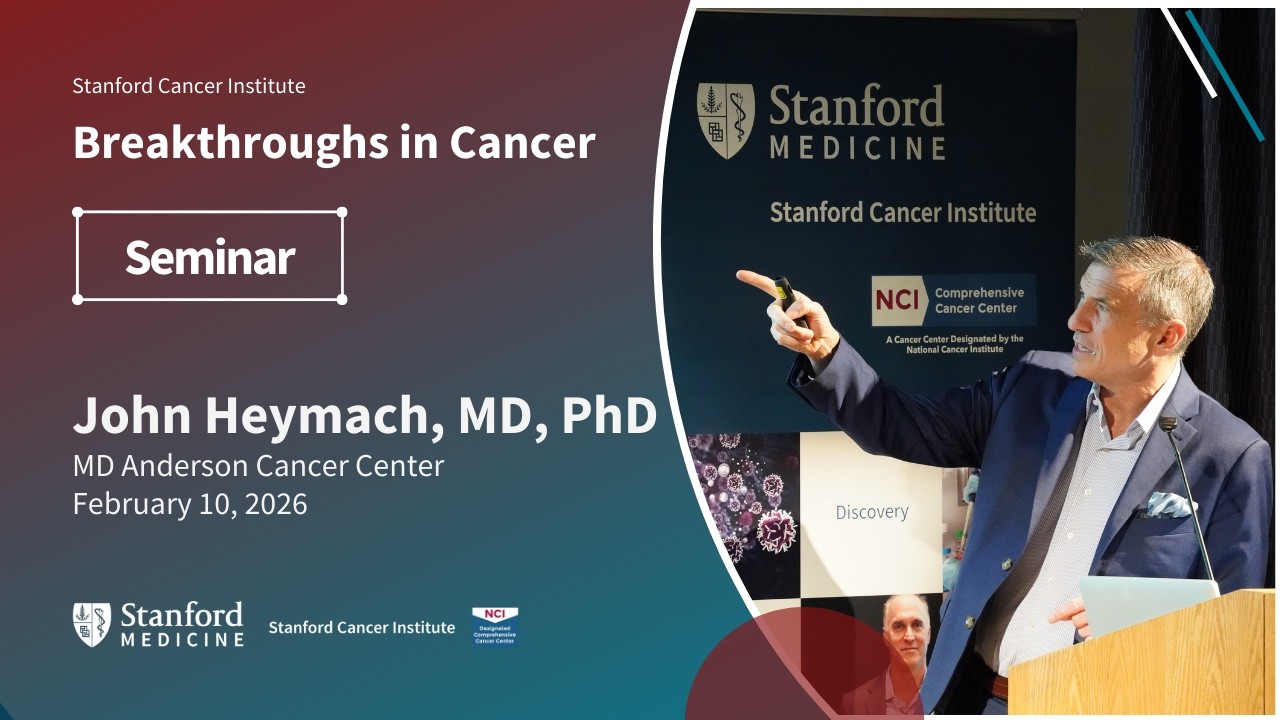
Stanford Cancer Institute Breakthroughs in Cancer: John Heymach, MD, PhD
Keywords
Summary
193 words
Critical Evaluation
Value of the Information & Strength of the Argument
The talk provides high-value information, presenting a novel classification system for EGFR mutations that has direct clinical implications. The argumentation is solid, supported by preclinical data from large-scale drug screening and clinical observations. The speaker effectively uses historical context and concrete examples to illustrate the need for a paradigm shift. The proposed structure-function classification is a significant contribution that could guide future drug development and treatment decisions.
76 words
Title / Content Match
The title accurately reflects the content, which focuses on moving beyond driver oncogenes to new paradigms for personalizing lung cancer therapies.
Quality & Reliability
9/10
Presentation by a leading physician-scientist at a top-tier institution, with detailed data from clinical trials and preclinical studies. The talk is based on peer-reviewed research and ongoing clinical experience, though it is a seminar presentation rather than a formal peer-reviewed publication.
Key Moments
Markers derived by PSI from the transcript: the creator did not define chapters.
- Introduction by Heather Wakeley
- Talk begins: Beyond Driver Oncogenes
- Historical context: chemotherapy era and limited progress
- Current landscape: driver oncogenes and targeted therapy success
- Heterogeneity within EGFR mutations and limitations of current classification
- Structure-function classification of EGFR mutations
- PACK mutations and response to second-generation TKIs
- Audience Q&A
Cited Sources
- Stanford Cancer Institute — Institution hosting the seminar
- Breakthroughs in Cancer seminar series — Seminar series information
- Stanford Cancer Institute LinkedIn — Social media page
Concurring Sources
- Stanford Cancer Institute — Institution hosting the seminar
Contribution & Novelties
The talk presents a novel structure-function classification of EGFR mutations based on drug sensitivity, which could improve treatment selection and guide drug development. This is a significant advance over the traditional exon-based classification.
Pour aller plus loin :
- EGFR mutations in lung cancer — Overview of EGFR and its role in cancer.
- Tyrosine kinase inhibitors — Background on the drug class used in targeted therapy.
- Osimertinib — Third-generation EGFR TKI discussed in the talk.
74 words
Radar Profile
The radar profile shows high scores across all dimensions, indicating a well-rounded and reliable presentation. The talk excels in information quantity and quality, with a strong technical level and high reliability.