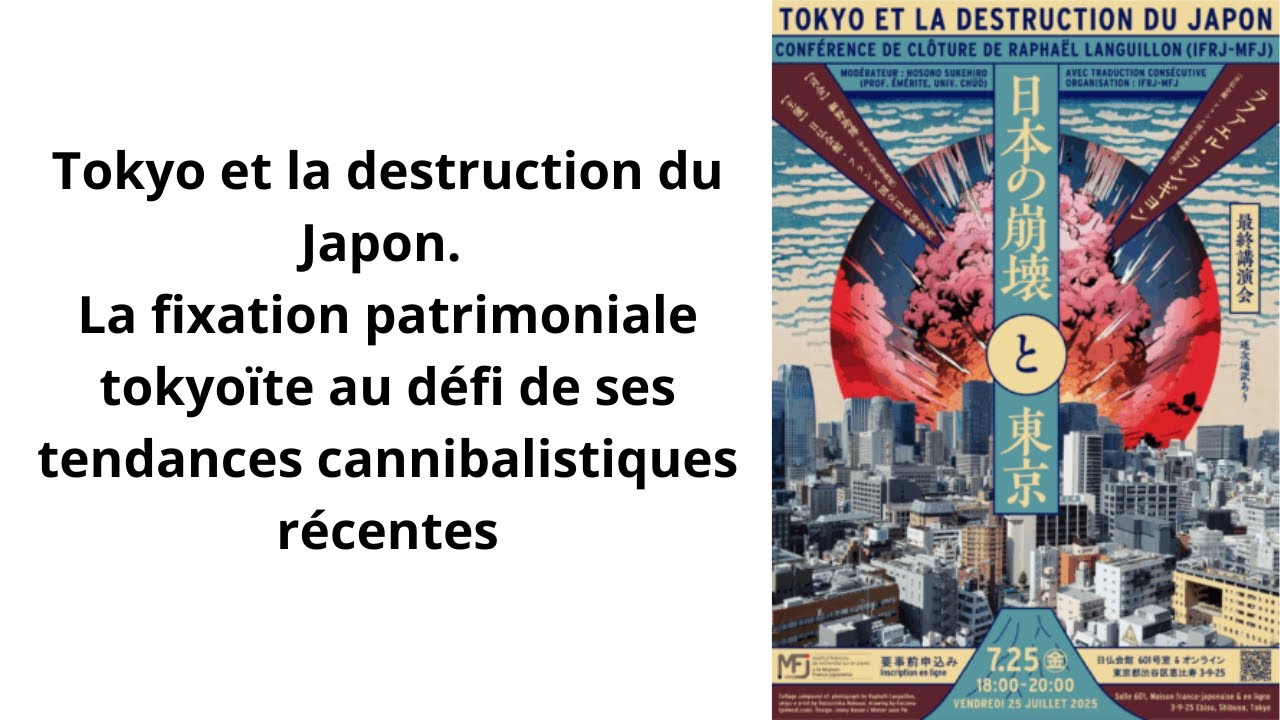
Tokyo et la destruction du Japon
Keywords
Summary
164 words
Critical Evaluation
Value of the Information & Strength of the Argument
The lecture offers a high-value, original theoretical contribution by proposing the concept of ‘patrimonial fixation’ to understand the relationship between urban planning and political regimes. The argument is well-structured, moving from historical analysis to contemporary policy, and is supported by references to established scholars like David Harvey and Henri Lefebvre. The speaker effectively weaves together economic, political, and spatial dimensions, providing a compelling narrative. However, the argumentation is largely interpretive and relies on a selective reading of history, which may not convince all scholars. The lack of empirical data and the broad generalizations about ‘cannibalistic accumulation’ could be seen as oversimplifications, but the overall coherence and intellectual rigor make it a valuable contribution to urban studies.
Scientific Rigor, Source Quality, Title Accuracy
The speaker demonstrates strong scientific rigor by grounding his arguments in academic literature, citing works by David Harvey, Henri Lefebvre, and Jean-Jacques Rousseau. He also references specific historical events and policies, such as the Plaza Accords and the 2002 Urban Renaissance Special Measures Law. The sources are credible and relevant, though the lecture does not provide a systematic review of literature. The title accurately reflects the content, and the subtitle adds depth. The speaker’s credentials and the institutional context (French Research Institute on Japan) enhance the reliability. However, the lecture is an opinion piece rather than a peer-reviewed study, so the claims should be considered as expert interpretation rather than established fact.
243 words
Title / Content Match
The title accurately reflects the core thesis: Tokyo's urban development as a destructive force on the rest of Japan. The subtitle adds nuance about 'patrimonial fixation' and 'cannibalistic tendencies'.
Quality & Reliability
8/10
The lecture is delivered by a recognized expert (geographer, PhD in planning) and presents a novel theoretical framework grounded in established literature (Marx, Rousseau, Harvey). The argument is structured and supported by historical and economic data, though it remains an interpretive essay rather than a peer-reviewed study.
Key Moments
Markers derived by PSI from the transcript: the creator did not define chapters.
- Introduction and acknowledgments by the director of IFRJ
- Speaker's introduction and personal connection to Tokyo
- Historical overview of Edo and its role as a military rear base
- Conceptual introduction of 'patrimonial fixation' and its theoretical foundations
- Analysis of the 1980s bubble economy and the Plaza Accords
- Discussion of urban renaissance policies and 'cannibalistic accumulation'
Cited Sources
- David Harvey, The Limits to Capital — Referenced for concepts of capital shift and spatial fix
- Henri Lefebvre, The Production of Space — Referenced for the role of space in social contracts
- Jean-Jacques Rousseau, The Social Contract — Referenced for the spatial dimension of social contracts
Concurring Sources
- David Harvey, The Limits to Capital — Supports the concept of spatial fix
- Henri Lefebvre, The Production of Space — Supports the idea of space as a social product
Dissenting Sources
- Mainstream urban economics — May view Tokyo's growth as a natural agglomeration effect rather than a destructive force
Contribution & Novelties
The lecture’s main contribution is the introduction of the concept of ‘patrimonial fixation’ (fixation patrimoniale), which synthesizes neo-Marxist and neo-contractualist approaches to explain how urban planning stabilizes political regimes. This offers a novel framework for understanding Tokyo’s development and its impact on Japan. The speaker also proposes the idea of ‘cannibalistic accumulation’ to describe the late-capitalist phenomenon where a city’s growth consumes the resources of the nation.
Pour aller plus loin :
- David Harvey, The Limits to Capital — Foundational text for understanding spatial fix and capital shift.
- Henri Lefebvre, The Production of Space — Key work on the social production of space.
- Jean-Jacques Rousseau, The Social Contract — Theoretical basis for the contractualist perspective.
115 words
Radar Profile
The radar profile shows high scores in information quantity, quality, and technical level, indicating a dense and well-argued lecture. The reliability score is also high, reflecting the speaker's expertise and use of established theories. The overall profile suggests a highly informative and intellectually stimulating presentation.
💬 Sur les 0 commentaires analysés, aucune tendance n'a pu être dégagée.