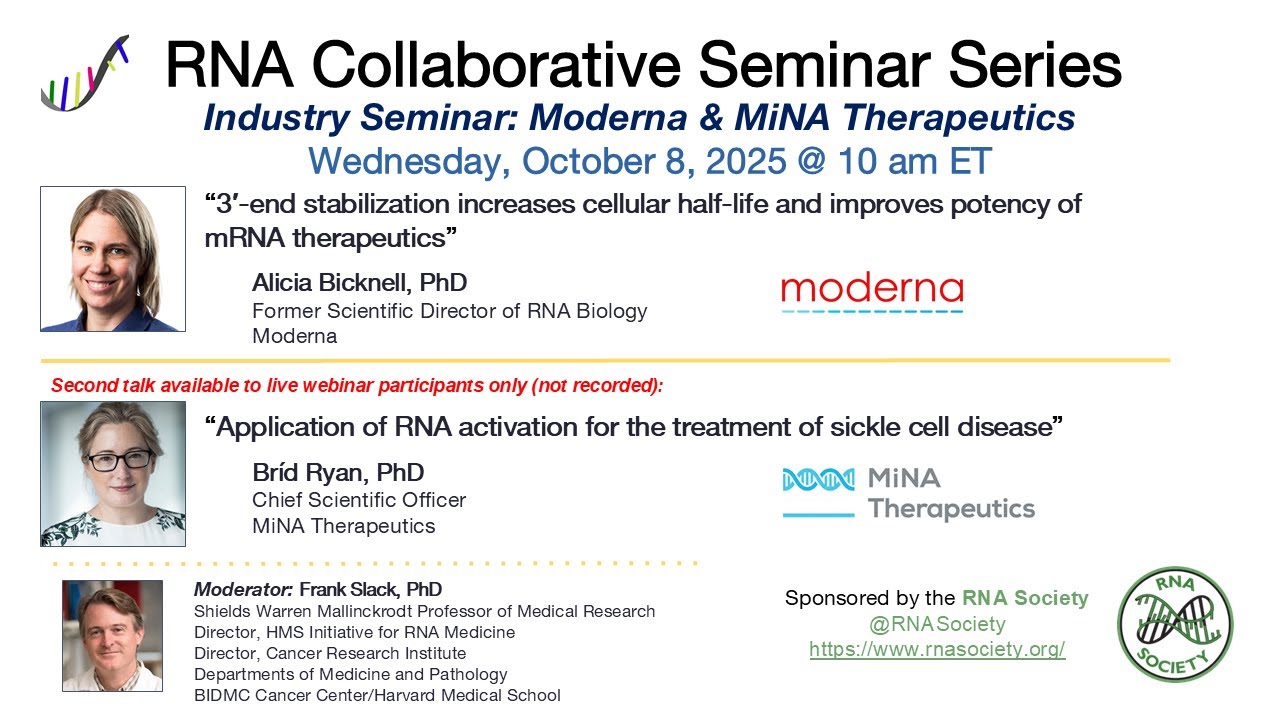
October 8: Moderna & MiNA Therapeutics
Keywords
Summary
160 words
Critical Evaluation
Value of the Information & Strength of the Argument
The talk provides valuable insights into mRNA degradation mechanisms and a practical solution to improve mRNA therapeutics. The argumentation is solid, based on systematic experiments with two well-designed mRNA pools. The correlation between deadenylation rate and RNA half-life is convincingly demonstrated, and the IDT modification is shown to be effective. The discussion of translation’s role in deadenylation is well-supported by ribosome profiling and initiation rate measurements. However, some aspects, such as the exact mechanism of residual degradation, remain unresolved, and the presentation is limited to one speaker’s work.
Scientific Rigor, Source Quality, Title Accuracy
The scientific rigor is high, with detailed experimental methods and data. The sources cited are primarily the speaker’s own work and collaboration with Eugene Valkov’s lab, but no specific publications are mentioned. The title is accurate but incomplete, as it omits the fact that only the Moderna talk is shown. The content is well-structured and technically sound, but the lack of peer-reviewed references and the limited public availability of the full data slightly reduce the reliability score.
180 words
Title / Content Match
The title is accurate but incomplete; it mentions both Moderna and MiNA Therapeutics, but only the Moderna talk is shown.
Quality & Reliability
8/10
The talk presents original research from a scientist at Moderna, with detailed methodology and data. The findings are plausible and align with known mechanisms of mRNA degradation, but the lack of peer-reviewed publication details and the limited public availability of the full data reduce the score.
Key Moments
Markers derived by PSI from the transcript: the creator did not define chapters.
- Introduction by Frank Slack and speaker introduction
- Overview of mRNA therapeutics and degradation challenges
- Design of two mRNA pools to study degradation
- Measurement of RNA half-lives and deadenylation rates
- Development of 3' IDT modification and in vitro validation
- In vivo effects of IDT on protein expression
- Relationship between translation and deadenylation
- Q&A session and concluding remarks
Cited Sources
- Moderna Therapeutics — The speaker's former employer and the context of the research.
- Eugene Valkov Lab at NCI — Collaboration for in vitro deadenylation assays.
Concurring Sources
- Moderna Therapeutics — The company's research aligns with the presented work.
Contribution & Novelties
The talk presents a novel 3’ inverted deoxythymidine (IDT) modification that stabilizes mRNA against deadenylation, extending half-life and protein expression. It also provides insights into the relationship between translation and deadenylation, showing that initiation rate is a key determinant. This work could improve the potency and duration of mRNA therapeutics.
Pour aller plus loin :
- mRNA degradation pathways — Overview of mRNA decay mechanisms.
- Deadenylation — Detailed description of the deadenylation process.
- mRNA therapeutics — Background on mRNA-based drugs.
79 words
Radar Profile
The radar profile shows high scores in information quantity, quality, and technical level, with slightly lower reliability due to the lack of peer-reviewed sources. The overall balance indicates a technically strong presentation with minor limitations in source verification.
💬 No comments were provided for analysis.