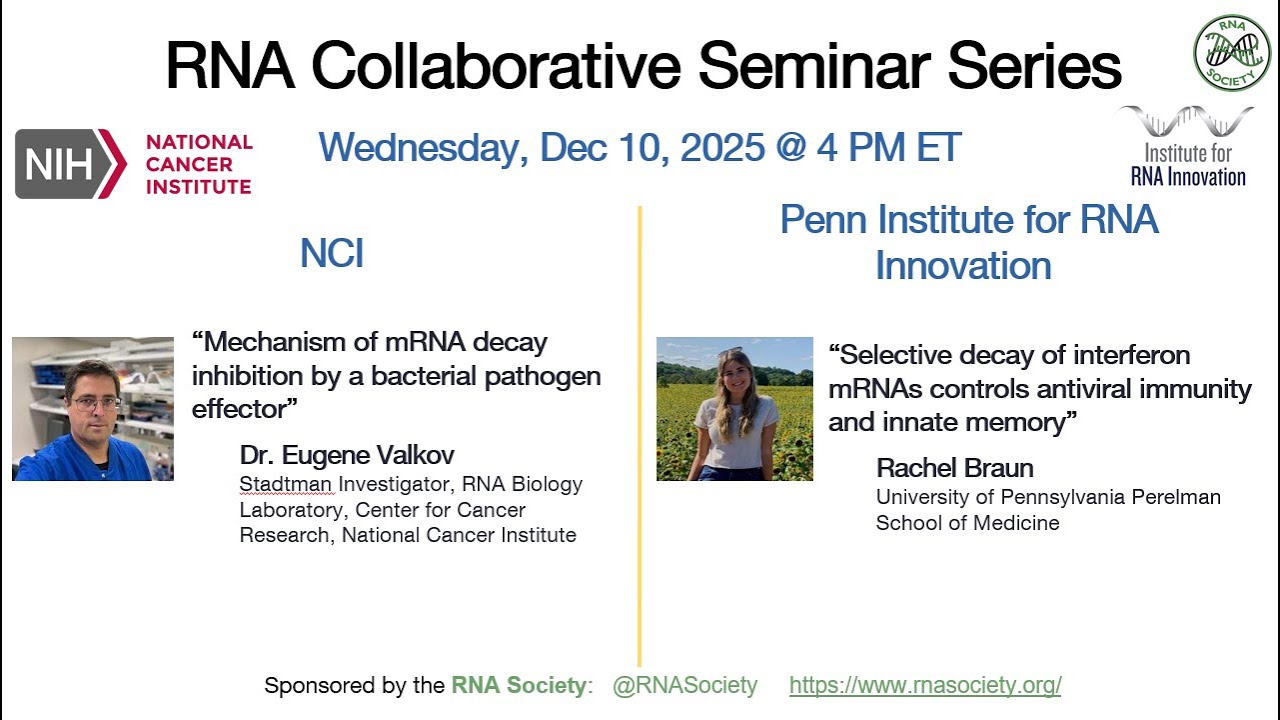
December 10: NCI RNA Biology Initiative & Penn Institute for RNA Innovation
Keywords
Summary
120 words
Critical Evaluation
Value of the Information & Strength of the Argument
The first talk provides a compelling mechanistic story, combining structural biology, biochemistry, and cellular assays to demonstrate a novel mechanism of mRNA decay inhibition. The argumentation is strong, with clear experimental evidence and logical progression. The second talk is more preliminary but presents an interesting hypothesis with supporting data. Both talks are well-structured and provide valuable insights into mRNA regulation.
Scientific Rigor, Source Quality, Title Accuracy
The seminar is scientifically rigorous, with detailed methods and references to published work. The speakers are established researchers, and the content aligns with the title. The sources cited are appropriate and include primary literature. The title accurately reflects the seminar’s content.
116 words
Title / Content Match
The title accurately reflects the content, which is a collaborative seminar featuring two talks on RNA biology.
Quality & Reliability
8/10
The seminar presents original research from two labs, with detailed experimental data and references to published work. The content is technical and appears scientifically rigorous, though not peer-reviewed in this format.
Key Moments
Markers derived by PSI from the transcript: the creator did not define chapters.
- Introduction by Pedro Batista, welcoming attendees and introducing the seminar series.
- Eugene Valkov begins his talk on Legionella effector and mRNA decay inhibition.
- Valkov describes the identification of the effector interacting with CNOT7.
- Structural analysis reveals the mechanism of inhibition.
- Cellular experiments show that the effector phenocopies CNOT7 dominant-negative mutant.
- Discussion on why Legionella manipulates the cell cycle.
- Rachel Braun begins her talk on selective decay of interferon mRNAs.
- Braun presents data on deadenylation of interferon mRNAs during SARS-CoV-2 infection.
Cited Sources
- RNA Collaborative Seminar Series — Official page for the seminar series, providing context and sponsorship information.
Concurring Sources
- RNA Collaborative Seminar Series — The seminar series is sponsored by the RNA Society, aligning with the content.
Contribution & Novelties
The seminar presents novel findings on mRNA decay regulation. The first talk identifies a bacterial effector that specifically inhibits CNOT7, revealing a new mechanism of host-pathogen interaction. The second talk uncovers selective deadenylation of interferon mRNAs, linking mRNA decay to antiviral immunity. These contributions advance understanding of mRNA regulation and its role in disease.
Pour aller plus loin :
- CCR4-NOT complex — Overview of the complex and its role in mRNA decay.
- Legionella pneumophila — Background on the pathogen and its effector proteins.
- Interferon — Key cytokines in antiviral immunity, relevant to the second talk.
95 words
Radar Profile
The radar profile shows high scores in technical level and information quality, reflecting the advanced scientific content. The lower score in information quantity is due to the seminar's focused scope. Overall, the profile indicates a highly specialized and reliable presentation.
💬 No comments were provided for analysis.