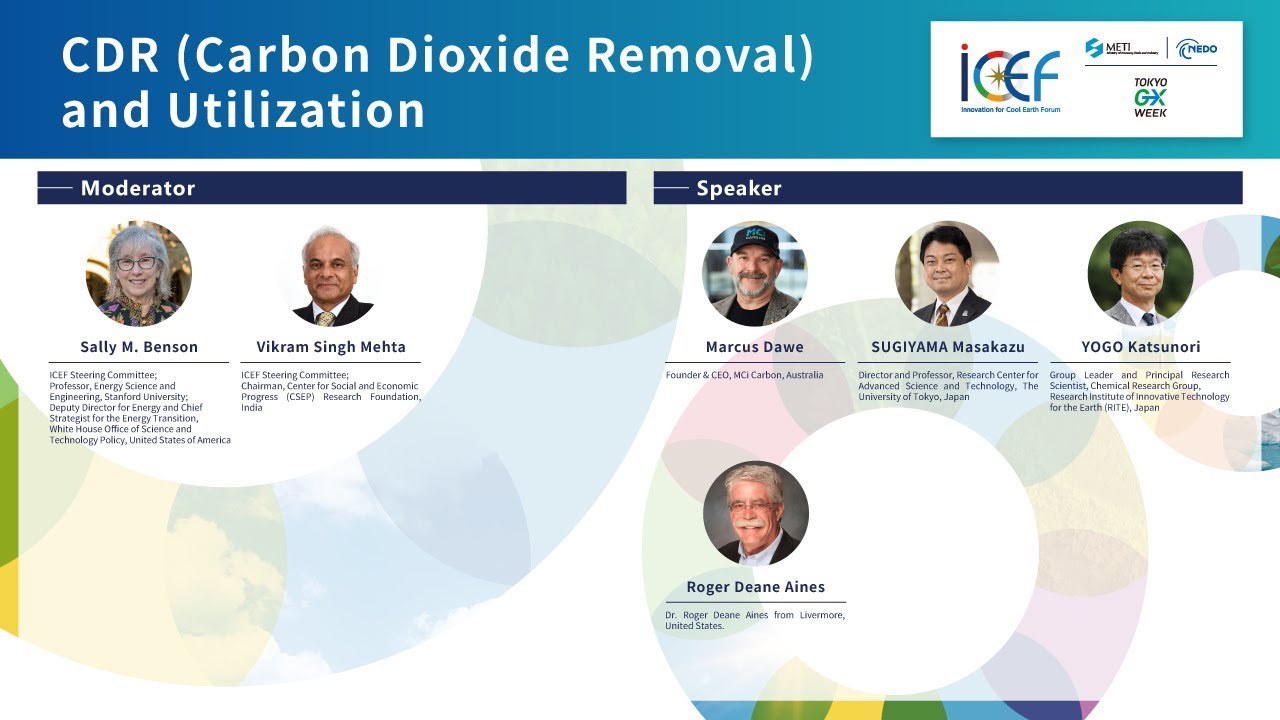
ICEF2025 | CDR (Carbon Dioxide Removal) and Utilization
Keywords
Summary
174 words
Critical Evaluation
Value of the Information & Strength of the Argument
The session provides valuable insights into the current state and future directions of CDR and CCU technologies. Each panelist brings concrete examples and data: Yogo details RITE’s DAC process and cost estimates ($300-600 per ton), Dawe highlights MCi Carbon’s commercial partnerships and the importance of creating valuable products, Sugiyama proposes an innovative building-integrated approach, and Aines offers market analysis with 790 companies and $10 billion in contracted removals. The argumentation is solid, grounded in practical experience and market trends. The discussion on the green premium and the necessity of cost reduction is particularly relevant. The panel effectively argues that while direct emission reduction is a priority, CDR is essential for addressing residual emissions and achieving net zero. The emphasis on MRV and the net flux framework adds rigor to the discussion.
Scientific Rigor, Source Quality, Title Accuracy
The session demonstrates high scientific rigor through the expertise of the panelists and their references to ongoing projects and international frameworks. While no formal citations are provided, the speakers reference IPCC reports, COP26 recognition, and Article 6 of the Paris Agreement, indicating alignment with established scientific and policy consensus. The title accurately reflects the content, which focuses on CDR and utilization technologies and their implementation. The discussion is well-structured, covering technical, economic, and policy aspects. The panelists are transparent about challenges, such as cost, scalability, and verification. Overall, the sources and arguments are credible and relevant.
242 words
Title / Content Match
The title accurately reflects the session's focus on carbon dioxide removal and utilization, with presentations and discussion covering technologies, economics, and policy.
Quality & Reliability
8/10
Panel of recognized experts from RITE, MCi Carbon, University of Tokyo, and Lawrence Livermore National Laboratory. Content is technical, grounded in ongoing projects and market data. No formal citations but references to IPCC, COP26, and Article 6 of Paris Agreement. High credibility due to institutional affiliations and practical experience.
Key Moments
Markers derived by PSI from the transcript: the creator did not define chapters.
- Yogo Katsunori presents RITE's DAC technology and demonstration at Osaka Expo.
- Marcus Dawe introduces MCi Carbon's CO2-to-materials technology and Myrtle plant.
- Masakazu Sugiyama proposes building-integrated CO2 capture and conversion.
- Roger Aines discusses market landscape, 790 companies, and importance of acceptability.
- Panel discussion on scaling to gigaton levels, cost reduction, and supply chain challenges.
- Discussion on green premium and economics of CDR utilization.
- Panel addresses balance between CDR and direct emission reduction.
Cited Sources
- IPCC Sixth Assessment Report — Referenced by moderator Sally Benson as concluding that CDR is necessary to achieve net zero emissions.
- COP26 — Mentioned by Marcus Dawe as the event where MCi Carbon was named number one clean technology.
- Paris Agreement Article 6 — Referenced by Roger Aines in context of international carbon trading mechanisms.
Concurring Sources
- IPCC Special Report on Global Warming of 1.5°C — Supports the necessity of CDR for achieving net zero emissions.
- IEA Net Zero by 2050 Roadmap — Provides scenarios for CDR scale-up and technology development.
Dissenting Sources
- Critiques of CDR scalability — Some studies question the feasibility of scaling CDR to required levels due to energy, land, and cost constraints.
Contribution & Novelties
The session provides a comprehensive overview of CDR and CCU technologies, highlighting recent innovations and market developments. Notable contributions include RITE’s solid sorbent DAC process with low-temperature regeneration, MCi Carbon’s mineralization approach for construction materials, and Sugiyama’s concept of building-integrated artificial photosynthesis. The discussion on the net flux framework and MRV challenges adds a critical perspective on ensuring the integrity of carbon removal claims. The emphasis on supply chain heterogeneity and the need for market acceptability provides a pragmatic view of scaling challenges.
Pour aller plus loin :
- Direct air capture — Overview of DAC technologies and challenges.
- Carbon mineralization — Explanation of CO2 mineralization processes.
- Carbon dioxide removal — Comprehensive overview of CDR methods and context.
- Article 6 of the Paris Agreement — Details on international carbon trading mechanisms.
130 words
Radar Profile
The radar profile shows high scores in information quantity, quality, and reliability, with a slightly lower technical level due to the panel's focus on practical applications and market dynamics rather than deep technical details. The overall balance indicates a highly informative and credible session.
💬 No comments were provided for analysis.