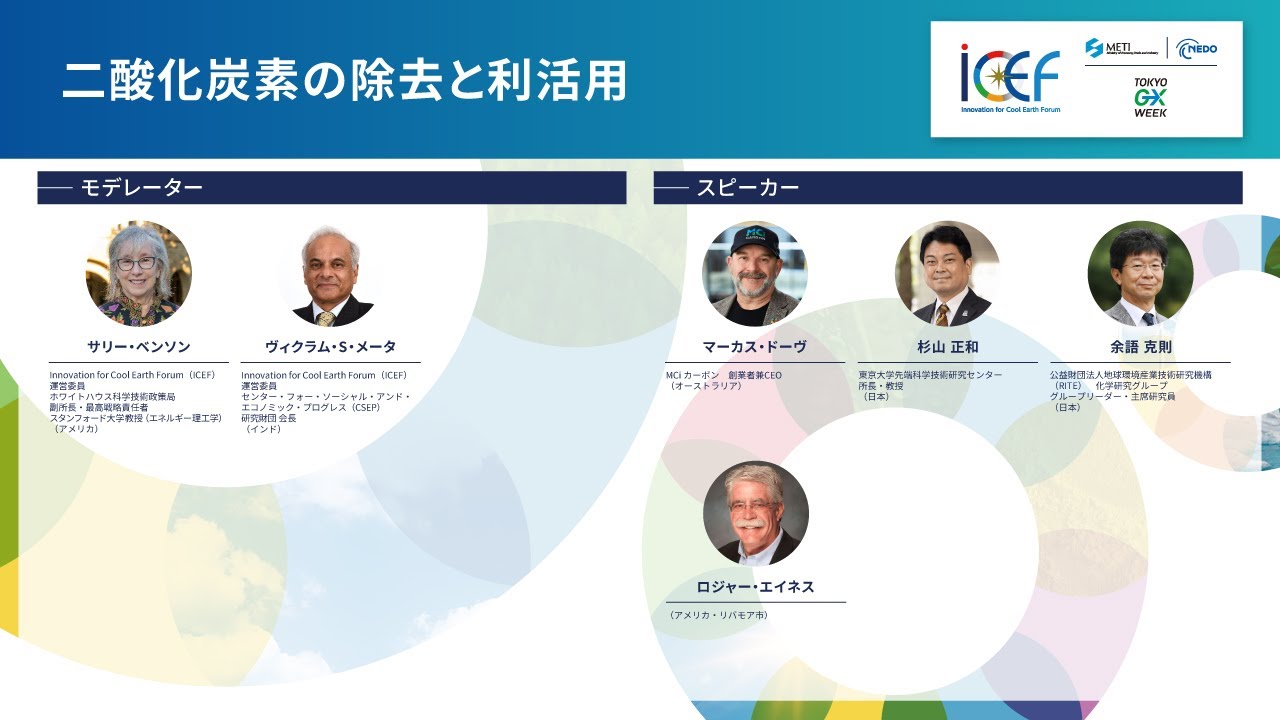
ICEF2025 | 二酸化炭素の除去と利活用
Keywords
Summary
188 words
Critical Evaluation
Value of the Information & Strength of the Argument
The video provides valuable insights into the current state and future directions of CDR and CCU technologies. The speakers present concrete examples of pilot projects and commercial efforts, such as RITE’s DAC plant and MCi Carbon’s materials production. The argumentation is generally solid, with speakers acknowledging challenges like cost and scalability. However, some presentations are more promotional than analytical, and the discussion lacks deep technical detail. The panel offers a balanced view on the need for both emissions reductions and CDR, and highlights the importance of a portfolio approach.
Scientific Rigor, Source Quality, Title Accuracy
The scientific rigor is moderate. The speakers are experts in their fields, and the content is based on ongoing research and projects. However, specific sources and citations are not provided in the video, and the discussion is more of a high-level overview than a detailed scientific analysis. The title accurately reflects the content. The video does not include a promotional segment.
165 words
Title / Content Match
The title accurately reflects the content, which focuses on carbon dioxide removal and utilization.
Quality & Reliability
7/10
The video features expert speakers from RITE, MCi Carbon, University of Tokyo, and Lawrence Livermore National Laboratory, discussing CDR and CCU technologies. The content is based on current research and pilot projects, but lacks detailed citations and peer-reviewed references. The discussion is balanced and acknowledges uncertainties, but the lack of verifiable sources and the promotional nature of some presentations slightly reduce the reliability score.
Key Moments
Markers derived by PSI from the transcript: the creator did not define chapters.
- Yogo Katsunori (RITE) presents DAC pilot plant at Osaka Expo.
- Marcus Dawe (MCi Carbon) introduces CO2 mineralization technology.
- Masakazu Sugiyama (University of Tokyo) proposes building-integrated CO2 capture.
- Roger Aines (LLNL) discusses CDR market and need for demand.
- Discussion on scaling up CDR technologies and cost reduction.
- Panel discusses role of CDR vs emissions reductions.
- Audience Q&A on agricultural transformation and CDR.
Cited Sources
- IPCC Sixth Assessment Report — Mentioned as basis for need for CDR.
- RITE (Research Institute of Innovative Technology for the Earth) — Yogo's institution, DAC pilot project.
- MCi Carbon — Marcus Dawe's company, CO2 mineralization.
- University of Tokyo — Sugiyama's institution.
- Lawrence Livermore National Laboratory — Aines' institution.
Concurring Sources
- IPCC AR6 Synthesis Report — Supports need for CDR.
Dissenting Sources
- None — No discordant sources mentioned.
Contribution & Novelties
The video provides a current snapshot of CDR and CCU technologies, highlighting pilot projects and market trends. It emphasizes the need for a portfolio approach and the importance of building demand and trust. The discussion on building-integrated CO2 capture is a novel concept.
Pour aller plus loin :
- Direct Air Capture — Overview of DAC technology.
- Carbon mineralization — Process of converting CO2 into stable minerals.
- Paris Agreement Article 6 — Framework for international carbon markets.
76 words
Radar Profile
The radar profile shows high scores in quantity of information and technical level, with moderate scores in quality and reliability. This indicates a content-rich video with expert input, but lacking in-depth citations and rigorous scientific verification.
💬 No comments provided.