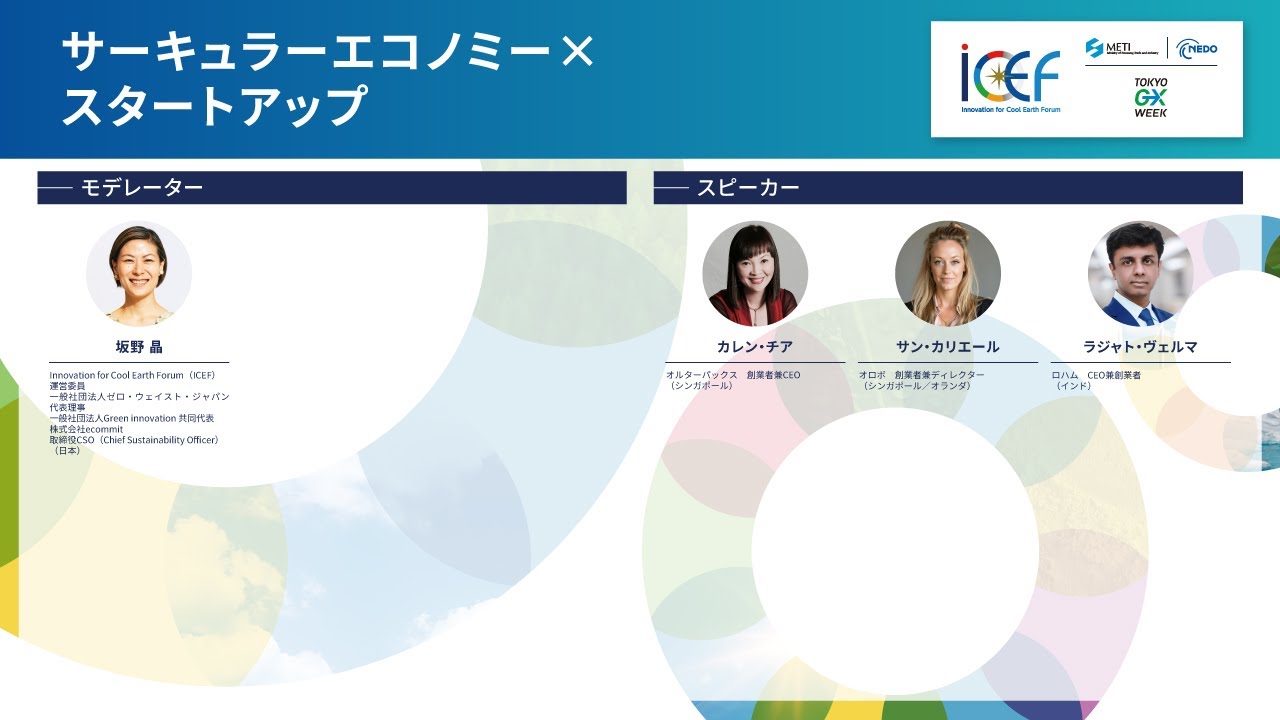
ICEF2025 | Circular Economy × Startups
Keywords
Summary
121 words
Critical Evaluation
Value of the Information & Strength of the Argument
The panel provides valuable insights from practitioners in the circular economy space. Each founder presents their business model and the challenges they face, offering concrete examples of how startups are addressing waste and resource efficiency. The argumentation is grounded in real-world experience, making it credible. However, the discussion is largely anecdotal and lacks quantitative data or rigorous analysis. The value lies in the practical knowledge shared, such as the specifics of India’s EPR regulations and the process of obtaining certifications for eco-materials. The panel also touches on the importance of policy and regulation in driving market change, which is a strong point. Overall, the information is useful for understanding the current landscape of circular economy startups in Asia.
Scientific Rigor, Source Quality, Title Accuracy
The video does not cite specific scientific sources, but the speakers reference their own companies and regulatory frameworks like the EU’s ESPR and India’s Battery Waste Management Rules. The title accurately reflects the content. The discussion is more focused on business and regulatory aspects rather than scientific rigor. The lack of formal citations and the anecdotal nature of the presentation reduce the scientific quality. However, the speakers are credible as they are directly involved in the field. The adequacy between title and content is high, as the session indeed covers circular economy and startups.
227 words
Title / Content Match
The title accurately reflects the content: a session on circular economy and startups at ICEF2025.
Quality & Reliability
7/10
The video is a panel discussion with three startup founders sharing practical insights and experiences. The information is credible as it comes from practitioners, but it lacks formal citations and scientific rigor. The discussion is largely anecdotal and focused on business and regulatory aspects.
Key Moments
Markers derived by PSI from the transcript: the creator did not define chapters.
- Introduction of speakers and moderator by the host.
- Karen Cheah (Alterpacks) presents her company's food waste-based packaging.
- San Carierre (Orobo) introduces digital product passports and their role in circular economy.
- Discussion on India's battery recycling regulations and EPR.
- Karen Cheah discusses challenges of competing with plastic and the importance of certifications.
- San Carierre explains the EU's ESPR and DPP, and China's adoption.
- Panel discusses the role of transparency and blockchain in supply chains.
- Q&A session: questions on scalability and market adoption.
- Discussion on collaborations between India and Japan in critical minerals recycling.
- Closing remarks: each founder shares final thoughts and calls for collaboration.
Cited Sources
- Lohum — Rajat Verma's company, focused on critical mineral recycling.
- Alterpacks — Karen Cheah's company, producing packaging from food waste.
- Orobo — San Carierre's company, providing digital product passports.
Concurring Sources
- Lohum — Company website confirming their focus on critical mineral recycling.
- Alterpacks — Company website confirming their food waste-based packaging.
- Orobo — Company website confirming their digital product passport services.
Contribution & Novelties
The video provides a unique perspective on circular economy startups in Asia, highlighting practical challenges and solutions. It emphasizes the role of digital technologies like blockchain and digital product passports in enabling transparency and compliance. The discussion on India’s EPR regulations and the potential for Japan-India collaboration offers fresh insights.
Pour aller plus loin :
- Extended Producer Responsibility — Relevant to the discussion on EPR in India.
- Digital Product Passport — Central to Orobo’s business model.
- EU Ecodesign for Sustainable Products Regulation — Background on the ESPR mentioned in the video.
91 words
Radar Profile
The radar profile shows balanced scores across all dimensions, with slightly higher scores in quantity and quality of information, and lower in technical level and reliability. This indicates a well-rounded discussion but with room for more technical depth and scientific rigor.
💬 No comments were provided for analysis.