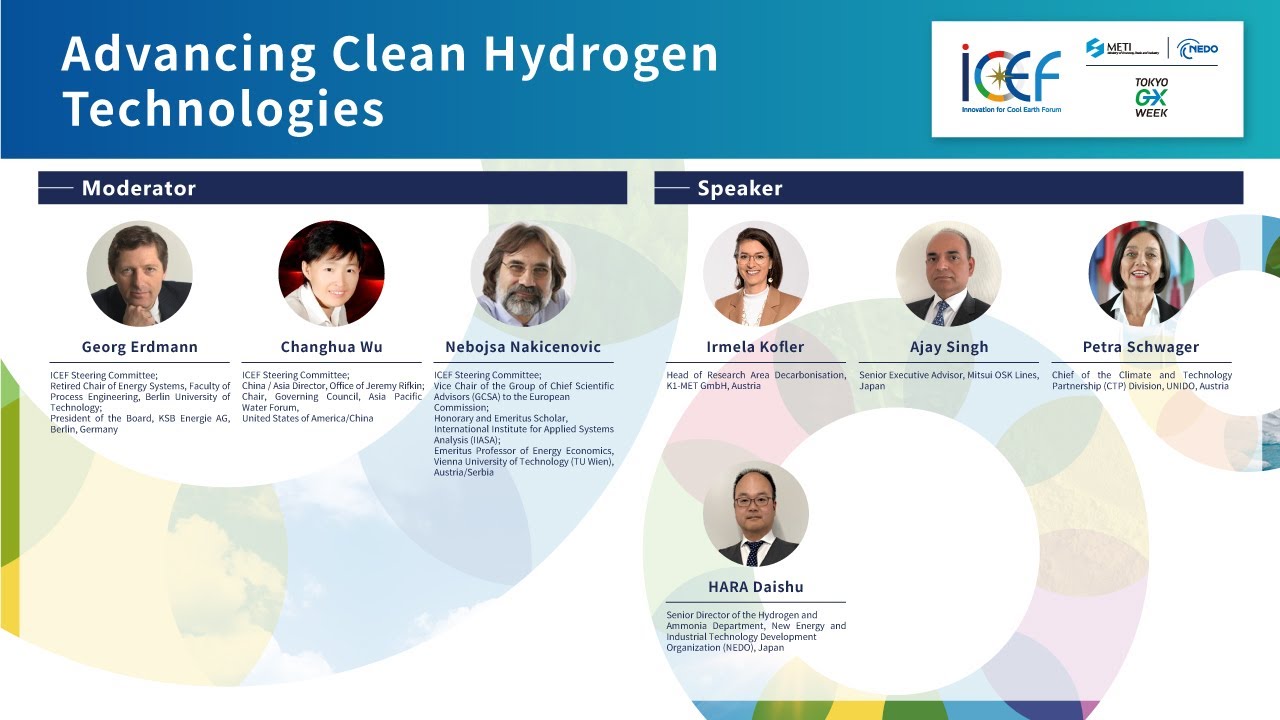
ICEF2025 | Advancing Clean Hydrogen Technologies
Keywords
Summary
197 words
Critical Evaluation
Value of the Information & Strength of the Argument
The video provides valuable insights into the demand-side challenges and opportunities for clean hydrogen across three key sectors: steel, fertilizer, and shipping. The speakers present concrete examples of ongoing projects and technological developments, such as hydrogen plasma smelting reduction and the HYFOR process in steel, and the potential for green ammonia in fertilizer production. The argumentation is solid, with speakers acknowledging the technical and economic hurdles, such as the need for high-grade iron ore, the high cost of renewable hydrogen, and the scale of fuel demand in shipping. The discussion effectively highlights the chicken-and-egg problem between supply and demand, and the importance of policy and regulatory frameworks to de-risk investments. However, the arguments are largely qualitative and lack detailed quantitative analysis, which limits the depth of the value provided.
Scientific Rigor, Source Quality, Title Accuracy
The scientific rigor is moderate. The speakers are experts in their fields, and the information is presented in a professional manner. However, no formal sources are cited within the video, and the discussion relies on the speakers’ expertise and institutional knowledge. The title accurately reflects the content, which focuses on advancing clean hydrogen technologies. The video is a panel discussion rather than a peer-reviewed presentation, so the rigor is appropriate for the format. No comments were provided for analysis.
223 words
Title / Content Match
The title accurately reflects the content, which focuses on advancing clean hydrogen technologies through demand-side applications.
Quality & Reliability
7/10
The video features expert speakers from industry and international organizations, providing credible insights into hydrogen demand sectors. However, it is a panel discussion with limited technical depth and no formal citations, so the score reflects moderate reliability.
Key Moments
Markers derived by PSI from the transcript: the creator did not define chapters.
- Irmela Kofler introduces K1-MET and its research areas, focusing on decarbonization and sector coupling.
- Petra Schwager discusses UNIDO's global program for hydrogen in industry and the importance of local application.
- Ajay Singh addresses the challenges of decarbonizing shipping, emphasizing the need for high-density fuels and regulatory support.
- Daishu Hara provides an overview of NEDO's hydrogen and ammonia initiatives in Japan.
- Q&A session begins, with questions about scaling up technologies and timelines.
- Discussion on the chicken-and-egg problem of hydrogen supply and demand, and the need for stable supply.
- Ajay Singh elaborates on the scale of fuel demand in shipping and the challenges of adopting ammonia.
- Concluding remarks and wrap-up of the session.
Cited Sources
- K1-MET GmbH — Irmela Kofler's organization, focused on metallurgical process efficiency and decarbonization.
- UNIDO Global Programme for Hydrogen in Industry — Petra Schwager discusses UNIDO's hydrogen program and its focus on local application.
- International Maritime Organization (IMO) — Ajay Singh mentions the IMO's net-zero framework and upcoming vote.
- NEDO (New Energy and Industrial Technology Development Organization) — Daishu Hara represents NEDO and discusses Japan's hydrogen initiatives.
Concurring Sources
- Hydrogen in steelmaking: a review — Supports the potential of hydrogen to reduce CO2 emissions in steel production, as discussed by Irmela Kofler.
- Green ammonia for fertilizer production — Aligns with Petra Schwager's discussion on using green ammonia to decarbonize fertilizer production.
- Decarbonizing shipping: challenges and opportunities — Provides context on the challenges of decarbonizing shipping, as highlighted by Ajay Singh.
Dissenting Sources
- Critique of hydrogen as a universal decarbonization solution — Some experts argue that hydrogen's low efficiency and high costs limit its role, contrasting with the optimistic outlook presented in the video.
Contribution & Novelties
The video provides a unique perspective by focusing on the demand side of hydrogen, which is often overshadowed by supply-side discussions. It highlights specific industrial applications and the challenges of scaling up hydrogen use in steel, fertilizer, and shipping. The discussion underscores the importance of creating lead markets and the need for regulatory frameworks to drive investment. The speakers bring diverse expertise from industry and international organizations, offering a comprehensive view of the current state and future prospects of clean hydrogen technologies.
Pour aller plus loin :
- Hydrogen economy — Provides background on the concept and challenges of a hydrogen-based economy.
- Direct reduced iron — Relevant to the steelmaking technologies discussed, particularly the HYFOR process.
- Green ammonia — Discusses the production of ammonia from renewable hydrogen, relevant to fertilizer and shipping applications.
- International Maritime Organization greenhouse gas strategy — Details the IMO’s targets for reducing shipping emissions, as mentioned in the video.
152 words
Radar Profile
The radar profile shows a balanced performance across all dimensions, with slightly higher scores in information quality and reliability, reflecting the expertise of the speakers. The lower score in technical depth indicates that the discussion remains at a strategic level rather than delving into detailed technical specifics.