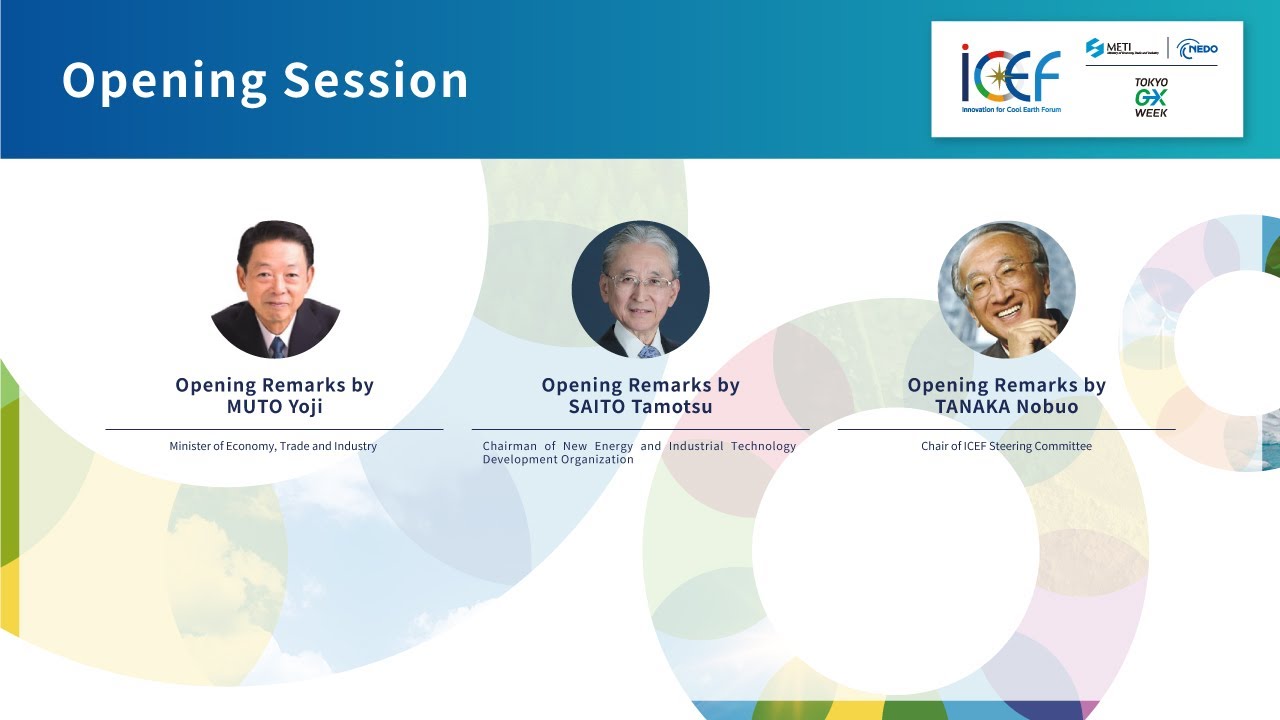
ICEF2025 | Opening Session
Keywords
Summary
244 words
Critical Evaluation
Value of the Information & Strength of the Argument
The video provides valuable insights into Japan’s official climate policy and strategic thinking. Minister Muto’s remarks offer concrete policy details, such as the NDC targets and investment plans, which are useful for understanding Japan’s approach. NEDO Chairman Saito’s update on the Green Innovation Fund and specific projects adds a practical dimension. Nobuo Tanaka’s geopolitical analysis is thought-provoking, framing energy transitions as a strategic competition. However, the argumentation is largely declarative and lacks in-depth evidence or data. The speakers present their views without detailed justification, and the geopolitical claims are simplified. The value lies in the authoritative perspectives and the identification of key themes, but the depth of analysis is limited.
Scientific Rigor, Source Quality, Title Accuracy
The video is a formal opening session, and the speakers are credible authorities: a government minister, a NEDO chairman, and a former IEA executive director. The information is consistent with known Japanese climate policies and international energy dynamics. However, no specific sources are cited within the video, and the claims are not backed by references. The title accurately describes the content. The video’s scientific rigor is moderate: it presents policy statements and expert opinions rather than peer-reviewed research. The lack of citations and detailed data reduces its scientific depth, but the institutional credibility of the speakers lends some reliability.
224 words
Title / Content Match
The title accurately reflects the content: it is the opening session of the ICEF 2025 conference.
Quality & Reliability
7/10
The video features high-level officials and experts (Minister of METI, NEDO Chairman, former IEA Executive Director) providing authoritative statements on Japan's climate policy and international energy geopolitics. However, it is primarily a ceremonial opening with limited technical depth, and claims are not backed by detailed data or citations within the video.
Key Moments
Markers derived by PSI from the transcript: the creator did not define chapters.
- Opening remarks by Yoji Muto, Minister of Economy, Trade and Industry, outlining Japan's NDC targets and GX 2040 vision.
- Opening remarks by Tamotsu Saito, NEDO Chairman, discussing climate impacts and NEDO's Green Innovation Fund projects.
- Opening remarks by Nobuo Tanaka, ICEF Steering Committee Chair, providing geopolitical analysis and recommendations for Japan and Korea.
Concurring Sources
- Japan's NDC submission to UNFCCC — The video mentions Japan's new NDC targets, which are officially documented here.
- METI's GX 2040 Vision — The video references the GX 2040 vision and national strategy, which are detailed on METI's website.
Contribution & Novelties
The video provides an official overview of Japan’s current climate and energy strategies, including specific targets and investment plans. It also offers a unique geopolitical framing of the energy transition, categorizing nations into ‘pro-states’ and ’electro-states’. The call for Japan-Korea cooperation on nuclear and hydrogen is a notable strategic suggestion. However, the content is largely a summary of existing policies and perspectives, with limited novel technical or scientific insights.
Pour aller plus loin :
- Japan’s NDC (Nationally Determined Contribution) — Official document on Japan’s emissions reduction targets.
- Green Transformation (GX) Policy — METI’s page on the GX initiative.
- Asia Zero Emission Community (AZEC) — Framework for Asia’s decarbonization cooperation.
- Small Modular Reactors (SMRs) — IAEA overview of SMR technology.
- CPTPP (Comprehensive and Progressive Agreement for Trans-Pacific Partnership) — Official information on the trade agreement.
134 words
Radar Profile
The radar profile shows moderate scores across all dimensions, with slightly higher quality and reliability due to the authoritative speakers, but lower technical depth and information quantity. This indicates a video that is informative at a policy level but lacks technical detail and comprehensive data.