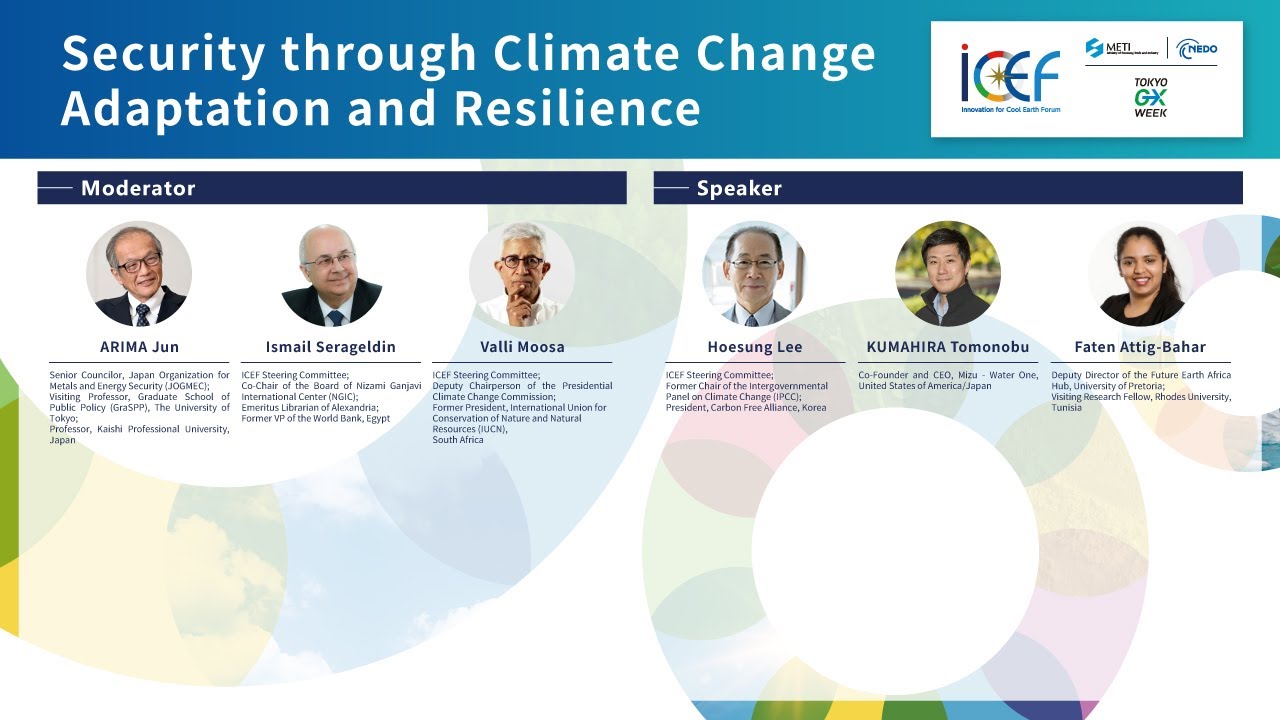
ICEF2025 | Security through Climate Change Adaptation and Resilience
Keywords
Summary
141 words
Critical Evaluation
Value of the Information & Strength of the Argument
The session provides valuable insights from leading experts, particularly on the financial barriers to adaptation and the need for innovative financing mechanisms. Dr. Lee’s argument for debt-for-climate swaps is well-structured and supported by the Barbados example. Mr. Kumahira’s practical perspective from the ground adds concreteness, while Dr. Attig-Bahar’s data on Africa’s climate impacts strengthens the case for urgent action. The argumentation is generally solid, though some claims lack detailed evidence, and the discussion remains at a high level without deep technical analysis.
Scientific Rigor, Source Quality, Title Accuracy
The session demonstrates strong scientific rigor through the involvement of IPCC leadership and references to reports like the WMO State of Climate in Africa 2024. However, specific sources are not always cited explicitly during the discussion, and the reliance on personal expertise is evident. The title accurately reflects the content, focusing on adaptation and resilience as security issues. The session is well-structured and maintains a high level of expertise throughout.
167 words
Title / Content Match
The title accurately reflects the session's focus on climate change adaptation and resilience, with a strong emphasis on security implications.
Quality & Reliability
7/10
The session features high-level experts including a former IPCC chair, providing authoritative perspectives on climate adaptation finance and policy. However, the discussion is largely qualitative and lacks detailed data citations, with some claims presented without specific references.
Key Moments
Markers derived by PSI from the transcript: the creator did not define chapters.
- Dr. Hoesung Lee begins keynote on adaptation definition and history.
- Tomonobu Kumahira presents on water and agriculture adaptation.
- Dr. Faten Attig-Bahar discusses African climate impacts and science-led adaptation.
- Panel discussion on finance innovation and de-risking projects.
- Discussion on international cooperation and knowledge sharing.
Cited Sources
- IPCC Definition of Adaptation — Referenced by Dr. Lee in his keynote.
- WMO State of Climate in Africa 2024 — Cited by Dr. Attig-Bahar for climate data.
- Barbados Debt-for-Climate Swap — Mentioned by Dr. Lee as a successful example.
Concurring Sources
- IPCC Sixth Assessment Report — Supports the urgency of adaptation and financial needs.
- UNEP Adaptation Gap Report — Provides data on adaptation finance gaps.
Contribution & Novelties
The session offers a high-level synthesis of adaptation challenges and finance gaps, with a notable emphasis on debt-for-climate swaps and the need to de-risk projects for private investment. It brings together perspectives from policy, private sector, and African research, highlighting the importance of local context and youth engagement.
Pour aller plus loin :
- Climate adaptation — Overview of adaptation concepts and strategies.
- Debt-for-nature swap — Related financial mechanism to debt-for-climate swaps.
- World Resources Institute Aqueduct — Water risk mapping tool referenced by Mr. Kumahira.
84 words
Radar Profile
The radar profile shows a balanced performance across all dimensions, with slightly higher scores in information quality and reliability, reflecting the expert panel. The lower score in technical level indicates the discussion is accessible to a broad audience.
💬 No comments were provided for analysis.