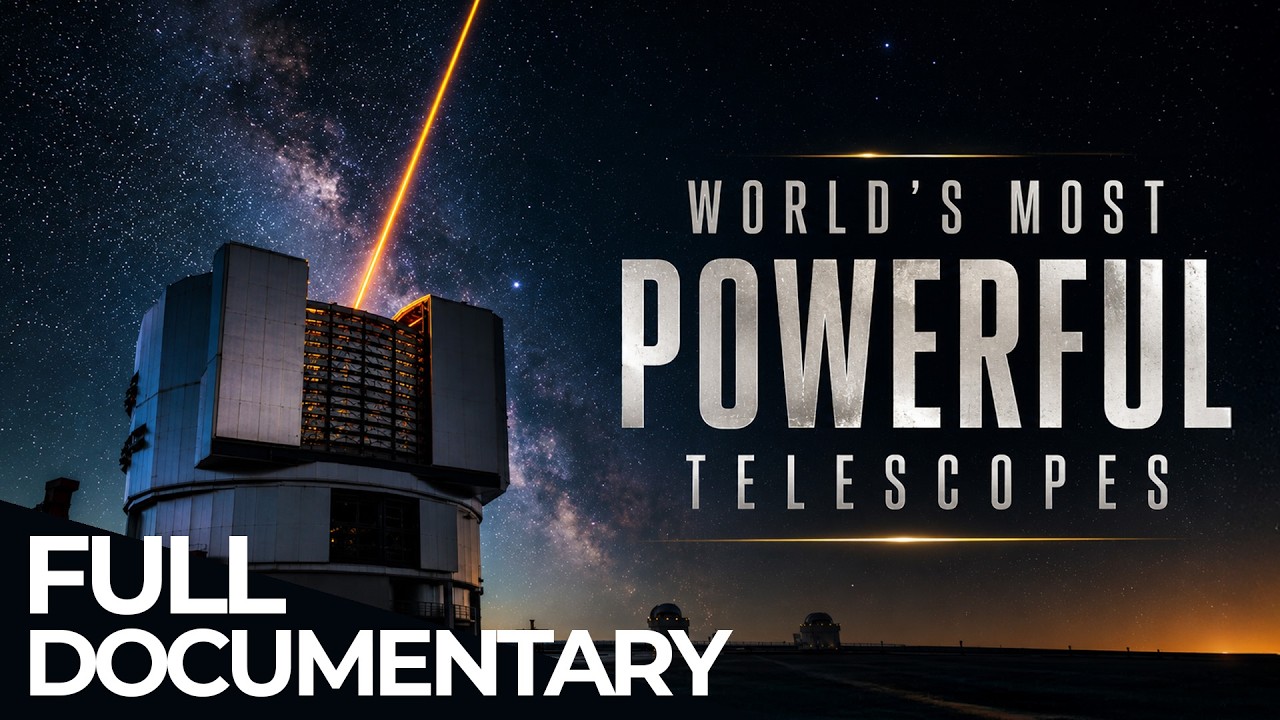
Observing the Universe: The World’s Most Powerful Telescopes | Free Documentary Space
Keywords
Summary
122 words
Critical Evaluation
The documentary provides a visually stunning and generally accurate overview of modern ground-based astronomy, focusing on ESO’s facilities in Chile. It excels in showcasing the technological marvels of telescopes like the VLT, VISTA, and ALMA, and effectively explains complex concepts such as interferometry, adaptive optics, and the transit method in an accessible manner. The interviews with astronomers lend credibility and provide insights into the practical challenges and scientific goals. However, the content is relatively superficial, lacking in-depth technical details or critical discussion of limitations and controversies. The documentary tends to romanticize the desert environment and the search for life, without delving into the statistical probabilities or the philosophical implications. The sources are not explicitly cited within the video, and the reliance on ESO’s promotional material may introduce a positive bias. The title accurately reflects the content, but the documentary does not critically examine the future of these projects or the potential drawbacks. Overall, it serves as an excellent introduction for a general audience but falls short of a rigorous scientific analysis.
171 words
Title / Content Match
The title accurately reflects the content, which focuses on powerful telescopes and their observations.
Quality & Reliability
7/10
The documentary presents accurate information about ESO's telescopes and astronomical techniques, but lacks depth and critical analysis, and relies on visual appeal rather than rigorous scientific detail.
Key Moments
Markers derived by PSI from the transcript: the creator did not define chapters.
- Introduction to the Atacama Desert and ESO
- Explanation of the VLT and its mirrors
- Interferometry and adaptive optics explained
- Exoplanet hunting with SPHERE and VISTA
- The Next Generation Transit Survey and the transit method
- Supermassive black hole at the Milky Way's center
- Life in the Atacama Desert and the search for life
- La Silla Observatory and TRAPPIST telescope
- Spectroscopy and analyzing starlight
- Future telescopes and conclusion
Cited Sources
- Free Documentary Channel — Channel subscription link
- Free Documentary Instagram — Social media link
- Free Documentary Facebook — Social media link
- Free Documentary Twitter — Social media link
Concurring Sources
- ESO - The Very Large Telescope — Official ESO page on the VLT, confirming its specifications and capabilities.
- ESO - ALMA — Official ESO page on ALMA, another major telescope mentioned in the documentary.
Dissenting Sources
- Critique of ground-based astronomy limitations — The documentary does not discuss the limitations of ground-based telescopes compared to space telescopes like Hubble or JWST, which is a notable omission.
Contribution & Novelties
The documentary provides a comprehensive visual tour of ESO’s telescopes, offering insights into their capabilities and the scientific questions they address. It effectively communicates the importance of location and technology in modern astronomy.
Pour aller plus loin :
- European Southern Observatory (ESO) official website — For detailed information on telescopes and research.
- Very Large Telescope (VLT) on Wikipedia — Overview of the VLT and its instruments.
- Adaptive optics on Wikipedia — Explanation of the technique used to correct atmospheric distortion.
- Exoplanet exploration on NASA’s website — For more on exoplanet discovery and research.
- Event Horizon Telescope (EHT) on Wikipedia — Related to black hole imaging, complementing the documentary’s discussion.
109 words
Radar Profile
The radar profile shows balanced scores across the dimensions, with slightly lower technical depth and information quantity, indicating a documentary that is accessible but not highly detailed.