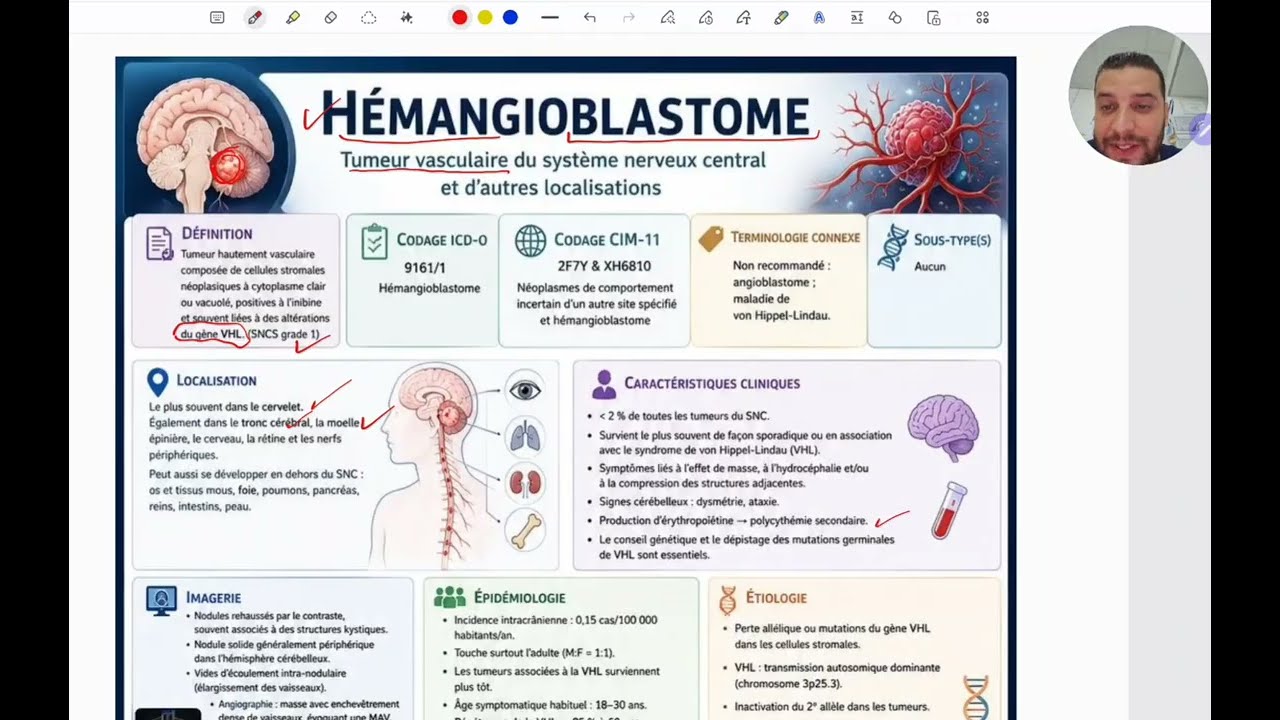
Hémangioblastome
Keywords
Summary
210 words
Critical Evaluation
Value of the Information & Strength of the Argument
The video offers valuable information for medical students and professionals, presenting a structured and detailed account of hemangioblastoma. The argumentation is logical, progressing from definition and epidemiology to molecular mechanisms, imaging, histopathology, and treatment. The explanation of the VHL-HIF-VEGF pathway is particularly clear and well-illustrated, enhancing understanding of the tumor’s vascular nature. The inclusion of histopathological and immunohistochemical details adds depth, making it a useful educational resource. However, the presentation lacks critical evaluation of sources and does not discuss controversies or alternative viewpoints, which slightly weakens the argumentative rigor.
Scientific Rigor, Source Quality, Title Accuracy
The scientific rigor is generally high, with accurate and up-to-date information consistent with standard medical knowledge. However, the video does not cite specific sources or references, which limits the ability to verify claims. The title accurately reflects the content, and the video stays on-topic throughout. The absence of citations is a notable weakness in terms of source quality. No comments were provided for analysis.
168 words
Title / Content Match
The title accurately reflects the content, which is a comprehensive educational presentation on hemangioblastoma.
Quality & Reliability
7/10
The video provides a detailed and accurate overview of hemangioblastoma, covering clinical, radiological, histopathological, and molecular aspects. The content aligns with established medical knowledge, though it lacks explicit citations and references to sources.
Key Moments
Markers derived by PSI from the transcript: the creator did not define chapters.
- Introduction to hemangioblastoma and historical context
- Definition and WHO grade 1 classification
- Association with VHL gene and sporadic vs syndromic cases
- Clinical features: cerebellar symptoms and polycythemia
- Molecular mechanism: VHL, HIF, and VEGF pathway
- Imaging findings: cystic lesion with enhancing mural nodule
- Macroscopic and microscopic pathology
- Immunohistochemistry markers and differential diagnosis
- Treatment options: surgery and anti-VEGF therapy
- Summary and conclusion
Contribution & Novelties
The video provides a comprehensive and accessible overview of hemangioblastoma, integrating clinical, radiological, and pathological aspects. It clarifies common misconceptions, such as the term ‘blast’ and the significance of the mural nodule. The explanation of the VHL-HIF-VEGF pathway is particularly valuable for understanding the tumor’s vascular nature. The video also highlights the importance of immunohistochemistry in differential diagnosis.
Pour aller plus loin :
- Von Hippel-Lindau disease — Overview of the syndrome and its manifestations.
- Hemangioblastoma — General information on the tumor.
- Hypoxia-inducible factor — Role in cellular response to hypoxia and tumor angiogenesis.
93 words
Radar Profile
The radar profile shows high scores in information quantity and technical level, indicating a detailed and specialized content. The quality and reliability scores are moderate, reflecting the lack of explicit citations. Overall, the video is a solid educational resource for medical audiences.