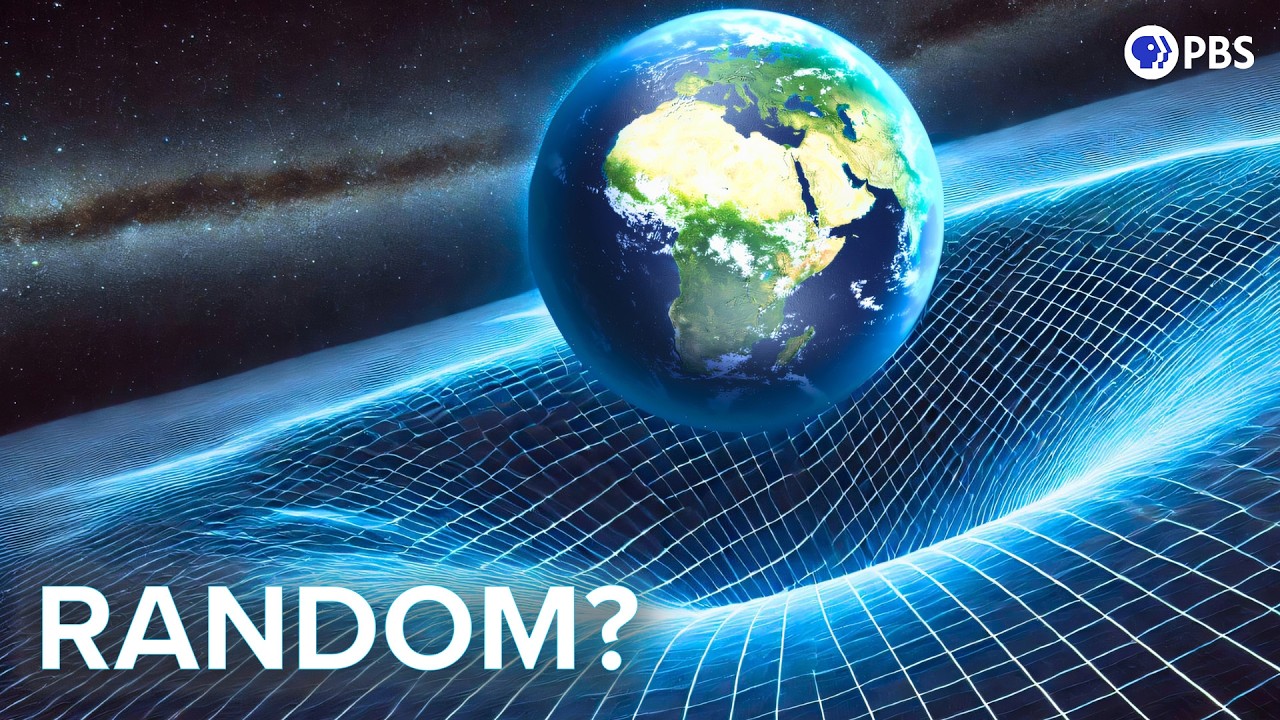
Is Gravity RANDOM Not Quantum?
Keywords
Summary
169 words
Critical Evaluation
Value of the Information & Strength of the Argument
The video provides valuable information by clearly explaining a complex and recent theoretical proposal. It effectively uses thought experiments, such as the quantum Earth and the double-slit experiment, to illustrate the conceptual difficulties and the proposed solution. The argumentation is logical and well-structured, building from the known problems to the novel idea. The host presents the material in an engaging manner, making it accessible to a general audience while maintaining scientific accuracy. The inclusion of the testability of the theory adds to its credibility.
Scientific Rigor, Source Quality, Title Accuracy
The video demonstrates scientific rigor by accurately presenting the key concepts and attributing the hypothesis to Jonathan Oppenheim. It references the Feynman-Aharonov-Rohrlich argument and mentions Hawking’s work on black hole radiation, grounding the discussion in established physics. The description provides links to the show’s merchandise, Patreon, and mailing list, but not directly to the scientific papers. The title accurately reflects the content, which is a balanced exploration of the post-quantum gravity hypothesis. The comments are largely positive, with many viewers appreciating the content, though some complain about the audio levels.
189 words
Title / Content Match
The title accurately reflects the central question of the episode, which explores whether gravity could be fundamentally random rather than quantum.
Quality & Reliability
8/10
The video presents a coherent and accurate overview of the post-quantum gravity hypothesis, clearly explaining the conceptual problems with semiclassical gravity and the Feynman-Aharonov-Rohrlich argument. It distinguishes between established physics and speculative proposals, and mentions testability. However, it lacks detailed mathematical derivations and does not discuss criticisms or alternative viewpoints in depth.
Key Moments
Markers derived by PSI from the transcript: the creator did not define chapters.
- Introduction: The holy grail of physics and the question of quantum gravity.
- Explanation of the Einstein field equations and the classical nature of gravity.
- Discussion of the quantum nature of matter and the challenge of coupling it to classical gravity.
- Introduction of semiclassical gravity and the thought experiment of the quantum Earth.
- The problem with semiclassical gravity: the apple falls towards the expectation value.
- The alternative: superposition of spacetimes and the violation of the uncertainty principle.
- Introduction of post-quantum gravity: adding randomness to the gravitational field.
- How randomness resolves the uncertainty principle issue and causes decoherence.
- The radical consequence: destruction of quantum information and the black hole information paradox.
- Conclusion: the future of quantum gravity and the possibility of a random spacetime.
Cited Sources
- PBS Space Time Patreon — Support the show and get access to the Space Time Discord.
- PBS Donation Page — Support PBS Member Stations.
- Space Time Mailing List — Sign up for episode notifications and special announcements.
- Space Time Library Search — Search the entire Space Time library.
- Space Time Merch Store — Purchase merchandise, including the new desktop mat.
- End Credits Music by J.R.S. Schattenberg — Music for the end credits.
Concurring Sources
- Post-quantum gravity — Wikipedia article that aligns with the video's description of the theory.
Dissenting Sources
Contribution & Novelties
The video provides a clear and accessible explanation of a recent and speculative theory, post-quantum gravity, which is not widely covered in popular science media. It highlights the conceptual problems with traditional approaches to quantum gravity and presents a novel alternative that challenges the assumption that gravity must be quantized. The explanation of how randomness in gravity could resolve the uncertainty principle issue and the black hole information paradox is particularly insightful.
Pour aller plus loin :
- Post-quantum gravity — Wikipedia article on the hypothesis.
- Semiclassical gravity — Wikipedia article on the semiclassical approach.
- Black hole information paradox — Wikipedia article on the paradox and its implications.
107 words
Radar Profile
The radar profile shows high scores in information quantity and quality, with a moderate technical level. This indicates a well-produced educational video that balances depth with accessibility. The reliability score is also high, reflecting the accurate presentation of the scientific concepts.
💬 Positif. Sur les 30 commentaires analysés, le public est très enthousiaste, saluant la qualité de l'épisode et la clarté des explications, bien que plusieurs se plaignent du volume sonore de l'intro.