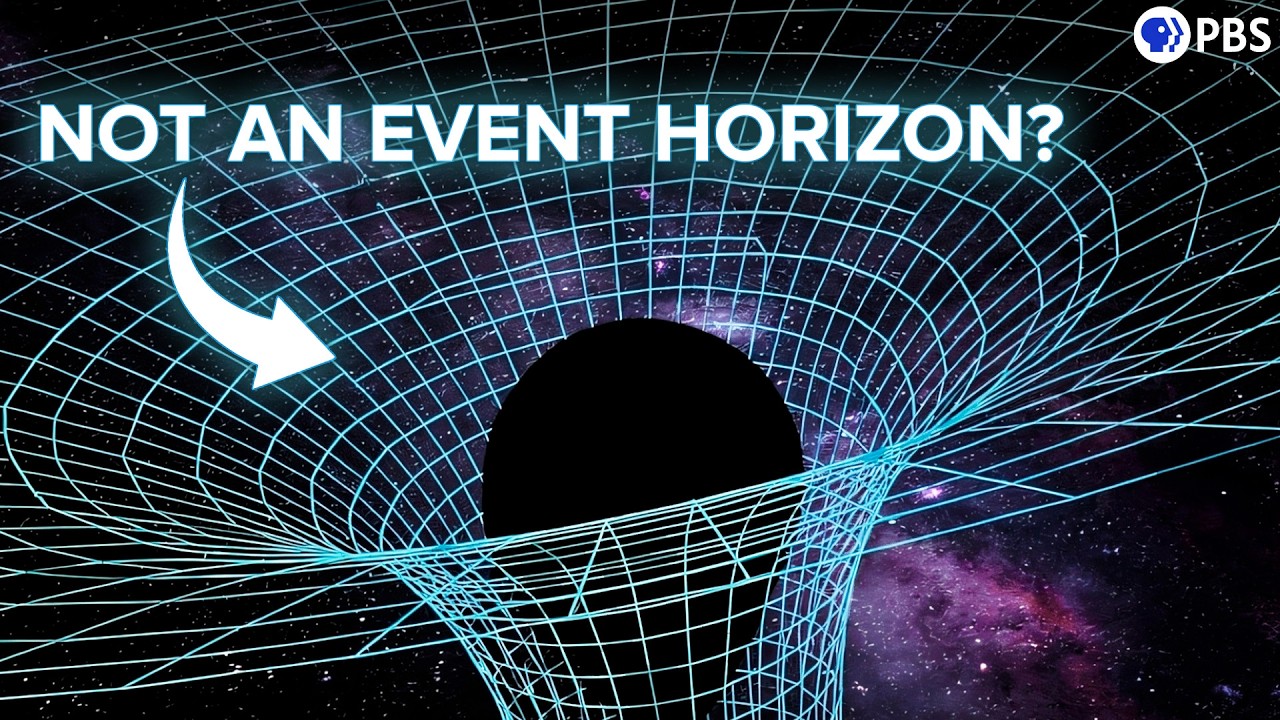
We Thought Black Holes Created Event Horizons. It Might Be the Opposite
Keywords
Summary
183 words
Critical Evaluation
Value of the Information & Strength of the Argument
The video provides substantial value by clarifying a conceptually difficult topic in general relativity. It effectively uses thought experiments and Penrose diagrams to build an intuitive understanding of the teleological nature of event horizons. The argumentation is solid, logically progressing from the standard definition to its counterintuitive implications, and then introducing the apparent horizon as a complementary, local concept. The distinction between the two is well-argued and supported by references to the work of Hawking and Ellis and to the Vaidya spacetime.
Scientific Rigor, Source Quality, Title Accuracy
The scientific rigor is high, with the content accurately reflecting established theoretical physics. The video explicitly references the textbook ‘The Large Scale Structure of Spacetime’ by Hawking and Ellis for the formal definition of an event horizon, and mentions the Vaidya spacetime as a toy model. The title is highly appropriate, as it encapsulates the central twist of the episode: that event horizons may not be created by black holes but can pre-exist them. The content is well-aligned with the title, exploring this idea in depth.
183 words
Title / Content Match
The title accurately reflects the content, which challenges the common assumption that black holes create event horizons, presenting the alternative view that horizons may form before the collapse.
Quality & Reliability
9/10
The video provides a rigorous and accurate explanation of the distinction between event horizons and apparent horizons, grounded in general relativity and referencing the work of Hawking and Ellis. The presentation is clear, well-structured, and avoids oversimplification, making it highly reliable for its intended audience.
Key Moments
Markers derived by PSI from the transcript: the creator did not define chapters.
- Introduction to the idea that an event horizon might be forming around you right now.
- Thought experiment: escaping a growing black hole and the realization that the true event horizon is not the visible surface.
- Formal definition of an event horizon using the causal past of future null infinity, explained with a Penrose diagram.
- Explanation of the teleological nature of event horizons and how they can form before the black hole.
- Vaidya spacetime thought experiment: a collapsing shell of radiation and the pre-formation of the event horizon.
- Introduction of the apparent horizon as a local, observer-dependent boundary, contrasted with the global event horizon.
- Behavior of apparent horizons during black hole mergers, including the surprising formation of a joint apparent horizon.
- Summary: the event horizon is a global causal boundary, while the apparent horizon is a practical local tool.
Cited Sources
- Space Time Mailing List — Sign up for episode notifications and announcements.
- Space Time Library Search — Search the entire Space Time video library.
- Space Time Merch Store — Official merchandise store.
- End Credits Music by J.R.S. Schattenberg — Music for the end credits.
Concurring Sources
- Event horizon — General definition and properties of event horizons.
- Apparent horizon — Definition and properties of apparent horizons.
Contribution & Novelties
The video offers a clear and accessible explanation of a subtle but fundamental concept in black hole physics: the distinction between event horizons and apparent horizons. It challenges the common visual intuition and provides a rigorous, yet understandable, framework using Penrose diagrams and the Vaidya spacetime. This helps viewers appreciate the global, teleological nature of event horizons and the practical utility of apparent horizons in dynamical situations.
Pour aller plus loin :
- Event horizon — Wikipedia article providing a general overview and definitions.
- Apparent horizon — Wikipedia article explaining the local concept of an apparent horizon.
- Penrose diagram — Wikipedia article on the conformal diagrams used to represent spacetime.
- Vaidya metric — Wikipedia article on the Vaidya spacetime, a simple model for a radiating star.
- The Large Scale Structure of Space-Time — Wikipedia article on the book by Hawking and Ellis, which is the source of the formal definition.
149 words
Radar Profile
The radar profile shows high scores across all dimensions, indicating a well-balanced and high-quality educational video. The slightly lower score in 'niveau_technique' reflects the advanced nature of the topic, but it is still accessible to a motivated audience. The overall profile suggests a reliable and informative resource.
💬 Très positif. Sur les 30 commentaires analysés, le public exprime un fort enthousiasme pour la clarté des explications et la profondeur du sujet, avec de nombreuses réactions humoristiques et des remerciements pour la qualité pédagogique.