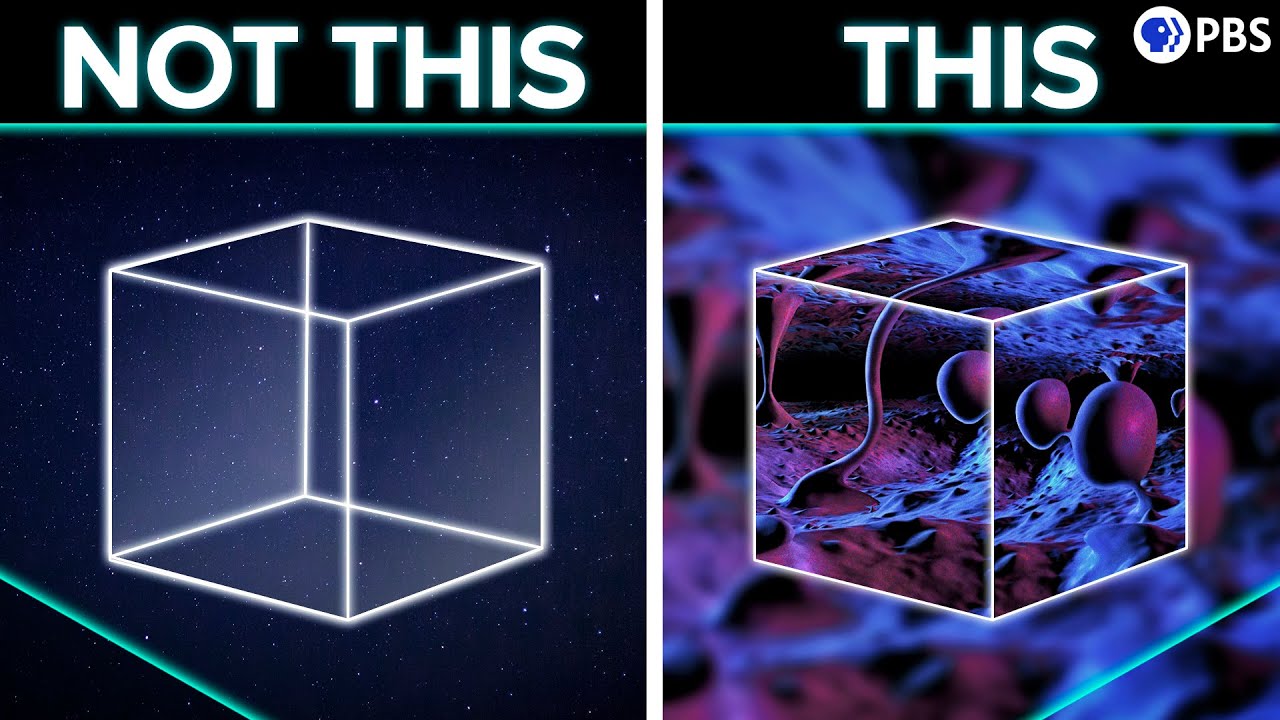
What If Space is NOT Empty?
Keywords
Summary
159 words
Critical Evaluation
Value of the Information & Strength of the Argument
The video provides substantial value by clearly explaining a complex and speculative topic in theoretical physics. It builds a logical argument from established principles (Heisenberg uncertainty, Einstein’s field equations) to derive the concept of spacetime foam, making it accessible to a general audience. The argumentation is solid, carefully distinguishing between what is well-established theory and what is speculative. It also presents the current state of observational efforts, giving a balanced view of the evidence. The use of analogies, like the ocean surface, effectively aids understanding without oversimplifying the core physics.
Scientific Rigor, Source Quality, Title Accuracy
The scientific rigor is high for a popular science video. The content is based on well-established physics and the reasoning is sound. However, the video does not provide direct citations to specific scientific papers within the episode, relying instead on general knowledge and the host’s expertise. The title accurately reflects the content, which is a key strength. The description includes links to PBS and Patreon, but no direct links to the scientific literature discussed. The video’s production quality and the host’s credibility contribute to its overall reliability.
192 words
Title / Content Match
The title is a provocative question that accurately reflects the central theme: the nature of 'empty' space at the Planck scale. The content directly addresses this by explaining the concept of spacetime foam.
Quality & Reliability
8/10
The video presents a well-structured, logical argument grounded in established physics (Heisenberg uncertainty, general relativity, quantum field theory) and cites specific studies attempting to detect spacetime foam effects. It clearly distinguishes established theory from speculation, and the host is a credible astrophysicist. However, it lacks detailed citations to primary literature within the video itself, and some analogies simplify complex concepts.
Key Moments
Markers derived by PSI from the transcript: the creator did not define chapters.
- Introduction to the question of whether space is fundamental, and the conflict between general relativity and quantum mechanics.
- Wheeler's ocean analogy to explain spacetime foam.
- Derivation of the Planck length as the limit of measurement, combining Heisenberg uncertainty with general relativity.
- Explanation of how quantum fluctuations in the vacuum lead to uncertainty in spacetime geometry.
- Discussion of how spacetime foam could be tested using diffraction patterns of distant light sources.
- Review of current observational attempts and the potential for future telescopes to detect the effect.
Cited Sources
- PBS Space Time Patreon — Support page for the show, mentioned in the description.
- PBS Donation Page — Link to support PBS member stations, mentioned in the description.
- Space Time Merch Store — Merchandise store for the show, mentioned in the description.
- Space Time Mailing List — Sign-up for episode notifications, mentioned in the description.
- Space Time Library Search — Search tool for past episodes, mentioned in the description.
- End Credits Music by J.R.S. Schattenberg — Music credit for the end credits, mentioned in the description.
Concurring Sources
- Spacetime foam - Wikipedia — General concept of spacetime foam, consistent with the video's description.
- Planck length - Wikipedia — The scale at which quantum gravity effects become significant, as discussed in the video.
Dissenting Sources
- String theory - Wikipedia — String theory is an alternative approach to quantum gravity that does not necessarily predict spacetime foam in the same way, and the video mentions it as a speculative solution to the conflict between GR and QM.
External References
Contribution & Novelties
The video’s original contribution lies in its clear, step-by-step derivation of spacetime foam from the combination of quantum mechanics and general relativity, making the concept accessible without oversimplifying. It also provides a concise overview of current observational efforts, which is valuable for viewers seeking to understand the testability of this idea.
Pour aller plus loin :
- Spacetime foam - Wikipedia — A general overview of the concept, its history, and proposed tests.
- Planck length - Wikipedia — Provides context on the fundamental scale where quantum gravity effects are expected.
- Heisenberg uncertainty principle - Wikipedia — Background on the quantum mechanical principle central to the argument.
- John Archibald Wheeler - Wikipedia — Information on the physicist who coined the term ‘spacetime foam’.
121 words
Radar Profile
The radar profile shows a balanced performance across all dimensions, with slightly lower scores in 'niveau_technique' and 'quantite_information' compared to 'qualite_information' and 'fiabilite_globale'. This indicates a video that is highly reliable and informative, but may require a moderate level of background knowledge to fully grasp the technical details.
💬 Très positif. Sur les 30 commentaires analysés, l'immense majorité exprime une profonde appréciation pour la clarté des explications, la qualité de la narration et l'impact éducatif de la chaîne, avec plusieurs témoignages personnels sur la vocation scientifique suscitée.