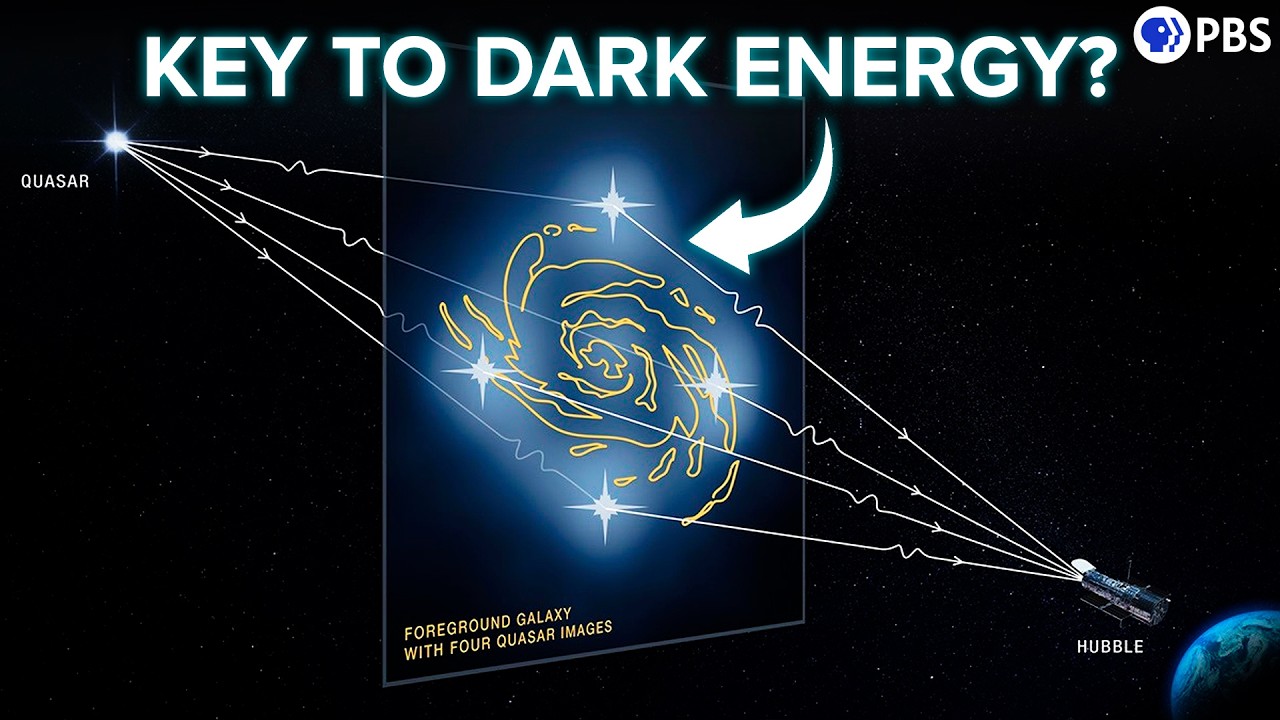
The Universe Is Racing Apart. We May Finally Know Why.
Keywords
Summary
197 words
Critical Evaluation
Value of the Information & Strength of the Argument
The video provides substantial value by explaining a cutting-edge cosmological technique in an accessible yet detailed manner. It clearly outlines the scientific problem (Hubble tension), the proposed solution (time-delay cosmography), and the current state of research, including specific results from major collaborations. The argumentation is solid: the host builds a logical case for why time-delay cosmography is a promising independent probe, acknowledges its limitations, and explains how future surveys will overcome them. The reasoning is transparent, and the host does not overstate conclusions, noting that the tension is not yet confirmed by lensing alone.
Scientific Rigor, Source Quality, Title Accuracy
The video demonstrates high scientific rigor, referencing specific collaborations (H0LiCOW, TDCOSMO, DESI) and their published results. The host, Matt O’Dowd, is an astrophysicist, and the content is consistent with current scientific consensus. The description provides links to the channel’s general resources but not directly to the cited papers, which is a minor weakness. The title is somewhat sensational but accurately reflects the content’s focus on dark energy and the Hubble tension. The video is well-structured and the science is presented accurately.
190 words
Title / Content Match
The title is catchy and slightly sensationalized, but accurately reflects the content: the video discusses the Hubble tension and how time-delay cosmography may resolve it and reveal the nature of dark energy.
Quality & Reliability
9/10
High-quality presentation by an expert astrophysicist, referencing recent peer-reviewed results (H0LiCOW, TDCOSMO, DESI) and explaining methodology in depth. Minor caveats: no direct citations to specific papers in the description, and some simplifications for a general audience.
Key Moments
Markers derived by PSI from the transcript: the creator did not define chapters.
- Introduction: Supernova Refsdal and the promise of time-delay cosmography.
- Announcements: algorithm plea, new merch, and sponsor segment.
- Review of the Hubble tension: CMB vs. supernova measurements.
- Introduction to time-delay cosmography and quasars.
- Explanation of gravitational lensing and time delays.
- Challenges: lens modeling, mass-sheet degeneracy, and observing constraints.
- Results from H0LiCOW and TDCOSMO collaborations.
- Lensed supernovae: Refsdal and SN H0pe.
- Future prospects: Vera Rubin Observatory and LSST survey.
- Potential to trace dark energy evolution and conclusion.
Cited Sources
- The Economist (sponsor) — Sponsor segment, not a scientific source.
- PBS Space Time Mailing List — Channel resource for episode notifications.
- PBS Space Time Library Search — Search engine for past episodes.
- PBS Space Time Merch Store — Merchandise, not a scientific source.
- End Credits Music by J.R.S. Schattenberg — Music credit.
Concurring Sources
- H0LiCOW Collaboration — Cited in the video as a key source of time-delay cosmography results.
- TDCOSMO Collaboration — Successor to H0LiCOW, also cited in the video.
Dissenting Sources
- Planck Collaboration (CMB measurements) — The CMB-based measurement of the Hubble constant is lower than the late-universe measurements, creating the tension discussed in the video.
Contribution & Novelties
The video provides a clear and up-to-date synthesis of the state of time-delay cosmography, highlighting recent results and future prospects. It explains the method’s potential to not only measure the Hubble constant but also to probe the evolution of dark energy, which is a novel angle. The video effectively communicates the significance of the upcoming Vera Rubin Observatory for this field.
Pour aller plus loin :
- Hubble’s law — Fundamental concept for understanding cosmic expansion.
- Gravitational lens — Core phenomenon behind time-delay cosmography.
- Dark Energy Spectroscopic Instrument (DESI) — Recent results on dark energy evolution mentioned in the video.
- Vera C. Rubin Observatory — Upcoming facility expected to revolutionize the field.
111 words
Radar Profile
The radar profile shows a well-rounded video with high scores across all dimensions, reflecting its strong educational value, technical depth, and reliability. The slightly lower score in 'niveau_technique' compared to others indicates that while it is technical, it remains accessible to a broad audience.
💬 Très positif — Sur les 30 commentaires analysés, l'écrasante majorité exprime une forte appréciation de la chaîne et de la qualité du contenu, avec des appels à l'algorithme pour mieux la recommander.