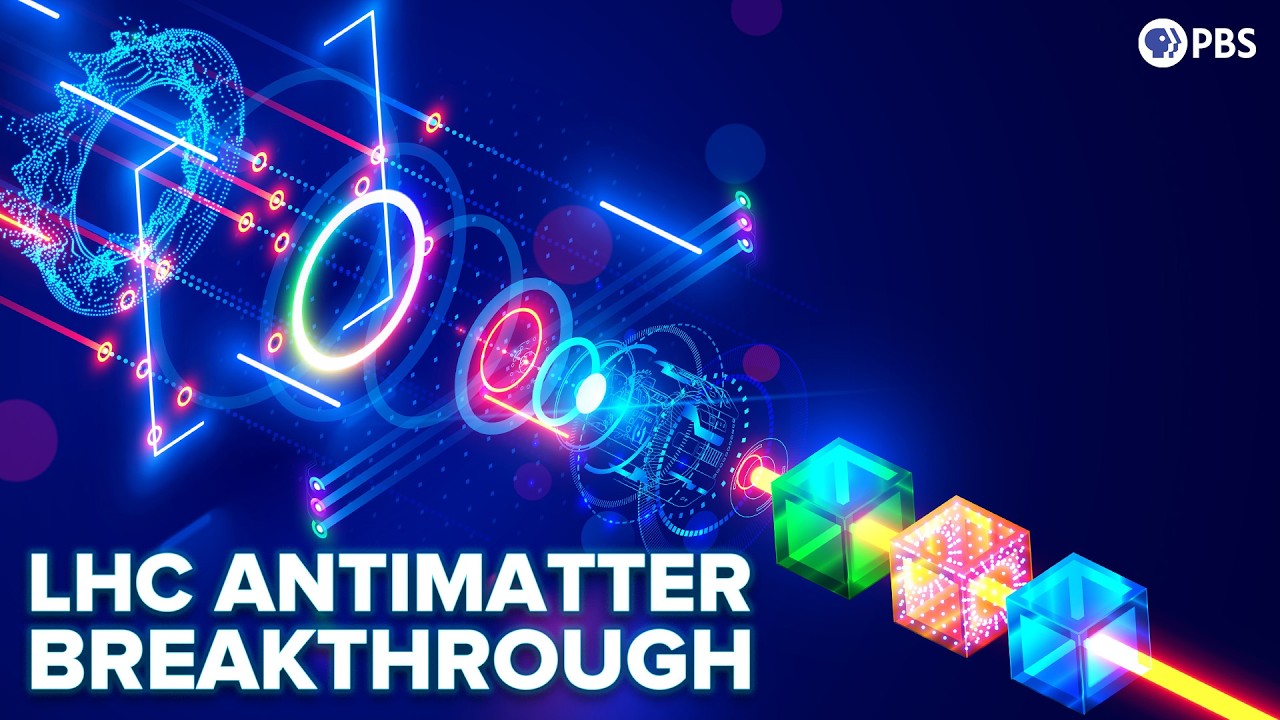
How a One-in-a-Billion Mistake Made the Universe Possible
Keywords
Summary
192 words
Critical Evaluation
Value of the Information & Strength of the Argument
The video provides a clear and engaging explanation of a complex topic in particle physics. It effectively uses analogies (e.g., vortices, musical chairs) to make the concepts accessible. The argumentation is solid, building from the fundamental question to the specific experimental result. It correctly places the new LHCb finding in the broader context of the matter-antimatter asymmetry problem, acknowledging that it is not the final answer but a significant step. The video also discusses the limitations of the current standard model and the need for new sources of CP violation, which adds depth to the argument.
Scientific Rigor, Source Quality, Title Accuracy
The video demonstrates high scientific rigor. It references a specific paper (arXiv:2312.07647) for further reading, which is a good practice. The host, Matt O’Dowd, is a known astrophysicist, and the channel has a strong reputation for accuracy. The title accurately reflects the content, focusing on the ‘one-in-a-billion mistake’ that allowed matter to survive. The video also mentions other experiments (BaBar, Belle II, T2K, Hyper-Kamiokande) and their roles, showing a comprehensive understanding of the field. The sponsored segment is clearly marked and does not detract from the scientific content.
199 words
Title / Content Match
The title accurately reflects the content, which discusses the matter-antimatter asymmetry and a new LHCb result that brings us closer to understanding why matter survived the early universe.
Quality & Reliability
9/10
The video presents a recent LHCb result on CP violation in baryons, explaining the physics context and the significance of the finding. The content is accurate, well-structured, and includes a reference to a peer-reviewed paper (arXiv:2312.07647). The host is a known astrophysicist, and the channel has a strong reputation for science communication.
Key Moments
Markers derived by PSI from the transcript: the creator did not define chapters.
- Introduction to the mystery of matter-antimatter asymmetry
- Explanation of pair production and the early universe
- Introduction to CP symmetry and its violation
- Overview of the LHCb experiment and its focus on bottom quarks
- Explanation of Feynman diagrams and quantum interference
- Details of the new LHCb result on CP violation in baryons
- Discussion of the significance and limitations of the finding
- Future experiments and the search for leptonic CP violation
- Conclusion and sponsored segment for KiwiCo
Cited Sources
- Dr. Caplan Paper for Review — Referenced as a paper for further reading on the topic of matter-antimatter asymmetry and CP violation.
Concurring Sources
- CP violation — General reference on CP violation, consistent with the video's explanation.
- LHCb experiment — Information about the LHCb experiment, matching the video's description.
External References
Contribution & Novelties
The video provides an accessible explanation of a recent scientific breakthrough: the first detection of CP violation in baryons by the LHCb experiment. This is a significant step in understanding the matter-antimatter asymmetry of the universe. The video also contextualizes this finding within the broader search for new sources of CP violation, including in leptons. It offers a clear explanation of the underlying physics, making it valuable for both enthusiasts and students.
Pour aller plus loin :
- CP violation — Overview of CP violation and its role in particle physics.
- LHCb experiment — Details on the LHCb detector and its scientific goals.
- Baryon asymmetry — Explanation of the matter-antimatter imbalance problem.
- Standard Model — Background on the theoretical framework of particle physics.
122 words
Radar Profile
The radar profile shows high scores across all dimensions, indicating a well-balanced and reliable science communication video. The high scores in information quantity and quality reflect the depth and accuracy of the content, while the technical level is appropriately high for the target audience. The overall reliability is strong, supported by the use of a peer-reviewed reference.
💬 Très positif. Sur les 30 commentaires analysés, les spectateurs expriment une grande appréciation pour la clarté de l'explication et l'importance de la découverte, avec des remarques humoristiques et des remerciements pour la mise en avant de Physics Girl.