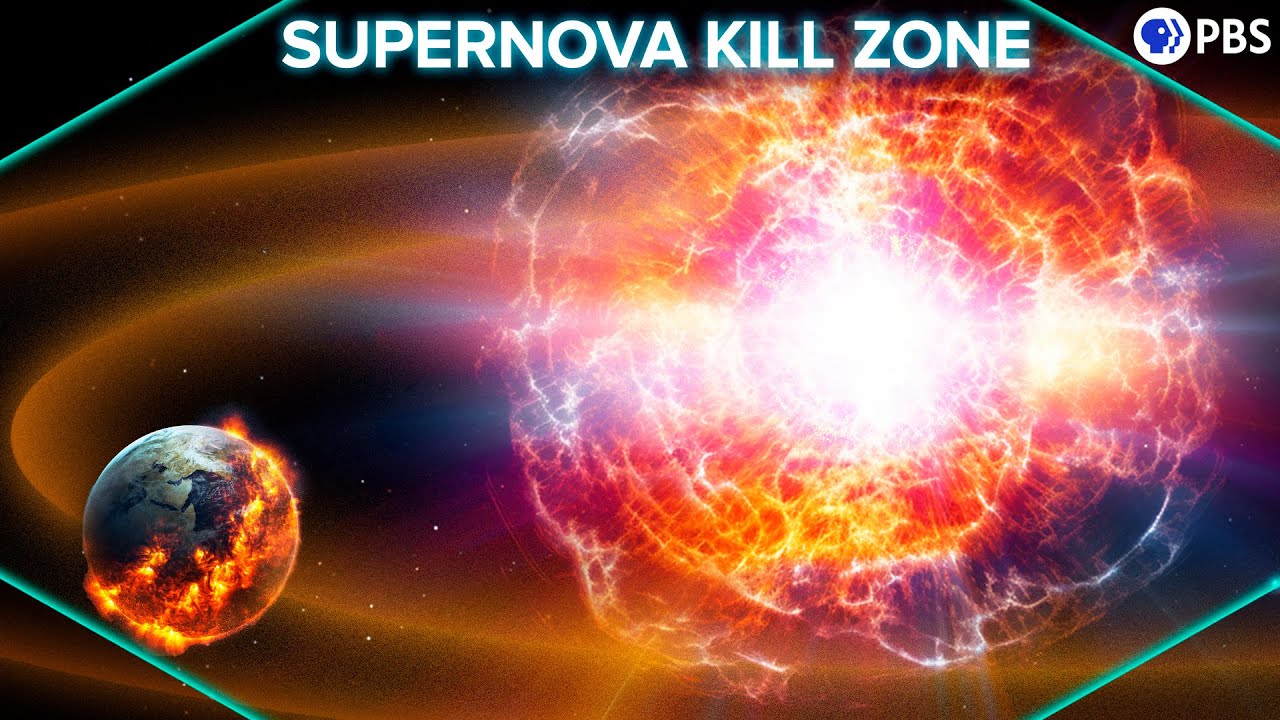
What Supernova Distance Would Trigger Mass Extinction?
Keywords
Summary
213 words
Critical Evaluation
Value of the Information & Strength of the Argument
The video provides substantial value by synthesizing current scientific understanding of supernova dangers into a clear, quantitative framework. It effectively communicates the concept of a ‘kill zone’ and differentiates between the threats from gamma rays, X-rays, and cosmic rays. The argumentation is solid, building from fundamental stellar physics to the specific risks to Earth, and is supported by references to geological evidence (iron-60), historical supernovae, and recent research. The host’s explanations are logical and well-paced, making complex topics accessible without oversimplification.
Scientific Rigor, Source Quality, Title Accuracy
The scientific rigor is high, consistent with PBS Space Time’s reputation. The video cites specific studies (e.g., the April 2023 paper on X-ray bright supernovae) and uses established astrophysical concepts. The title accurately reflects the content, which directly addresses the question of dangerous supernova distances. The presentation is balanced, acknowledging uncertainties in estimates. The description provides links to PBS, Brilliant (sponsor), and the show’s merchandise, but no direct links to the cited research papers, which is a minor limitation for source verification.
178 words
Title / Content Match
The title accurately reflects the content, which explores the distances at which supernovae become dangerous to Earth and life.
Quality & Reliability
9/10
High-quality science communication from PBS Space Time, hosted by astrophysicist Matt O'Dowd. The content is well-researched, up-to-date (references a 2023 study), and presents complex astrophysical concepts accurately. The channel has a strong reputation for reliability.
Key Moments
Markers derived by PSI from the transcript: the creator did not define chapters.
- Introduction: A hypothetical supernova seen by an australopithecus 2.7 million years ago, and the question of when we might see one.
- Betelgeuse's recent dimming and brightening, and its distance of 640 light-years.
- Explanation of core-collapse (Type II) supernovae and the role of neutrinos.
- Dangers from gamma rays and X-rays, and the ozone layer as a shield.
- Cosmic rays as the primary long-range threat, with a kill zone of 30-50 light-years.
- The 2023 study on X-ray bright supernovae extending the kill zone to 150 light-years.
- Nearby potential supernova progenitors: Spica, IK Pegasi, and Betelgeuse.
- Estimating supernova frequency in the Milky Way and the likelihood of a dangerous event.
Cited Sources
- PBS Donation Page — Support for PBS Member Stations.
- Brilliant.org — Sponsor of the episode, offering STEM courses.
- Space Time Mailing List — Sign up for episode notifications.
- Space Time Library Search — Search all past episodes.
- Space Time Merch Store — Purchase merchandise.
- J.R.S. Schattenberg (Music) — End credits music.
Concurring Sources
- NASA - Supernovae — General information on supernovae and stellar evolution.
Contribution & Novelties
The video’s original contribution lies in its clear synthesis of the various lethal mechanisms of supernovae and their respective distances, providing a comprehensive ‘kill zone’ framework. It also highlights a recent 2023 study on X-ray bright supernovae, which extends the potential danger zone significantly. This is a valuable update for the public understanding of astrophysical threats.
Pour aller plus loin :
- Supernova — Overview of supernova types and physics.
- Cosmic ray — High-energy particles from space, a key threat discussed.
- Ozone depletion — The mechanism by which supernovae can harm life.
- Iron-60 — Isotope evidence for past supernovae.
- Betelgeuse — The famous red supergiant discussed in the video.
108 words
Radar Profile
The radar profile shows a well-rounded video with high scores across all dimensions, indicating excellent information density, quality, technical depth, and reliability. It is a strong educational resource.
💬 Très positif. Sur les 30 commentaires analysés, l'enthousiasme est palpable : les spectateurs expriment leur admiration pour le présentateur Matt O'Dowd, leur fascination pour le sujet, et partagent des anecdotes personnelles et des références culturelles liées aux supernovae.