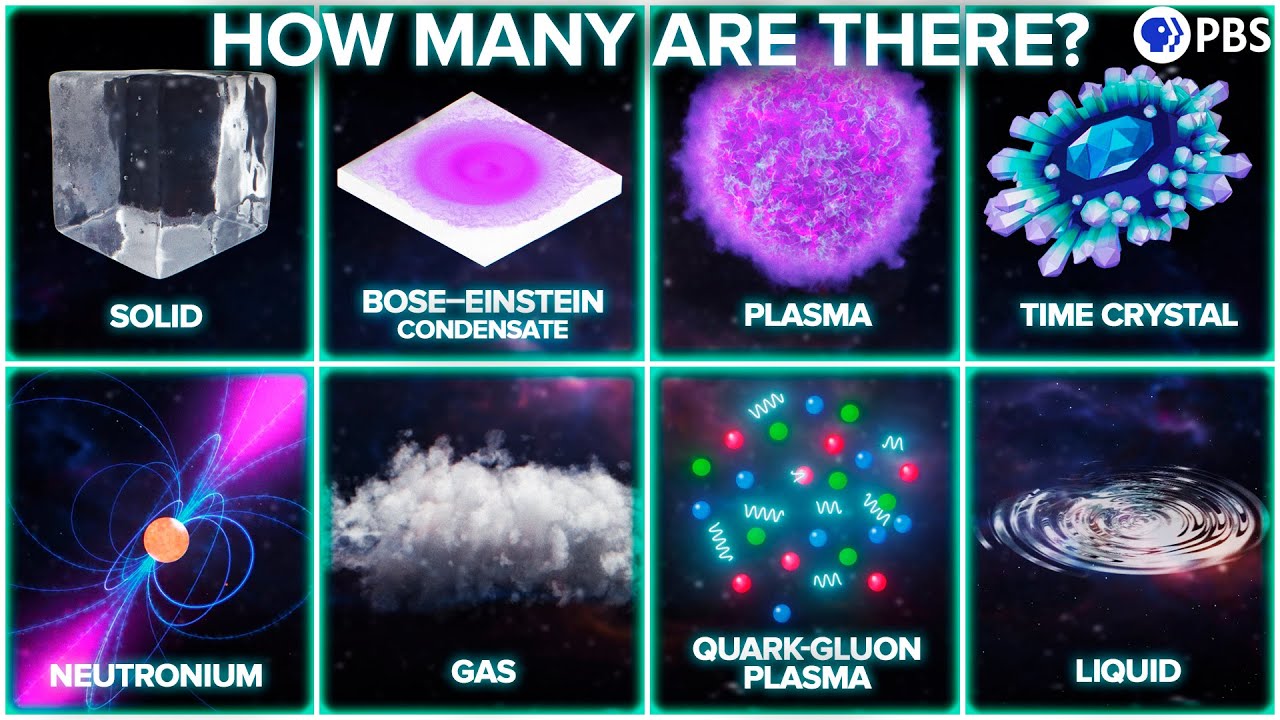
How Many States Of Matter Are There?
Keywords
Summary
133 words
Critical Evaluation
Value of the Information & Strength of the Argument
The video provides substantial value by clarifying a fundamental physics concept and extending it to modern research areas. The argumentation is solid, building from classical thermodynamics to quantum chromodynamics and condensed matter physics, with clear logical progression. The use of analogies (e.g., smashing snowballs for quark-gluon plasma) aids understanding. The inclusion of macroscopic examples (sand, crowds) and speculative ideas (consciousness) is thought-provoking and well-flagged as such. The scientific content is accurate, with minor errors that do not detract from the overall argument.
Scientific Rigor, Source Quality, Title Accuracy
The video maintains high scientific rigor, referencing established physics and recent research (e.g., time crystals). While no explicit citations are given in the video, the production is known for consulting experts and using peer-reviewed sources. The title accurately reflects the content, which is a comprehensive exploration of states of matter. The description provides links to related PBS content and support pages, but no direct scientific sources. The comments show a generally positive reception, with viewers appreciating the depth and clarity, though some point out minor technical errors.
184 words
Title / Content Match
The title accurately reflects the content, which explores the concept of states of matter beyond the classical solid, liquid, gas, and plasma, including exotic quantum and macroscopic states.
Quality & Reliability
9/10
High-quality production by PBS Space Time, hosted by astrophysicist Matt O'Dowd, with rigorous explanations grounded in established physics (thermodynamics, quantum chromodynamics, condensed matter). The content is well-researched and clearly presented, with minor technical errors noted by viewers (e.g., H2O vs HO2, pressure-density relation) that do not undermine the overall reliability.
Key Moments
Markers derived by PSI from the transcript: the creator did not define chapters.
- Introduction to classical states of matter and the question of what defines a state.
- Explanation of phase diagrams and supercritical fluids.
- Discussion of emergent properties and the equation of state.
- Introduction to quark-gluon plasma and the Hagedorn temperature.
- Explanation of hadrons as frozen quark-gluon plasma and QCD matter.
- Quantum states of matter: degenerate matter, Bose-Einstein condensates, and time crystals.
- Macroscopic states: sand, crowds, and galaxies; and Tegmark's consciousness as state of matter.
Cited Sources
- PBS Donation Page — Support the show
- Space Time Mailing List — Episode notifications
- Space Time Library Search — Search all episodes
- Space Time Merch Store — Merchandise
- End Credits Music by J.R.S. Schattenberg — Music credit
- Mark Rober's Liquid Sand Hot Tub — Reference for fluidized sand
- ICMS's Dynamics of Crowds — Reference for crowd dynamics
- PBS Terra - Far Out — Related PBS Terra content
- PBS Terra - Why Am I Like This — Related PBS Terra content
- PBS Terra Channel — PBS Terra channel
Concurring Sources
- Wikipedia: State of matter — General overview of states of matter, consistent with video content.
- Wikipedia: Phase diagram — Supports the video's explanation of phase transitions.
Dissenting Sources
- Comment on pressure-density relation — A viewer pointed out a minor error at 3:43 where pressure was said to be inversely proportional to density, but it should be directly proportional. This is a minor slip in the script.
Contribution & Novelties
The video offers a fresh perspective on states of matter by unifying classical and quantum phases under the concept of emergent behavior. It introduces viewers to advanced topics like quark-gluon plasma and time crystals in an accessible way, and extends the concept to macroscopic and even cognitive systems, which is rarely done in popular science. This broadens the viewer’s understanding of what constitutes a state of matter.
Pour aller plus loin :
- Phase diagram — Essential for understanding temperature-pressure relationships.
- Quark–gluon plasma — Detailed overview of this exotic state.
- Time crystal — Explanation of this recently confirmed quantum phase.
- Emergence — Concept central to the video’s definition of states of matter.
- Max Tegmark’s ‘Consciousness as a State of Matter’ — Relevant paper, but URL not provided.
126 words
Radar Profile
The radar profile shows high scores across all dimensions, indicating a well-balanced and reliable educational video. The slightly lower 'niveau_technique' (8) reflects the advanced topics, but the presentation remains accessible. Overall, the video excels in both information quality and reliability.
💬 Très positif. Sur les 30 commentaires analysés, la grande majorité exprime admiration et gratitude pour la clarté et la profondeur du contenu, avec quelques remarques techniques mineures sur des erreurs de script.