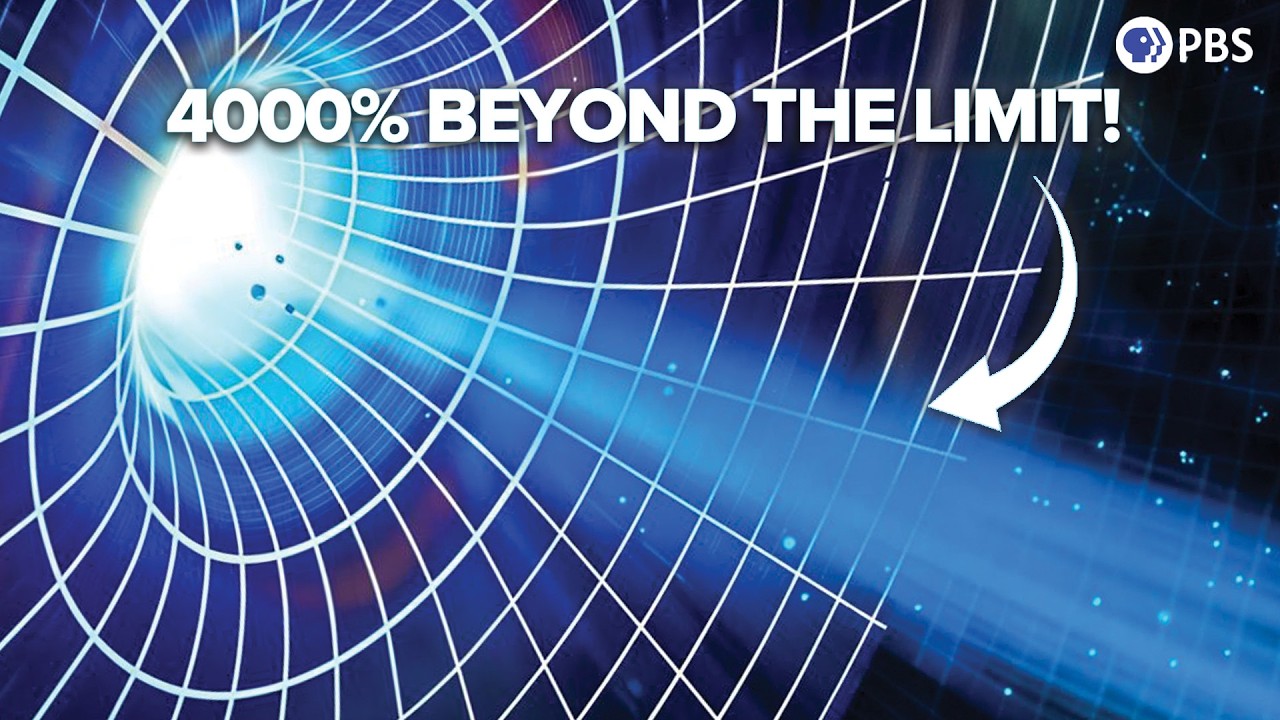
The NEW Ultimate Energy Limit of the Universe
Keywords
Summary
154 words
Critical Evaluation
Value of the Information & Strength of the Argument
The video provides valuable insights into a recent astronomical discovery and its implications for black hole formation. The argumentation is solid, building from the historical context of the Eddington limit to the modern understanding of accretion disks. It clearly explains complex concepts like radiation pressure and advection, making them accessible. The reasoning is logical and well-supported by theoretical models and simulations, though it acknowledges that the explanation for LID-568’s extreme luminosity is still a hypothesis.
Scientific Rigor, Source Quality, Title Accuracy
The scientific rigor is high, with accurate explanations of established physics and references to recent JWST observations. The sources are not explicitly cited in the video, but the content aligns with current astrophysical literature. The title is appropriate and not misleading. The video does not include any external sources in the description, but it is produced by PBS Space Time, known for its reliable science communication. The content is well-researched and presented by an expert host.
166 words
Title / Content Match
The title accurately reflects the content, which explores the theoretical limits of energy and luminosity in the universe, specifically the Eddington limit and its violation by the quasar LID-568.
Quality & Reliability
9/10
High-quality science communication with clear explanations of complex astrophysics, grounded in established theories and recent JWST observations. The content is accurate and well-structured, though it presents hypotheses as plausible explanations rather than definitive conclusions.
Key Moments
Markers derived by PSI from the transcript: the creator did not define chapters.
- Introduction to the problem of oversized black holes in the early universe.
- Introduction of LID-568, a quasar exceeding the Eddington limit by 4000 times.
- Explanation of the Eddington limit and its origin in stellar physics.
- Derivation of the mass-luminosity relation for stars and the onset of radiation pressure.
- Application of Eddington's ideas to black holes and accretion disks.
- Discussion of thin accretion disks and their inefficiency in feeding black holes.
- Introduction of super-Eddington accretion and thick disks (slim disks, Polish doughnuts).
- Explanation of how radiation can escape through funnels, allowing rapid growth.
- Conclusion: LID-568 as evidence for super-Eddington growth in the early universe.
Cited Sources
- DeleteMe — Sponsor of the video, mentioned in the introduction and conclusion.
- DeleteMe International — Sponsor of the video, mentioned in the description.
- Space Time Mailing List — Mentioned in the description for episode notifications.
- Space Time Library Search — Mentioned in the description for searching past episodes.
- Space Time Merch Store — Mentioned in the description and at the end of the video.
- J.R.S. Schattenberg's YouTube Channel — End credits music by J.R.S. Schattenberg.
Concurring Sources
- Eddington luminosity — The theoretical limit discussed in the video.
- Accretion disk — The structure that allows super-Eddington accretion.
- Quasar — The type of object LID-568 is.
Contribution & Novelties
The video provides a clear and accessible explanation of the Eddington limit and its violation by the quasar LID-568, highlighting a recent JWST discovery. It connects theoretical concepts to observational evidence, offering a plausible mechanism for the rapid growth of supermassive black holes in the early universe.
Pour aller plus loin :
- Eddington luminosity — The theoretical limit on luminosity for a celestial body, central to the video’s topic.
- Accretion disk — The structure of matter falling into a black hole, key to understanding super-Eddington accretion.
- Quasar — The bright active galactic nuclei discussed in the video.
- James Webb Space Telescope — The telescope that observed LID-568, providing the data for the video’s discussion.
114 words
Radar Profile
The radar profile shows high scores across all dimensions, indicating a well-rounded and reliable science communication piece. The video excels in providing substantial information with high quality and technical depth, while maintaining a strong overall reliability.
💬 Très positif. Sur les 30 commentaires analysés, les spectateurs expriment une admiration générale pour la qualité du contenu et la clarté des explications, avec quelques remarques sur une erreur d'image mineure et des suggestions de sujets supplémentaires.