From FinFET to CFET: Semiconductor Roadmap, Materials & Device Junctions | 2026 L2
Keywords
Summary
145 words
Critical Evaluation
Value of the Information & Strength of the Argument
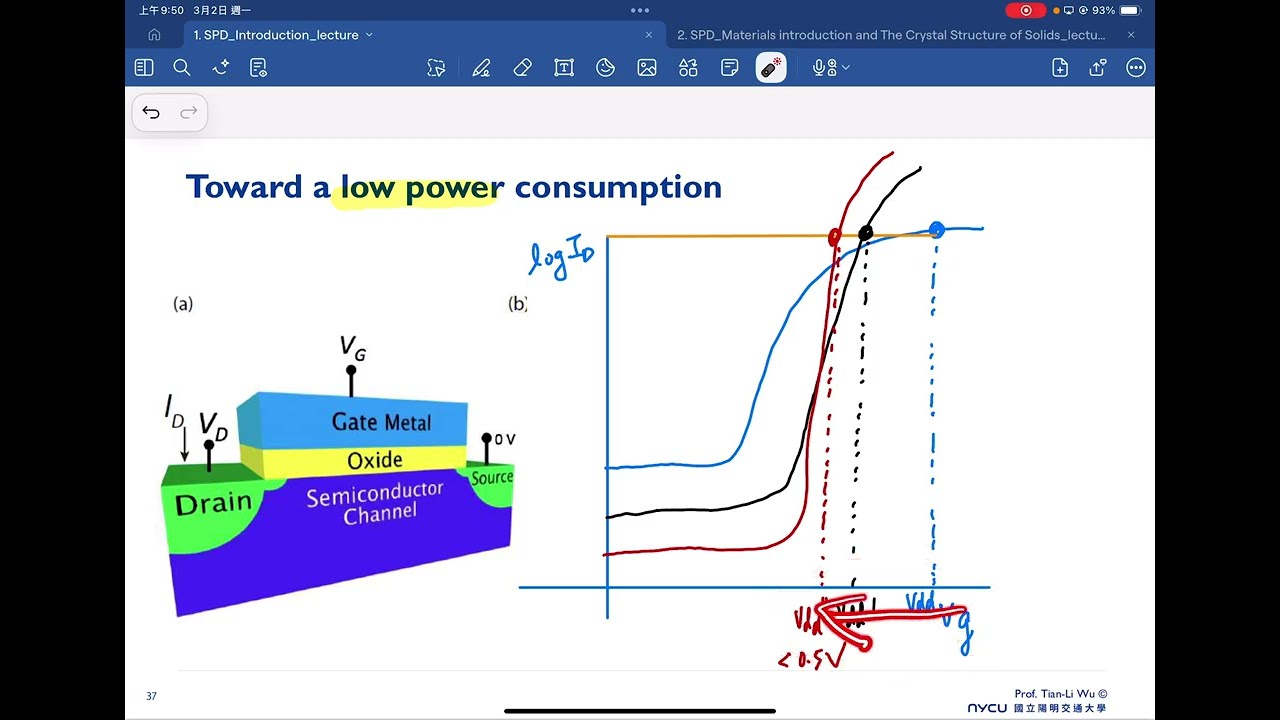
The lecture provides a comprehensive overview of the semiconductor roadmap, connecting device scaling goals to power consumption challenges. It effectively argues that reducing subthreshold swing and off-current are key to lowering operating voltage and power. The discussion of more-than-Moore technologies, such as GaN and SiC for power conversion, illustrates the broader impact of semiconductor innovation. The argumentation is logical and well-structured, though some claims (e.g., efficiency improvements) are presented without detailed evidence.
Scientific Rigor, Source Quality, Title Accuracy
The lecture is scientifically rigorous, based on established semiconductor physics and industry trends. It references TSMC roadmaps and NVIDIA data, but these are not formally cited. The title accurately reflects the content, which covers the roadmap from FinFET to CFET and discusses materials and junctions. The lecture is suitable for an academic audience, and the content is consistent with current knowledge in the field.
151 words
Title / Content Match
The title accurately reflects the content, covering the semiconductor roadmap from FinFET to CFET and discussing materials and device junctions.
Quality & Reliability
8/10
The lecture is delivered by a professor in the field, based on established semiconductor physics and industry roadmaps. It includes references to TSMC and NVIDIA data, and the content is consistent with current knowledge. However, it is a lecture, not peer-reviewed, and some claims (e.g., efficiency improvements) are not deeply sourced.
Key Moments
Markers derived by PSI from the transcript: the creator did not define chapters.
- Introduction and review of FinFET structure and benefits.
- Discussion of beyond-FinFET options: GAA, nanosheet, CFET, and novel mechanisms.
- Explanation of low power consumption goal and subthreshold swing.
- More-than-Moore technologies: power conversion for AI data centers and EVs.
- Introduction to semiconductor materials and band gaps.
- Discussion of junction types: metal-semiconductor, PN, heterojunction, MOS.
- Crystal structures and unit cell calculations.
Cited Sources
- Course outline at NYCU — Official course information for this lecture series.
Concurring Sources
- TSMC Technology Roadmap — Official TSMC page describing logic technology nodes and roadmap.
Contribution & Novelties
The lecture provides a comprehensive and up-to-date overview of the semiconductor roadmap, connecting device physics to power consumption challenges. It uniquely bridges advanced logic scaling with more-than-Moore power electronics, emphasizing the shared goal of energy efficiency. The discussion of CFET and backside power delivery reflects the latest industry trends.
Pour aller plus loin :
- Gate-all-around FET — Overview of GAA technology.
- Subthreshold swing — Explanation of SS and its importance.
- Gallium nitride — Material for power electronics.
- Silicon carbide — Material for high-power applications.
84 words
Radar Profile
The radar profile shows high scores across all dimensions, indicating a well-balanced lecture with substantial information, solid technical depth, and good reliability. The slightly lower score in 'niveau_technique' relative to others suggests it is accessible to a broad audience while still providing advanced content.