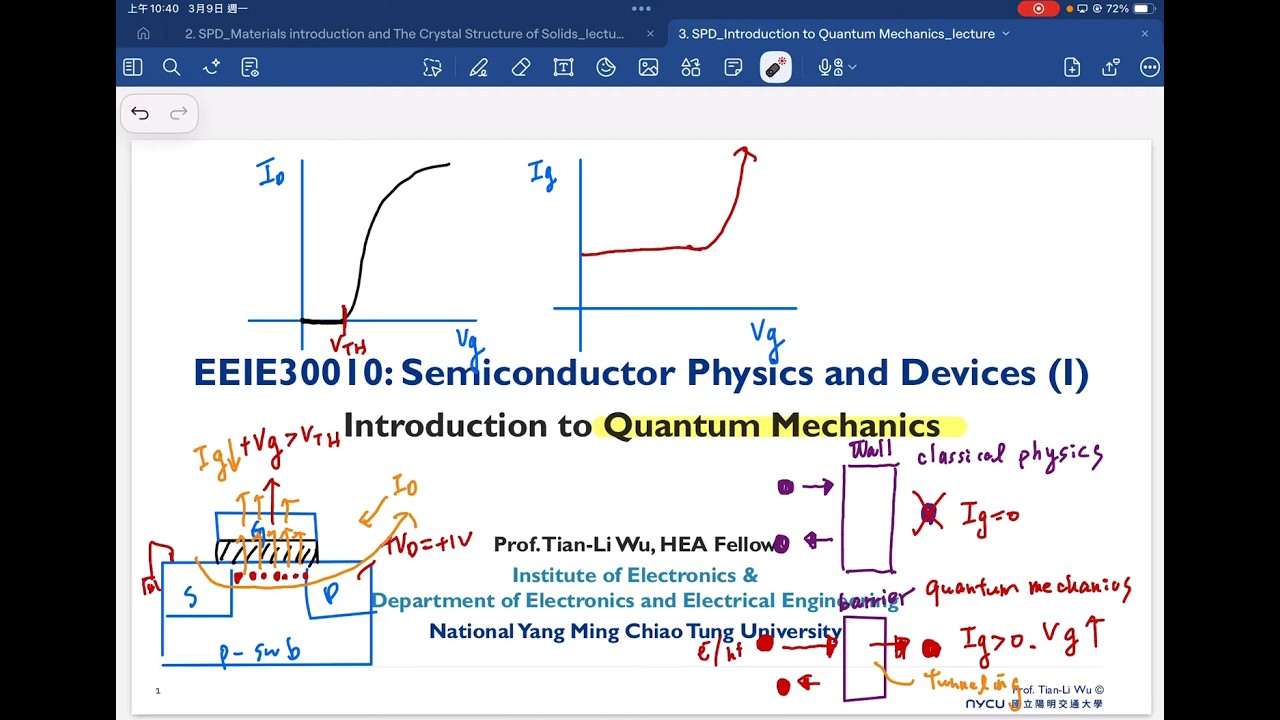
From Crystal to Quantum Tunneling: Why We Need Quantum Mechanics for Modern Transistors | 2026 L3
Keywords
Summary
133 words
Critical Evaluation
Value of the Information & Strength of the Argument
The lecture provides a solid foundation in semiconductor materials and introduces quantum mechanics with clear motivation. The explanation of Miller indices is thorough and accessible, using examples to illustrate concepts. The argumentation for quantum mechanics is logical, starting from the limitations of classical physics at the nanoscale. The instructor effectively links material defects to reliability issues, emphasizing practical implications. However, the lecture is introductory and does not delve into advanced derivations or experimental evidence, limiting its depth for experts.
Scientific Rigor, Source Quality, Title Accuracy
The lecture is scientifically rigorous, with accurate explanations of established concepts. The instructor references a specific paper to illustrate the application of Miller indices, but does not provide detailed citations. The title accurately reflects the content, which transitions from crystal structure to quantum mechanics. The lecture is part of a university course, indicating a structured curriculum. However, the lack of explicit sources and the introductory nature may not satisfy advanced researchers seeking primary references.
168 words
Title / Content Match
The title accurately reflects the content, which transitions from crystal structures and defects to the necessity of quantum mechanics for understanding tunneling in modern transistors.
Quality & Reliability
8/10
The lecture is delivered by a professor in a university course, providing structured and accurate explanations of semiconductor physics. The content aligns with established scientific knowledge, and the instructor demonstrates expertise. However, the lecture is introductory and does not include citations to primary sources, limiting its depth for advanced verification.
Key Moments
Markers derived by PSI from the transcript: the creator did not define chapters.
- Introduction to Miller indices and their importance in defining crystal planes.
- Explanation of negative intercepts and parallel planes in Miller index calculation.
- Discussion of bonding types: ionic, covalent, metallic, and van der Waals.
- Introduction to crystal imperfections: vacancies, interstitials, and line defects.
- Impact of defects on device reliability and trapping phenomena.
- Transition to quantum mechanics: why classical physics fails at the nanoscale.
- Introduction to quantum tunneling and its relevance to gate leakage current in MOSFETs.
Cited Sources
- Course Outline - Semiconductor Physics and Devices — Official course outline for the lecture series, providing context and syllabus.
Concurring Sources
- Semiconductor Physics and Devices — General reference on semiconductor devices, consistent with the lecture's content.
Contribution & Novelties
The lecture provides a clear pedagogical bridge from classical crystal physics to quantum mechanics, emphasizing the practical necessity for modern transistor design. It effectively connects material defects to reliability issues, a perspective often underemphasized in introductory courses.
Pour aller plus loin :
- Miller index - Wikipedia — Provides a comprehensive overview of Miller indices, including mathematical derivation and applications.
- Quantum tunnelling - Wikipedia — Explains the quantum mechanical phenomenon of tunneling, relevant to the lecture’s discussion of gate leakage.
- MOSFET - Wikipedia — Details the structure and operation of MOSFETs, the device context for the lecture’s tunneling discussion.
98 words
Radar Profile
The radar profile shows high scores in information quantity, quality, and reliability, with a slightly lower technical level, indicating a well-structured introductory lecture that is accessible yet scientifically sound.