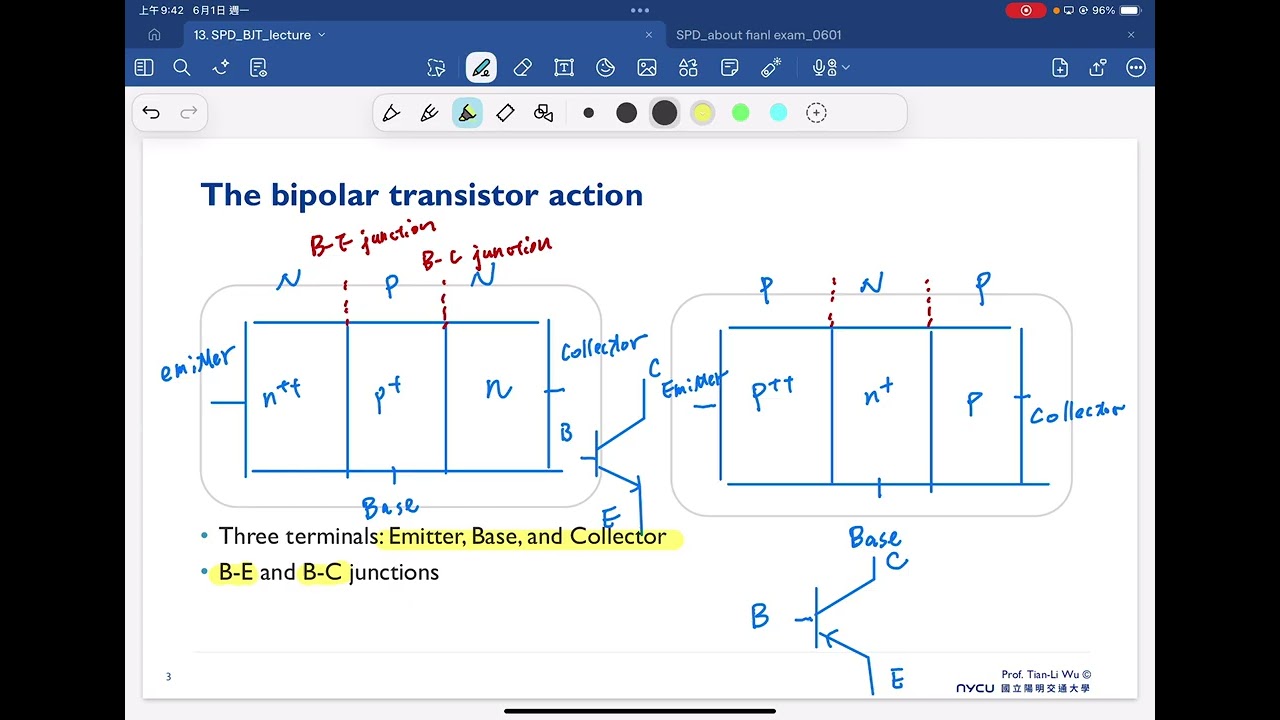
BJT Part1: NPN Operation, Minority Carrier Distribution & What Controls Current Gain | 2026 L12
Keywords
Summary
139 words
Critical Evaluation
Value of the Information & Strength of the Argument
The lecture provides a thorough and systematic explanation of BJT operation, building on prior knowledge of PN junctions. The argumentation is logically structured, starting from the device structure and biasing conditions, then deriving minority carrier distributions, and finally linking these to current gain. The professor uses clear diagrams and step-by-step reasoning, making complex concepts accessible. The emphasis on physical intuition, such as the role of concentration gradients and electric fields, strengthens the educational value. The derivation of current gain into three factors is particularly valuable, as it provides a clear framework for understanding device design trade-offs.
Scientific Rigor, Source Quality, Title Accuracy
The lecture is scientifically rigorous, adhering to standard semiconductor physics theory. The content is consistent with established textbooks and academic literature. However, the lecture does not cite specific external sources, relying instead on the professor’s expertise and the course material. The title accurately reflects the content, focusing on NPN operation, minority carrier distribution, and current gain. The lecture is part of a formal university course, which adds to its credibility. No comments were provided for analysis.
187 words
Title / Content Match
The title accurately reflects the content, focusing on NPN operation, minority carrier distribution, and current gain control.
Quality & Reliability
8/10
The lecture is a formal academic presentation by a professor, based on established semiconductor physics principles. The content is technically accurate and well-structured, though it lacks explicit citations to external sources.
Key Moments
Markers derived by PSI from the transcript: the creator did not define chapters.
- Introduction to BJT and learning outcomes
- Explanation of BJT structure and circuit symbols
- Four operation modes and biasing conditions
- Minority carrier distribution in forward active mode
- Minority carrier distribution in saturation, cutoff, and inverse active modes
- Band diagram and carrier transport in forward active mode
- Derivation of current gain and its three factors
- Design insights for maximizing current gain
Cited Sources
- Course outline — Official course page providing details of the semiconductor physics course.
Concurring Sources
- Semiconductor Physics and Devices — Standard textbook by Donald Neamen, covering BJT operation in detail.
Contribution & Novelties
The lecture provides a clear pedagogical breakdown of BJT operation, particularly the minority carrier distribution and its link to current gain. The decomposition of current gain into three physical factors is a standard but well-explained approach. The lecture’s contribution lies in its step-by-step derivation and emphasis on physical intuition, which is valuable for students.
Pour aller plus loin :
- Bipolar junction transistor — Overview of BJT theory and applications.
- Minority carrier — Explanation of minority carriers in semiconductors.
- Current gain — Definition and significance of current gain in transistors.
89 words
Radar Profile
The radar profile shows high scores in technical level and information quality, indicating a rigorous and detailed lecture. The lower score in quantity of information reflects the focused scope on fundamental concepts. Overall, the lecture is well-balanced for an academic audience.