MOSFET Part 2: Basic Operations and Key Advanced Concepts| 2026 L11
Keywords
Summary
156 words
Critical Evaluation
Value of the Information & Strength of the Argument
The lecture provides a solid foundation in MOSFET physics, explaining the operation from first principles. The argumentation is logical and builds step by step, from the basic device structure to the derivation of current equations. The instructor emphasizes the physical intuition behind each concept, such as the gradual channel approximation and the effect of drain bias on channel charge. The value of the information is high for educational purposes, as it clarifies common misconceptions and provides a clear framework for understanding MOSFET behavior. The argumentation is consistent with standard textbook treatments, and the instructor’s explanations are accessible without oversimplifying the underlying physics.
Scientific Rigor, Source Quality, Title Accuracy
The lecture demonstrates scientific rigor by systematically deriving the current-voltage relationships and clearly stating the assumptions involved. The content aligns with established semiconductor device theory, and the instructor references the course textbook implicitly. The title accurately reflects the content, which covers both basic operations and advanced concepts. The lecture is part of a structured course, and the instructor’s expertise is evident. However, as a lecture, it does not cite specific research papers, but the material is well-established and reliable.
196 words
Title / Content Match
The title accurately reflects the content, which covers basic operations and advanced concepts of MOSFETs.
Quality & Reliability
8/10
Lecture by a professor at a reputable institution (NYCU), covering standard MOSFET physics with clear explanations and derivations. The content is consistent with established semiconductor device theory, though it is a lecture rather than peer-reviewed research.
Key Moments
Markers derived by PSI from the transcript: the creator did not define chapters.
- Introduction to enhancement-mode and depletion-mode MOSFETs, explaining threshold voltage differences.
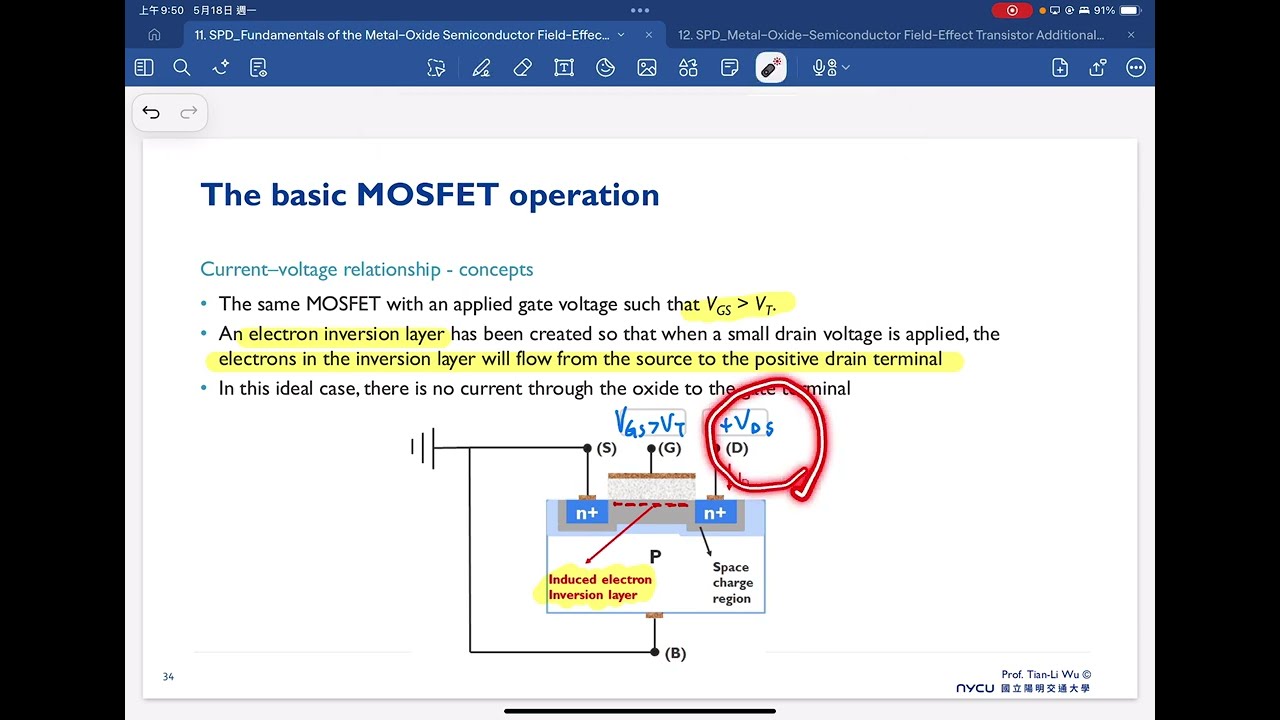
- Explanation of n-channel enhancement-mode operation, including electron flow and current direction.
- Discussion of p-channel devices and their complementary operation.
- Analysis of ID-VD characteristics in the linear region, treating the channel as a resistor.
- Explanation of channel pinch-off and the onset of saturation.
- Derivation of the drain current equations for linear and saturation regions.
- Discussion of short-channel effects and threshold voltage modulation.
- Introduction to carrier mobility and its impact on device performance.
Cited Sources
- Course outline for Semiconductor Physics and Devices — Course page providing details about the lecture series.
Concurring Sources
- MOSFET on Wikipedia — General reference for MOSFET operation and types.
- Semiconductor Device Physics by S.M. Sze — Standard textbook covering MOSFET theory in depth.
Contribution & Novelties
This lecture provides a clear and systematic explanation of MOSFET operation, bridging the gap between basic concepts and advanced topics. It emphasizes the physical mechanisms behind the ID-VD characteristics, making it valuable for students and practitioners. The lecture’s contribution lies in its pedagogical approach, breaking down complex phenomena into understandable steps.
Pour aller plus loin :
- MOSFET on Wikipedia — Comprehensive overview of MOSFET types and operation.
- Gradual channel approximation — Key assumption used in deriving the current equations.
- Short-channel effects — Advanced topic discussed in the lecture, relevant for modern device scaling.
93 words
Radar Profile
The radar profile shows high scores across all dimensions, indicating a well-rounded and reliable educational resource. The lecture excels in providing quantitative information and technical depth, with a strong emphasis on physical understanding.
💬 No comments were provided for analysis.