2025 L10: Mass Transport Induced Failures (1)
Keywords
Summary
153 words
Critical Evaluation
Value of the Information & Strength of the Argument
The lecture provides a solid foundation in mass transport induced failures, clearly explaining the physical mechanisms and their relevance to modern semiconductor technology. The argumentation is logical, building from basic diffusion concepts to specific failure modes. The use of a simple model to illustrate electromigration is effective. The instructor emphasizes the practical importance of these issues in advanced interconnects, making the content valuable for engineers and researchers. However, the lecture is introductory and does not delve into advanced modeling or recent research findings.
Scientific Rigor, Source Quality, Title Accuracy
The lecture is scientifically rigorous, presenting well-established concepts in semiconductor reliability. The instructor references a 2012 paper on electromigration in 3D IC TSV interconnects, but no specific citation is given during the talk. The course syllabus link is provided in the description, but no other sources are mentioned. The title accurately reflects the content. The lecture is part of a structured course, indicating a systematic approach to the subject.
167 words
Title / Content Match
The title accurately reflects the content, which focuses on mass transport induced failures in semiconductor interconnects.
Quality & Reliability
8/10
The lecture is part of a university course on semiconductor device reliability, presented by a faculty member. It provides a structured overview of mass transport induced failures, covering fundamental physics and practical reliability concerns. The content is consistent with established knowledge in the field, though it lacks explicit citations to specific sources during the talk.
Key Moments
Markers derived by PSI from the transcript: the creator did not define chapters.
- Introduction to mass transport induced failures and learning outcomes.
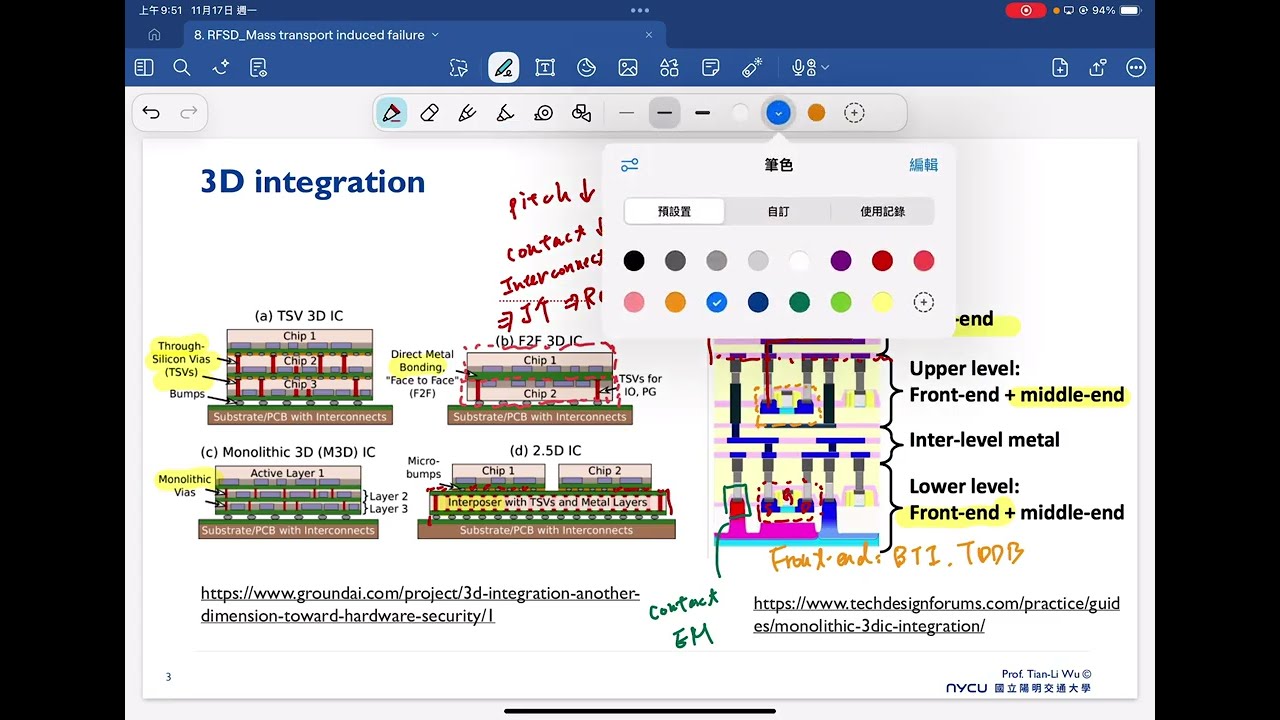
- Overview of 3D IC integration schemes (TSV, face-to-face, monolithic, 2.5D).
- Discussion of front-end vs back-end reliability issues, including TDDB in interconnects.
- Introduction to electromigration and its impact on interconnect resistance.
- Explanation of atom movement and driving forces (electric field, concentration gradient, stress).
- Discussion of stress voiding due to CTE mismatch in BEOL structures.
- Derivation of atom flux using Nernst-Einstein equation.
- Identification of three main driving forces for mass transport.
Cited Sources
- Course Syllabus — Provided in the video description as the course syllabus.
Concurring Sources
- Electromigration in 3D IC TSV interconnects (2012) — Referenced in the lecture as a study on electromigration in TSV interconnects.
Contribution & Novelties
The lecture provides a clear and structured introduction to mass transport induced failures in semiconductor interconnects, bridging fundamental physics with practical reliability concerns. It effectively explains the driving forces and failure mechanisms, making it a valuable educational resource. The discussion of 3D IC integration highlights the growing importance of interconnect reliability in advanced packaging.
Pour aller plus loin :
- Electromigration (Wikipedia) — Overview of electromigration phenomenon.
- Black’s equation (Wikipedia) — Empirical model for electromigration lifetime.
- Stress voiding (Wikipedia) — Explanation of stress-induced voiding in interconnects.
85 words
Radar Profile
The radar profile shows high scores in information quantity, quality, and reliability, with a slightly lower technical level, indicating a well-structured and informative lecture that is accessible to a technical audience but not overly advanced.