2025 L3: An Overview of Electronic Devices and Their Reliability (2)
Keywords
Summary
147 words
Critical Evaluation
Value of the Information & Strength of the Argument
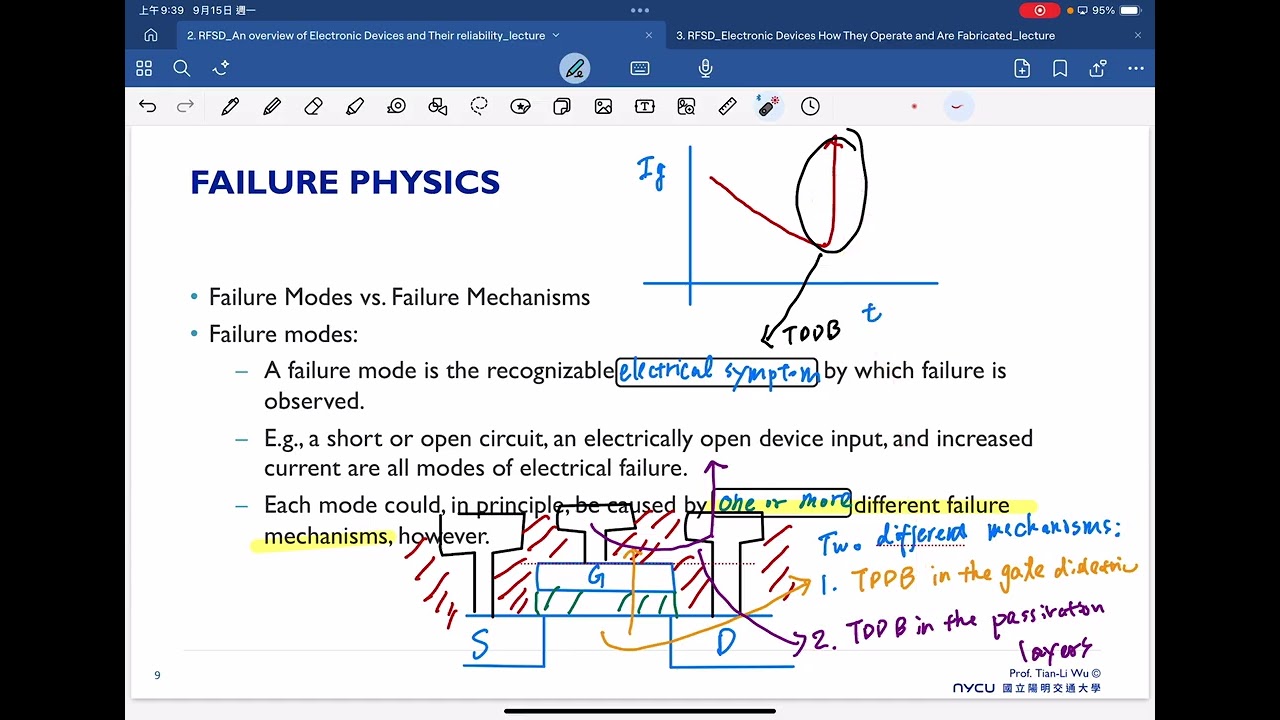
The lecture provides a solid foundation in reliability concepts, clearly distinguishing between failure modes and mechanisms. The argumentation is logical, building from basic definitions to thermodynamic and kinetic principles. The use of examples, such as the TDDB and corrosion, helps to concretize abstract ideas. The instructor effectively explains the Arrhenius equation and its relevance to reliability, making the content valuable for students and practitioners. The presentation is well-structured, though it could benefit from more specific case studies or real-world examples to further illustrate the application of these principles.
Scientific Rigor, Source Quality, Title Accuracy
The lecture is scientifically rigorous, presenting established concepts from thermodynamics and kinetics. The instructor references the Arrhenius equation and Gibbs free energy, which are well-known in the field. However, no specific sources are cited within the lecture, and the only link provided is the course syllabus. The title accurately reflects the content, which is an overview of electronic devices and their reliability. The lecture is part of a university course, indicating a level of academic credibility. The lack of explicit citations is a minor weakness, but the content aligns with standard reliability physics.
196 words
Title / Content Match
The title accurately reflects the content, which is the second part of an overview of electronic devices and their reliability.
Quality & Reliability
8/10
The lecture is part of a university course on semiconductor device reliability, presented by an academic expert. It covers fundamental concepts with clear explanations and references to established equations (Arrhenius, Gibbs free energy). The content is consistent with standard reliability physics, though it lacks explicit citations to specific literature.
Key Moments
Markers derived by PSI from the transcript: the creator did not define chapters.
- Introduction and recap of previous lecture on reliability definitions.
- Explanation of failure modes vs. failure mechanisms with examples.
- Discussion on how multiple mechanisms can cause the same failure mode.
- Introduction to thermodynamic principles: Gibbs free energy and spontaneous change.
- Explanation of kinetic principles: Arrhenius equation and temperature dependence.
- Application of Arrhenius equation to accelerated testing and reliability prediction.
Cited Sources
- Course Syllabus — Official course outline for the reliability and failure physics of semiconductor devices.
Concurring Sources
- Course Syllabus — The syllabus outlines the course content, which aligns with the lecture topics.
Contribution & Novelties
The lecture provides a clear pedagogical framework for understanding semiconductor device reliability, emphasizing the distinction between failure modes and mechanisms. It connects fundamental thermodynamic and kinetic principles to practical reliability engineering, offering a comprehensive overview. The instructor’s approach of using simple examples to illustrate complex concepts is effective.
Pour aller plus loin :
- Arrhenius equation — The equation is central to modeling temperature-dependent failure rates.
- Gibbs free energy — The thermodynamic concept underlying spontaneous degradation.
- Time-dependent dielectric breakdown — A key failure mechanism discussed in the lecture.
87 words
Radar Profile
The radar profile shows high scores in quantity and quality of information, with a moderate technical level. The reliability score is high, reflecting the academic nature of the content. The profile suggests a well-balanced lecture that is informative and credible.
💬 No comments were provided for analysis.