2025 L6: Mathematics of Failure-and-Reliability(2)
Keywords
Summary
185 words
Critical Evaluation
Value of the Information & Strength of the Argument
The lecture provides valuable insights into the application of statistical distributions in semiconductor reliability. It clearly explains the mathematical formulations and, more importantly, the physical significance of parameters and the rationale for choosing one distribution over another. The argumentation is solid, building from the limitations of the exponential distribution to the flexibility of lognormal and Weibull distributions in modeling different failure phases. The instructor emphasizes the importance of understanding the underlying physics (e.g., diffusion, corrosion, electromigration) to guide distribution selection, which is a crucial point often overlooked. The use of examples (GaAs laser, bonding pad corrosion) illustrates practical applications. The discussion on the bathtub curve and how shape parameters can model its phases is particularly instructive. The lecture also touches on the evolving nature of failure mechanisms with technology scaling, highlighting the ongoing relevance of reliability engineering.
Scientific Rigor, Source Quality, Title Accuracy
The lecture is scientifically rigorous, presenting standard reliability engineering concepts accurately. The instructor references a textbook and mentions the course syllabus, but specific citations are not provided in the video. The title accurately reflects the content, which is a mathematical treatment of failure and reliability distributions. The lecture is well-structured and logically organized, building from basic concepts to more advanced applications. The lack of explicit citations to primary literature is a minor weakness, but the content aligns with established knowledge in the field. The instructor’s expertise is evident, and the explanations are clear and technically sound.
248 words
Title / Content Match
The title accurately reflects the content, which focuses on the mathematics of failure and reliability distributions.
Quality & Reliability
8/10
Lecture from a university course on semiconductor device reliability, presenting established statistical distributions (lognormal, Weibull) with clear explanations of their physical basis and applications. The content is technically sound and consistent with standard reliability engineering principles, though it lacks explicit citations to primary sources.
Key Moments
Markers derived by PSI from the transcript: the creator did not define chapters.
- Introduction and recap of exponential distribution limitations.
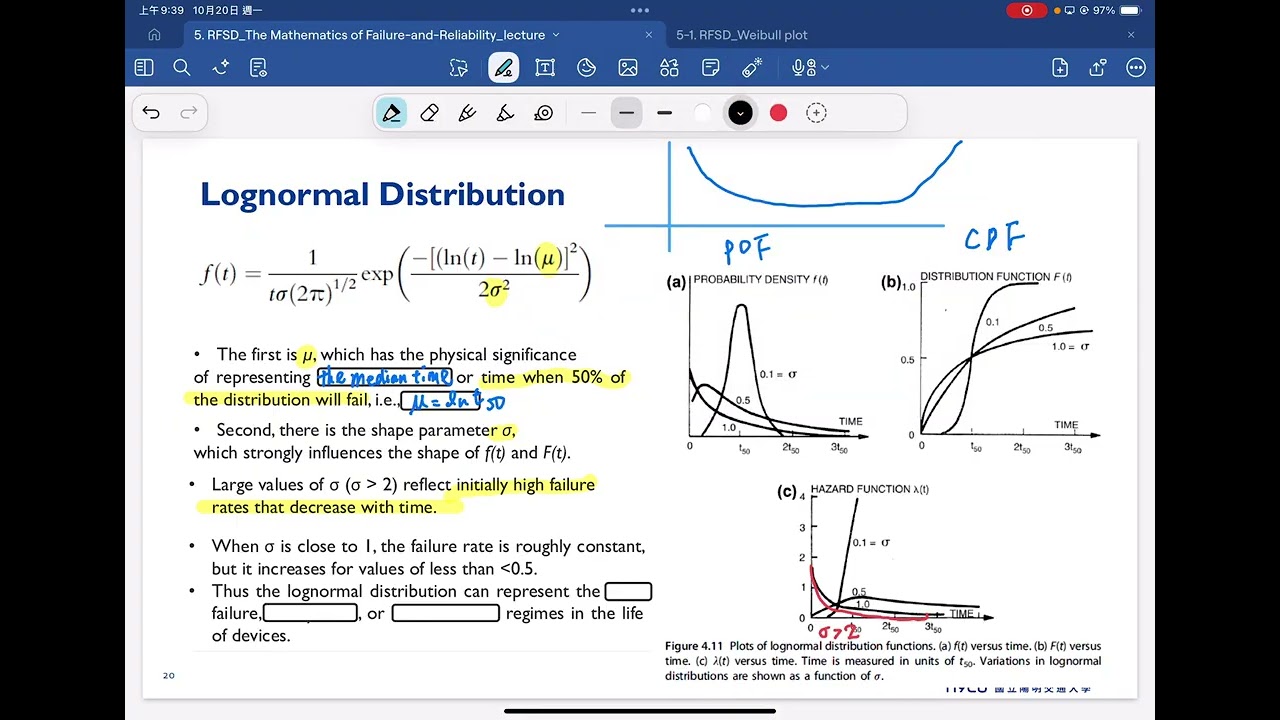
- Introduction to lognormal distribution: PDF, CDF, and hazard function.
- Physical meaning of lognormal parameters (mu, sigma) and effect on shape.
- Modeling bathtub curve phases with lognormal distribution by varying sigma.
- Example: GaAs laser lifetime data and extrapolation to low failure percentiles.
- Introduction to Weibull distribution: PDF, CDF, and hazard function.
- Weibull shape parameter beta and its role in modeling bathtub curve phases.
- Example: Weibull plot for bonding pad corrosion.
- Criteria for choosing between lognormal and Weibull distributions.
- Physical mechanisms favoring lognormal (diffusion, corrosion) and discussion of electromigration.
Cited Sources
- Course Syllabus — Referenced in the video description as the course syllabus.
Concurring Sources
- Reliability Engineering and System Safety — General field of reliability engineering, which includes the use of lognormal and Weibull distributions.
Contribution & Novelties
The lecture provides a clear and detailed explanation of lognormal and Weibull distributions in the context of semiconductor reliability, emphasizing the physical meaning of parameters and the importance of choosing the right distribution based on failure mechanisms. It bridges the gap between mathematical statistics and practical reliability engineering.
Pour aller plus loin :
- Lognormal distribution — Overview of the lognormal distribution, its properties, and applications.
- Weibull distribution — Detailed explanation of the Weibull distribution, including its parameters and uses in reliability.
- Bathtub curve — Concept of the bathtub curve in reliability engineering.
- Electromigration — Failure mechanism in interconnects, often modeled with lognormal distribution.
103 words
Radar Profile
The radar profile shows high scores in quantity and quality of information, technical level, and reliability, indicating a comprehensive and technically sound lecture. The balance across these dimensions suggests a well-rounded educational resource.