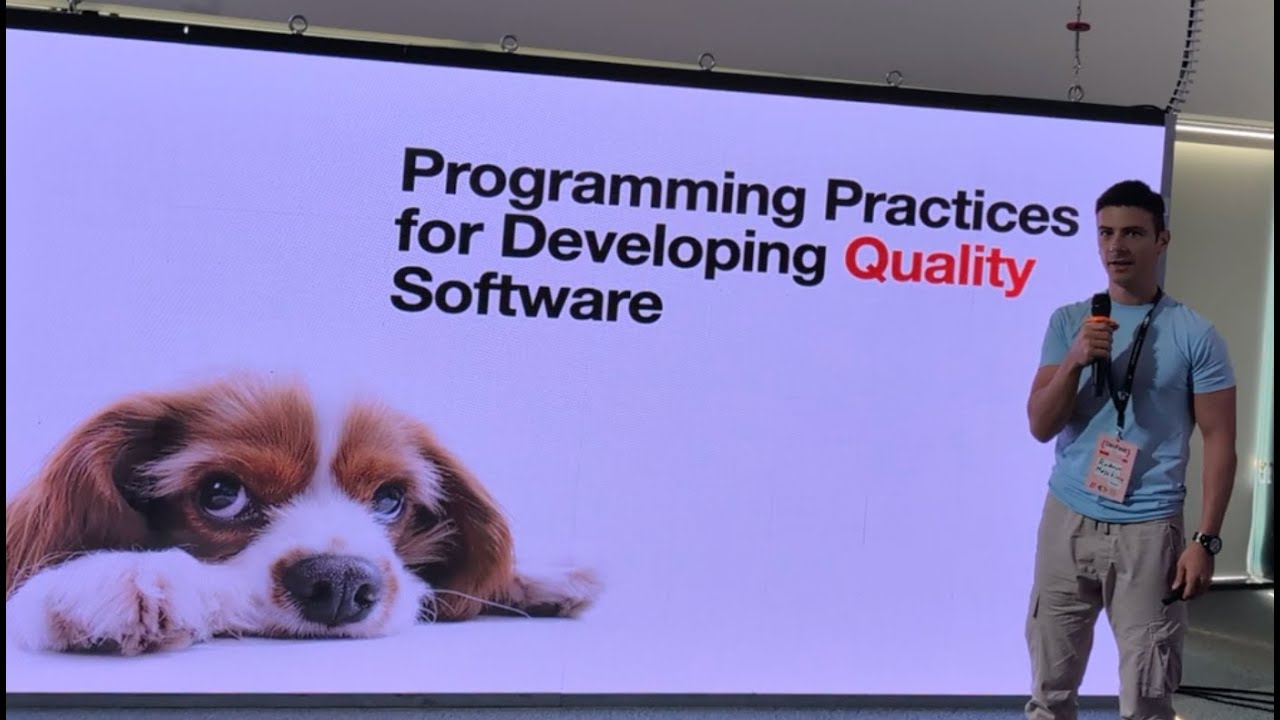
GDG DevFest Armenia 2025 | Programming Practices for Developing Quality Software (Eng)
Keywords
Summary
241 words
Critical Evaluation
Value of the Information & Strength of the Argument
The talk provides valuable, practical advice for software engineers, emphasizing principles that are widely recognized in the industry. The arguments are presented clearly and are supported by real-world examples, such as the JavaScript automatic semicolon insertion pitfall and the student’s factorial function. The speaker’s credibility is enhanced by his experience and his references to respected figures like Douglas Crockford and Uncle Bob. However, the talk is largely anecdotal and lacks empirical evidence or formal citations, which slightly weakens the scientific rigor. The advice is actionable and likely to improve code quality if followed.
Scientific Rigor, Source Quality, Title Accuracy
The talk is based on the speaker’s personal experience and does not cite specific sources. The only external reference is the DevFest Armenia website, which is not a source for the content. The title accurately reflects the content, which is a collection of programming practices. The talk is not a scientific study but an expert opinion, so the lack of citations is acceptable. The content aligns with established software engineering principles, such as those found in ‘Clean Code’ by Robert C. Martin, though these are not explicitly mentioned. The talk’s strength lies in its practical applicability rather than its academic rigor.
209 words
Title / Content Match
The title accurately reflects the content, which focuses on programming practices for developing quality software.
Quality & Reliability
8/10
The talk is based on the speaker's 20+ years of experience in software development, presenting widely accepted best practices. The content is coherent and aligns with established software engineering principles, though it lacks formal citations or empirical evidence.
Key Moments
Markers derived by PSI from the transcript: the creator did not define chapters.
- Introduction: speaker introduces the talk as a 'brain dump' of lessons learned over 20 years in software development.
- Reference to Douglas Crockford: software is the most complicated thing people make; impossibility of testing for perfection.
- First recommendation: keep APIs as small as possible, as they are promises that are hard to keep.
- Importance of automated testing to ensure promises are kept after code changes.
- Discussion of coupling: strive for loose coupling; introduction to message queues and pub/sub for decoupling.
- Inheritance vs composition: inheritance creates tight coupling; prefer composition.
- Emphasis on writing readable and simple code; avoid complicated code.
- Minimize code size: eliminate dead code and avoid adding unnecessary functions.
- Follow coding conventions: example of automatic semicolon insertion in JavaScript.
- Functions should ask for only what they need; example of passing an ID instead of a manager object.
- Minimize variable scope: example of a student's factorial function with a leaked variable.
- Minimize side effects: prefer pure functions for easier debugging and testing.
- Be careful with recursion: tail call optimization and its absence in many languages.
- Importance of good naming: use intuitive names, avoid negatives, name magic values, keep names symmetric.
- Avoid nested if statements for clarity; conclusion with Uncle Bob's advice and Q&A.
Cited Sources
- DevFest Armenia 2025 — The talk was presented at this conference, and the link is provided in the video description.
Concurring Sources
- Clean Code: A Handbook of Agile Software Craftsmanship — The talk's emphasis on readable code and avoiding bad code aligns with the principles in this book.
Contribution & Novelties
The talk synthesizes well-known software engineering best practices into a concise, memorable set of guidelines. Its originality lies in the speaker’s personal anecdotes and clear examples, making the advice relatable. It does not introduce new research but reinforces established principles.
Pour aller plus loin :
- Clean Code — A foundational book by Robert C. Martin (Uncle Bob) on writing readable and maintainable code.
- SOLID principles — A set of design principles that help reduce coupling and improve maintainability.
- Tail call optimization — A technique to optimize recursive functions, relevant to the discussion on recursion.
- Message queue — A communication method that decouples components, as mentioned in the talk.
- Publish–subscribe pattern — A messaging pattern that allows for decoupled communication.
119 words
Radar Profile
The radar profile shows high scores in quality of information and reliability, reflecting the speaker's experience and the soundness of the advice. The quantity of information is moderate, and the technical level is accessible to a broad audience. The talk is strong in practical value but less so in formal rigor.
💬 No comments were provided for analysis.