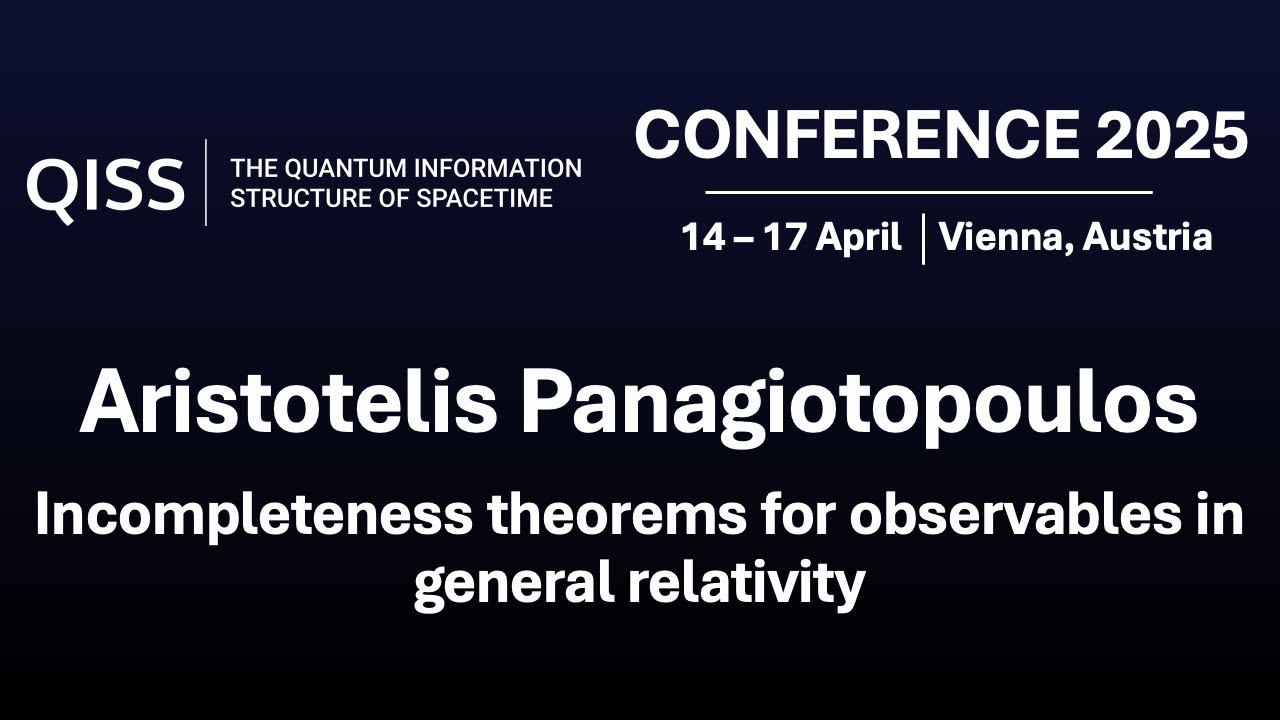
Incompleteness theorems for observables
Keywords
Summary
115 words
Critical Evaluation
Value of the Information & Strength of the Argument
The talk provides a novel perspective on the problem of observables by framing it within descriptive set theory, offering a rigorous mathematical framework to address the non-existence of complete observables. The argumentation is logically structured: it starts with an introduction to descriptive set theory, defines observables and completeness, presents the main theorem, and outlines the proof strategy. The use of Borel reduction and ergodic theory is well-motivated, and the speaker effectively communicates the significance of the result. However, the talk is largely an overview without detailed proofs, and some steps are only sketched, which may limit its value for non-specialists.
Scientific Rigor, Source Quality, Title Accuracy
The talk demonstrates scientific rigor by referencing established concepts and theorems (e.g., Borel isomorphism theorem, ergodic theory) and by situating the work within the historical context of the problem of observables (Bergmann, Smolin). The sources cited in the description are institutional (QISS, Templeton Foundation) and relevant to the talk’s context. The title accurately reflects the content, though it could be more specific about the descriptive set theory approach. The talk does not include a detailed bibliography, but the references to prior work are credible.
199 words
Title / Content Match
The title accurately reflects the content: the speaker presents incompleteness theorems for observables in general relativity, using descriptive set theory.
Quality & Reliability
8/10
The talk is an invited presentation at a specialized conference (QISS 2025) by a researcher in descriptive set theory, presenting joint work with Marios Christodoulou and George Sparling. The content is technical and appears rigorous, with references to established results (e.g., ergodic theory, Borel reduction hierarchy). However, as a conference talk, it lacks detailed proofs and peer-reviewed publication details, so a score of 8 reflects high expertise but limited verifiability.
Key Moments
Markers derived by PSI from the transcript: the creator did not define chapters.
- Introduction to descriptive set theory and its role as complexity theory for infinite problems.
- Definition of Polish spaces and Borel sets.
- Formulation of the problem of observables in general relativity.
- Statement of the main theorem: no complete Borel observables for vacuum solutions.
- Proof strategy: reduction from shift equivalence to diffeomorphism equivalence.
- Use of plane waves to construct the reduction.
- Future directions: descriptive gauge theory and complexity hierarchy.
Cited Sources
- QISS Virtual Seminars — Announcements for upcoming seminars.
- QISS website — Information about the Quantum Information Structure of Spacetime initiative.
- Samy Maroun Center for Space, Time and the Quantum — Coordinating institution for QISS.
- QISS mailing list — Join the QISS mailing list.
- Templeton Foundation grant - QISS — Funding for QISS.
- Templeton Foundation grant - QISS second phase — Funding for QISS second phase.
Concurring Sources
- QISS website — The talk is part of the QISS conference, which aligns with the research initiative.
Contribution & Novelties
The talk presents a novel application of descriptive set theory to the problem of observables in general relativity, providing a rigorous mathematical framework to show that complete observables cannot be Borel definable. This offers a new perspective on a long-standing problem and suggests a research program for classifying the complexity of gauge equivalence relations in physics.
Pour aller plus loin :
- Descriptive set theory — Foundational concepts.
- Borel equivalence relation — Key notion used.
- Ergodic theory — Underlying ideas for the proof.
- Problem of observables — General context.
- Canonical quantization — Motivation for observables.
94 words
Radar Profile
The radar profile shows high scores in technical level and information quality, reflecting the advanced mathematical content and the speaker's expertise. The quantity of information is moderate, as the talk is a concise overview. The overall reliability is high, but the lack of detailed proofs and peer-reviewed publication slightly lowers the score.
💬 No comments were provided for analysis.